What is a vacuum processing plant?
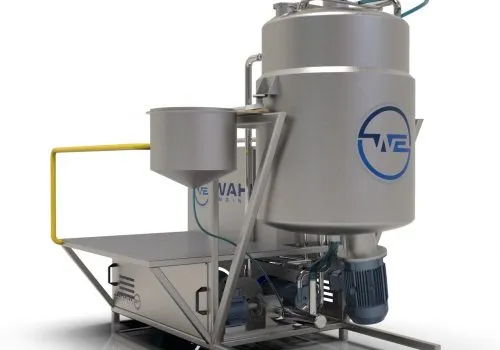
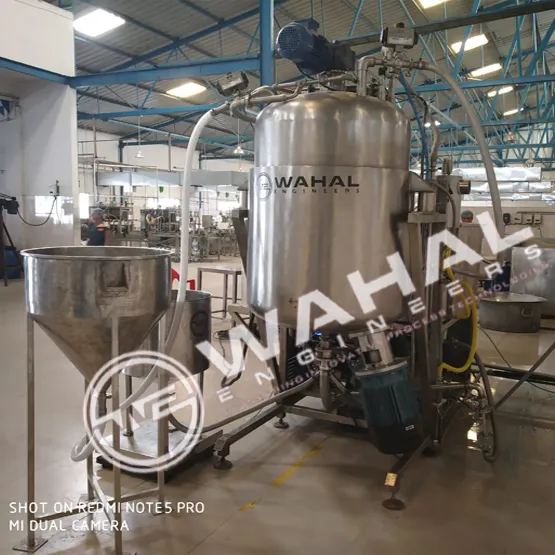
A vacuum processing plant, or vacuum mixing system, combines homogenization, blending and deaeration inside a sealed vacuum vessel. The vessel is fully sealed, so a vacuum pump draws down the internal pressure during mixing and removes air as it is generated, instead of trying to get it out afterwards. The vacuum environment gives bubble-free products while preventing oxidation and improving shelf life.
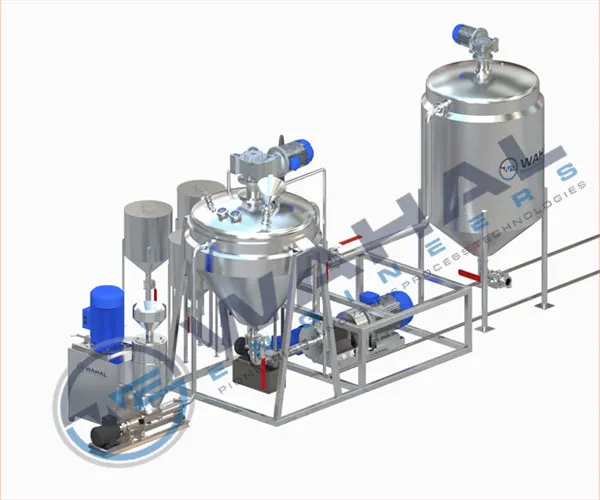
Wahal builds it as a fully integrated system: the vacuum tank, scraper agitation, inline mixing and temperature control are designed to work together, not sourced as separate components.
Why trapped air is a problem
When powders, liquids or viscous materials are mixed under normal atmospheric conditions, air gets into the mix: pulled in during powder addition, whipped in during agitation, or trapped between particles. For many products this is more than a cosmetic issue:
- Gloss and surface finish. Microscopic air bubbles at the surface scatter light, so coatings, paints and cosmetic creams look dull or hazy.
- Density and fill accuracy. Air takes up volume that should be product, so packs can be under-filled even when the correct mass was dispensed.
- Texture. Food products take on an aerated, foamy structure instead of a dense, smooth one.
- Stability and shelf life. Trapped air pockets can promote oxidation or provide sites for microbial growth.
- Strength. In composite and adhesive work, entrained air leaves voids that weaken the material.
How a vacuum mixer works: the five parts of the plant
A Wahal vacuum processing plant integrates five components in one hermetically sealed system:
| Component | What it does |
|---|---|
| Vacuum-tight mixing tank | Fully sealed, so a vacuum pump can draw down the pressure during mixing and remove air as it forms |
| Contra-rotary scraper agitator | Perforated blades, scrapers and a vortex breaker mix the full batch, including material at the vessel walls |
| Inline high shear mixer | Fine dispersion, emulsification or particle size reduction, working with the vacuum tank rather than as a separate downstream step |
| Triple jacket with insulation | Heating or cooling during processing, for formulations that need a controlled temperature profile |
| PLC automation | Actuated valves, dosing with flow meters and load cells, and recipe storage for repeatable batches |
A contra-rotary (dual-shaft) agitator is the type we use for very viscous, dense products; see our agitator mixers. For the inline machines themselves, see inline high shear mixers.
Sizes, viscosity and options
Our vacuum mixing systems are custom designs from 100 litres for pilot and R&D use to 20,000 litres for industrial plants, for viscosities up to 100,000 cps. Options include:
- jacketed vacuum vessels for heating and cooling
- PLC/HMI automation with recipe management, and automated dosing
- CIP/SIP cleaning options for hygiene-critical industries
- custom impellers and agitator designs for uniform processing without clogging
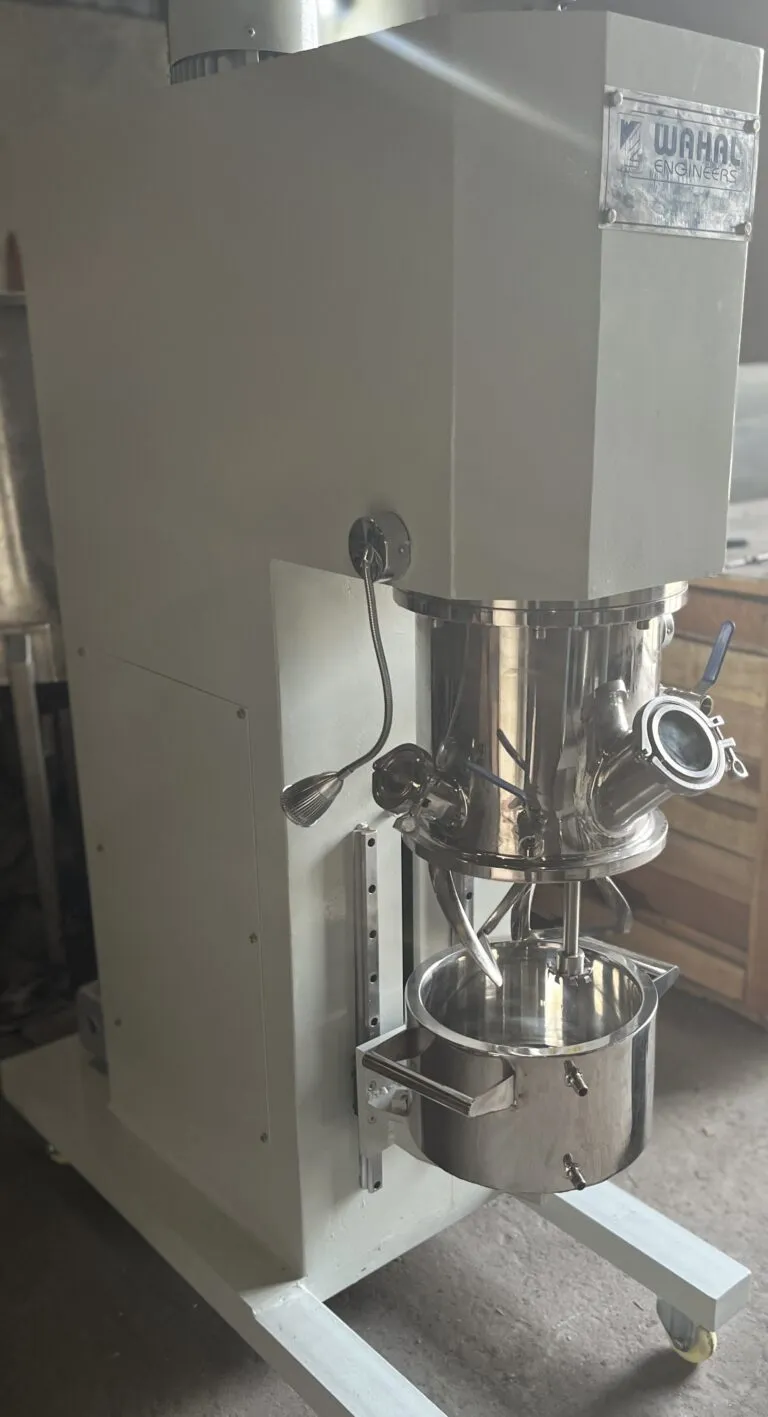
For thicker pastes, our vertical double planetary mixers run from 100 to 2000 litres with full vacuum sealing, up to around 6 million cP with high viscosity blades. Our triple and multi shaft dispersers use two or three independently driven agitators and mix high-viscosity creams, lotions and other products under vacuum, with the whole process in a closed system.
Vacuum mixer, vacuum emulsifier or vacuum cooker?
Wahal also builds a vacuum emulsification unit and vacuum cooking machines. All three work in a sealed vessel under vacuum, but they do different jobs.
| Vacuum processing plant | Vacuum emulsification unit | Vacuum cooking machine | |
|---|---|---|---|
| Main job | Air-free mixing, homogenization and deaeration | Mixing, cutting, homogenizing, emulsification and texture improvement | Heating and cooking under vacuum |
| How | Vacuum-tight tank, contra-rotary scraper agitator, inline high shear mixer, triple jacket | Vacuum homogenization in a hermetically sealed vessel; solids drawn into the liquid stream under vacuum; direct steam injection | Vacuum lowers the boiling point, so products cook at reduced temperatures; direct steam injection, double jacketing, bottom cutting system |
| Typical products | Creams, lotions, gels, sauces, pastes, coatings, pharmaceutical suspensions | Mayonnaise, ketchup, spreads, dips, processed cheese, hummus, peanut butter, baby food | Jams, jellies, confectionery syrups, sauces, wax-based creams |
| More | This page | Vacuum emulsification unit | Vacuum cooking machines |
Many plants use both kinds: a vacuum cooker prepares a syrup base, which is then transferred to a vacuum mixer for homogenization and deaeration with powders, flavours or active ingredients. For a side-by-side guide, see vacuum mixing vs vacuum cooking.
Applications
- Cosmetics: creams, lotions and gels that need a smooth texture and a glossy surface finish. We customise vacuum mixing machines for cosmetics with inbuilt high shear mixers. In liquid handwash lines, homogenization under vacuum stops foaming and gives a highly glossy, air-free product.
- Food: sauces, pastes and confectionery, where trapped air affects texture and appearance. Mayonnaise production is a typical use for a vacuum mixing system; see our mayonnaise processing plant. In our tomato ketchup plant, the ketchup is mixed under vacuum in a vessel with a homogenizer and a vacuum pump.
- Pharmaceuticals: suspensions, creams, ointments and syrups, where trapped air can affect consistency and dosing accuracy.
- Chemicals and coatings: formulations where gloss and finish are critical, and adhesives, varnishes and dispersions.
- Composites and adhesives: a sealed vacuum tank with proper agitation removes the entrained air that would leave voids; see aerospace mixing equipment.
Test your product before you buy
There's no better way of testing a machine than on your own product. You can run a trial in our fully equipped laboratory and see exactly what results you get, and at what times. If you need longer, our rental program lets you keep a machine, pre-configured to your requirements, for as long as you need. See trials and rentals.
Wahal Engineers makes vacuum processing plants in India, at our factory in Bhigan (Murthal), Sonipat, Haryana. Send us your product, batch size and target result, and we will recommend a machine.
Frequently asked questions
What is a vacuum mixer?
A mixer that works in a sealed vessel under vacuum. It combines homogenization, blending and deaeration, so the product comes out bubble-free. A Wahal vacuum processing plant is a vacuum mixer built as one system: a vacuum-tight tank, a contra-rotary scraper agitator, an inline high shear mixer, a triple jacket and PLC automation.
Why does trapped air affect gloss and surface finish?
Microscopic air bubbles at or near the product surface scatter light rather than letting it reflect cleanly. That is seen as a dull or hazy finish instead of the smooth gloss of a well-deaerated product.
What is a vortex breaker, and why is it needed?
A vortex breaker prevents the funnel-shaped surface turbulence that forms during agitation. Without it, the vortex would keep drawing new air into the mixture, even inside a vacuum-sealed vessel.
Can a vacuum processing plant heat and cool the product?
Yes. Wahal vacuum processing plants have a triple-jacketed vessel with insulation for heating or cooling alongside vacuum mixing, for formulations that need both at the same time.
What sizes and viscosities can a vacuum mixer handle?
Our vacuum mixing systems range from 100 litres for pilot and R&D use to 20,000 litres for industrial plants, and are designed for viscosities up to 100,000 cps. For thicker pastes, our planetary mixers with full vacuum sealing reach around 6 million cP with high viscosity blades.
What is the difference between a vacuum mixer and a vacuum cooker?
A vacuum mixer focuses on homogenization, blending and deaeration. A vacuum cooker heats and cooks under vacuum: the vacuum lowers the boiling point, so heat-sensitive products such as jams and syrups cook at lower temperatures. For food emulsions such as mayonnaise and ketchup, Wahal also builds a vacuum emulsifier with vacuum homogenization and direct steam injection.
Is vacuum processing only used for cosmetics?
No. Cosmetic gloss and texture are a common reason, but vacuum processing matters just as much in food, pharmaceutical and chemical or coatings manufacturing, wherever trapped air affects product quality, density or stability.