What is a bottom mounted homogenizer?
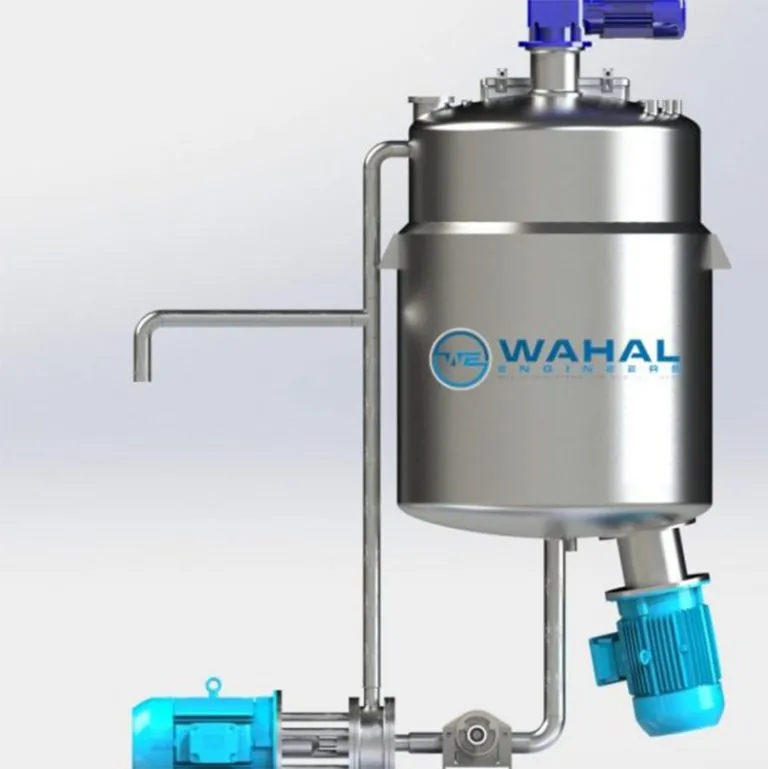
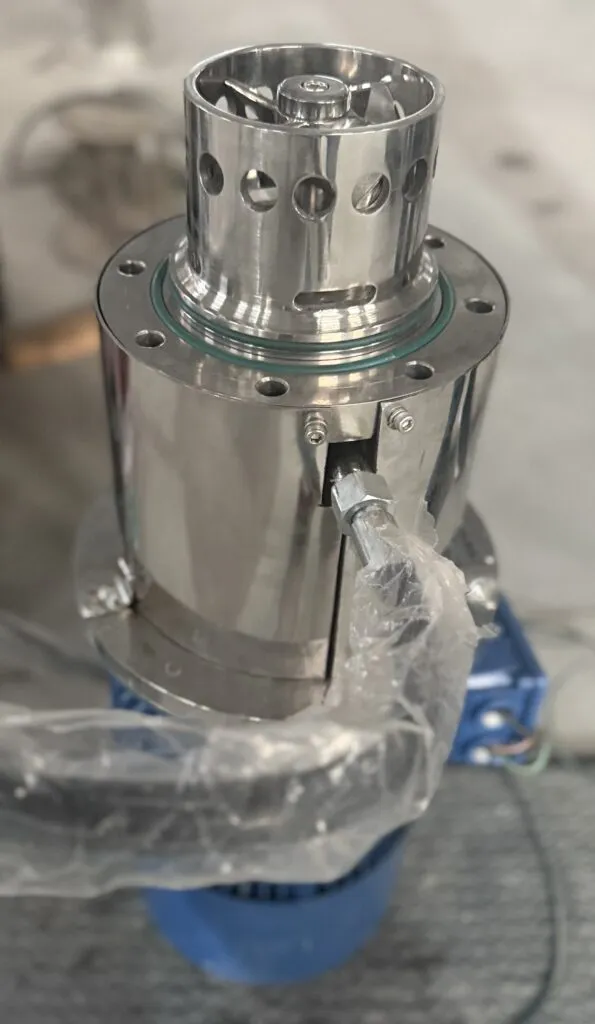
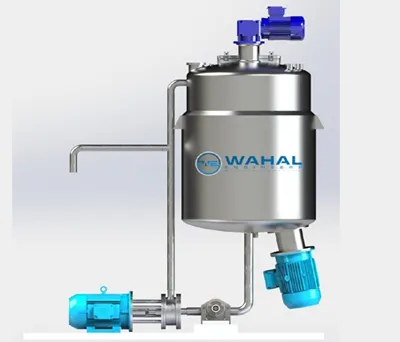
A bottom mounted homogenizer is a high shear homogenizer fitted to the bottom of a process vessel. The bottom drive is mounted under the vessel, and the working head (rotor and stator) dips into the material being processed. It is also known as a bottom entry mixer, a bottom entry homogenizer, a bottom homogenizer or a bottom mounted mixer.
Its main jobs are emulsification, blending and dissolving solids into liquids, and it can accommodate harder solids. The rotor-stator breaks them down: large blocks, bricks and agglomerates are ripped apart into fine particles, which then disperse easily into the mix. It can even disintegrate rubber bales.
Like our batch homogenizers, it processes a batch inside the vessel. The difference is the mounting: batch homogenizers work from the top, a bottom mounted homogenizer from under the vessel.
How a bottom entry mixer works
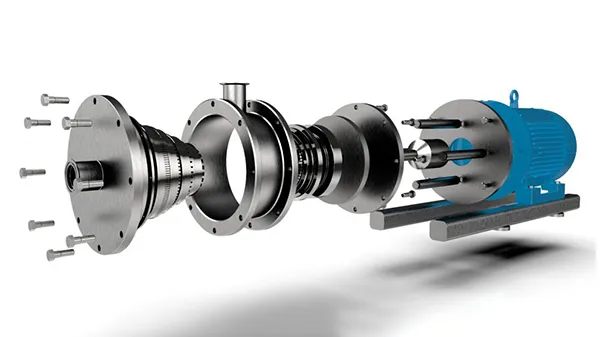
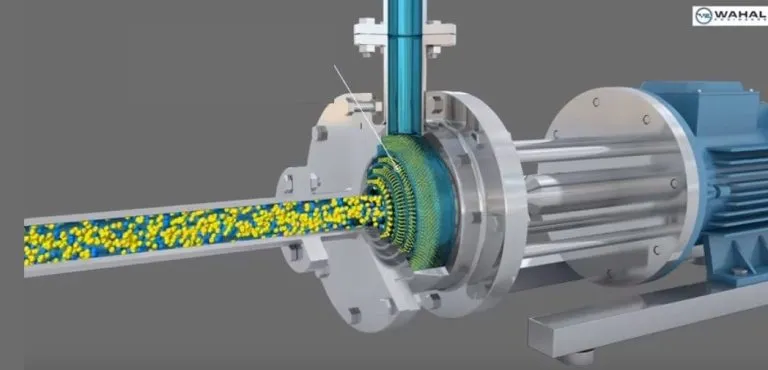
The working principle is the shear force produced between the rotor and the stator head. Step by step:
- Draw-in. The rotor-stator at the base of the vessel creates a strong upward flow and a vortex at the surface, so solids added on top are drawn down into the working head.
- Pumping. The material is pumped out from the rotor head centrifugally, towards the stator walls.
- Shear. Because the tolerance between rotor and stator is minimal, the material is crushed by the shear force produced.
- Discharge. The homogeneous product comes out of the stator with force and is projected radially outwards, towards the outlet.
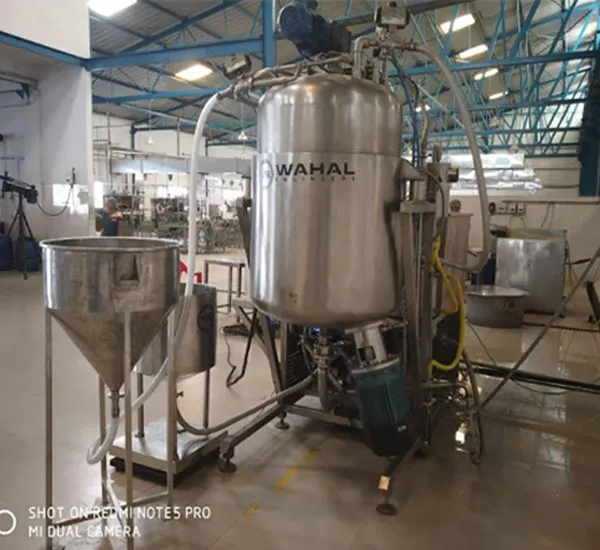
In our VI improver dissolver, the bottom-mounted mixer draws solid polymer blocks of up to 400 mm from the surface into the rotor-stator, with no manual shredding or cutting, even for hard polymers.
What it does
- Mixing, homogenization and emulsification
- Dissolving powder ingredients in a liquid feed
- Particle size reduction with uniform dispersion
- Dispersion of solids in liquids
- Disintegration of agglomerates and large particle clusters
- Stable emulsions and suspensions
- Disintegration of hard solids, blocks and rubber bales
Why mount it at the bottom? An agitator moves the bulk of the liquid but applies little shear. With polymers such as viscosity index improvers, top-entry agitators leave floating lumps, long hydration times and dead zones at the tank bottom. A bottom homogenizer generates intense shear at the tank base, and polymer added gradually is drawn straight into the homogenizer, which prevents lumps.
Applications
| Industry | Products |
|---|---|
| Pharmaceutical | Ointments and creams, cough syrups, tablet coatings, vaccines |
| Cosmetics | Carbopol gels, lipsticks, toothpaste |
| Food | Mustard, mayonnaise, tomato sauces and ketchup, ginger garlic paste |
| Lubricants | VI improver concentrates, lubricant additive packages, engine oil premixes, gear oil and hydraulic oil formulations, polymer-thickened industrial oils |
| Chemicals (in the dis-integrated dissolver) | Rubbers and polymers into liquids or solvents, lube oils, adhesives |
In Wahal plants:
- Lube oil blending. In a lube oil blending plant, base oil is charged into the vessel and the bottom homogenizer starts. Polymer and additives are added and drawn straight into the rotor-stator, and the mix is recirculated through an inline homogenizer until fully dissolved. The full process is on our viscosity index improver dispersing plant page.
- Tomato ketchup. Commercial ketchup often starts from concentrated tomato paste in block, chip or highly viscous form. A bottom-mounted homogenizer breaks the dense paste down to a smooth, workable base before sugar, salt and other ingredients are added; an inline homogenizer then refines the mix. See the tomato ketchup manufacturing process.
- Vacuum processing. In our tomato processing line, the Vacuumizer vacuum homogenization system has a bottom drive homogenizer for grinding and cutting the product in a hermetically sealed environment.
Construction and options
| Item | What we offer |
|---|---|
| Mounting | Drive under the vessel; the rotor-stator working head dips into the product |
| Design | Each bottom homogenizer is designed for the process, not picked from a catalogue |
| Hygiene | Designed for sanitary applications; can be configured to meet FDA norms |
| Hazardous areas | ATEX-approved motors or IEC 60079 flameproof/explosion-proof motors, with certification; ATEX-approved control panels |
| Motors | TEFC, explosion-proof or ATEX-certified, for use with frequency inverters or starters; washdown and stainless motors |
| Inlet and outlet | Flanged, DIN, Tri-clamp, ASA, or to your requirement |
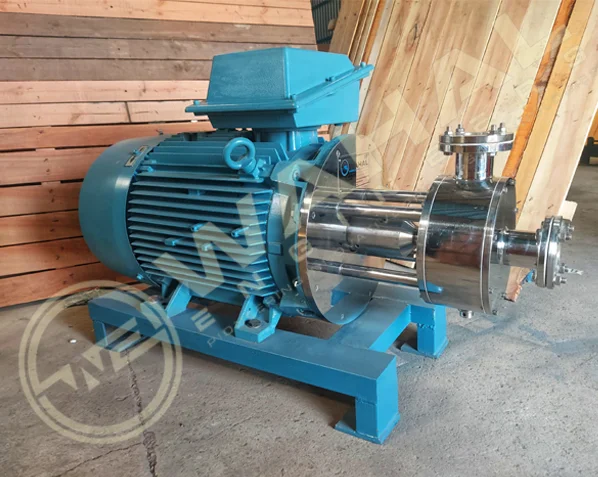
| Rotor-stator | Extra rotor-stator sets can be supplied and used interchangeably to suit the application |
| Seal (polymer duty) | Heavy-duty mechanical seal suitable for hot oils |
| Quality | ISO and GMP-compliant mixers trusted by pharmaceutical manufacturers; ISO-certified manufacturing |
We use CFD analysis to determine the right mixer.
Bottom mounted, batch or inline homogenizer?
| Bottom mounted homogenizer | Batch homogenizer | Inline homogenizer | |
|---|---|---|---|
| Where it works | Under the vessel | Inside the vessel, from the top | In the pipeline or a recirculation loop |
| Best for | Hard solids, agglomerates, powder dissolution | Batch processing; GMP duty (enclosed shaft) or chemicals (in-tank) | Continuous production, air-free processing, single-pass results |
| Key figures | Disintegrates blocks and rubber bales | Built to vessel size; hydraulic lift available | 15 to 200,000 L/hr |
| More | This page | Batch homogenizers | Inline homogenizer |
The top-entry designs are the in-tank batch homogenizer, for chemicals and other applications, and the enclosed shaft homogenizer, which seals the shaft from the process liquid so it is easy to clean and GMP-compliant.
The two approaches can be combined. Our dis-integrated dissolver puts a bottom-mounted homogenizer on the vessel, followed by an inline homogenizer that gives the final smooth and fine texture. It is used for rubbers, polymers, lube oils and adhesives. For rubber, resin and polymer solids, the duplex disintegrator dissolver passes the material through two rotor-stator stages in sequence, with less recirculation time.
Bottom entry mixer or bottom entry agitator? Both have the drive under the vessel. A bottom entry agitator moves the product with an impeller chosen for axial, radial or mixed flow; ours are compact units for laboratory and pilot-scale sanitary vessels. A bottom mounted homogenizer adds high shear with a rotor-stator. For bulk blending, see our agitators. For the full rotor-stator range, see high shear homogenizers.
Test your product before you buy
There's no better way to test a machine than on your own product. Run a trial in our fully equipped laboratory and see exactly what results you get, and how fast. If you need longer, our rental program lets you keep a machine, pre-configured to your requirements, for as long as you need. See trials and rentals.
Wahal Engineers makes bottom mounted homogenizers in India, at our factory in Bhigan (Murthal), Sonipat, Haryana. Send us your product, batch size and target result, and we will recommend a machine.
Frequently asked questions
What is a bottom mounted homogenizer?
A high shear homogenizer with its drive under the vessel and the rotor-stator working in the product from below. It is also called a bottom entry mixer or bottom entry homogenizer. It breaks down blocks, bricks and agglomerates, dissolves hard solids and can even disintegrate rubber bales.
How does a bottom entry mixer work?
By the shear force produced between the rotor and the stator. The material is pumped out of the rotor centrifugally towards the stator walls, crushed by the shear force in the minimal gap, and comes out of the stator with force.
What is the difference between a bottom mounted homogenizer and a batch homogenizer?
Both process a batch inside the vessel. Batch homogenizers (in-tank or enclosed shaft) work from the top and are designed to the length and diameter of your vessel, with an optional hydraulic lift. A bottom mounted homogenizer sits under the vessel and is chosen for hard solids, agglomerates and powder dissolution.
Can a bottom homogenizer dissolve rubber bales and polymer blocks?
Yes. It can disintegrate rubber bales, and in our VI improver dissolver it takes polymer blocks of up to 400 mm without manual shredding.
Can it be used in hazardous areas and GMP plants?
Yes. It is designed for sanitary applications and can be configured to meet FDA norms. It can be supplied with ATEX-approved or IEC 60079 flameproof motors and ATEX-approved control panels. We manufacture ISO and GMP-compliant mixers trusted by pharmaceutical manufacturers.
Can it be combined with an inline homogenizer?
Yes. Our dis-integrated dissolver puts a bottom-mounted homogenizer on the vessel, followed by an inline homogenizer for the final smooth, fine texture.