What is a powder induction mixer?
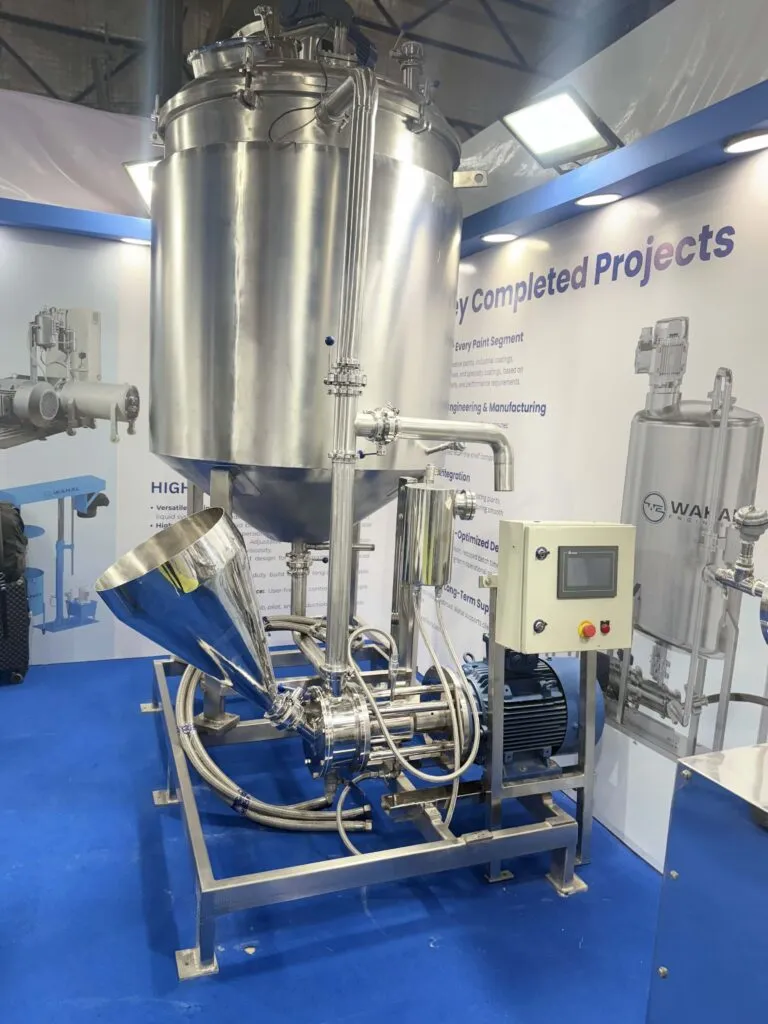
A powder induction mixer is an inline rotor-stator mixer built for one job: mixing powder into liquid. It creates a vacuum in the flowing liquid, draws the powder in, mixes it with the liquid and pumps it out, wetting it instantly.
We sell it as the liquid powder mixer (LPM). It is also called a solid liquid induction mixer, a powder liquid mixer, an inline powder liquid mixer or a powder induction system. It is one of the four kinds of inline high shear mixers we make, alongside inline homogenizers, the Super Mill and shear pumps.
What it does:
- Dust-free, loss-free and contamination-free powder dispersing and mixing.
- No lumps or agglomerates. The solids are dosed directly into the stream, mixed thoroughly in the liquid and then pumped into the vessel.
- Up to 80% solids in the final product, re-circulated to get the result you need.
- No foreign air is entrapped in the flowing stream, because the powder stream is much denser and thicker.
- Large volumes or small amounts. It handles large volumes of solids as well as small quantities of critical active ingredients.
How a powder induction mixer works
- Vacuum. The liquid flows through the rotor-stator working head, which is designed to generate a strong vacuum directly in the flowing stream.
- Induction. The vacuum draws the powder into the process line from the feed point: a silo, sack, hopper or barrel. The powder enters below the liquid surface.
- Wetting and dispersion. The powder is wetted and dispersed at once under high shear, so it cannot clump on the surface, and no foreign air is entrained in the stream.
- Discharge. The mixer pumps the slurry out, uniform, lump-free and ready for the next process step.
The LPM works in a continuous line or on a batch with re-circulation. On a batch, the product goes round until it reaches the solids content and result you need.
Powder feeding options
The LPM can take powder from any of four feed points, chosen to suit your plant layout and batch volume:
- Jumbo bag unloading system: high-volume, bulk powder handling
- Silo feed: continuous, large-scale production lines
- Flexible hose connection: routing from remote storage or mobile totes
- Hopper feed: manual or semi-automated small batches
Systems can include automated dosing and mechanical sealing options, for example for long batches or corrosive service.
For a bag tipping station, jumbo bag unloading and a suction wand combined with a high shear mixer, see our bag tipping unit with high shear mixer.
LPM models and powder induction rates
| Model | Motor power | Powder induction rate (kg/min)* |
|---|---|---|
| LPM 10 | 10 HP | 30–75 |
| LPM 20 | 20 HP | 75–125 |
| LPM 30 | 30 HP | 100–175 |
| LPM 50 | 50 HP | 150–275 |
| LPM 75 | 75 HP | 250–375 |
| LPM 100 | 100 HP | 350–475 |
| LPM 150 | 150 HP | 450–575 |
| LPM 200 | 200 HP | 550–675 |
*Rates are based on calcium carbonate (CaCO₃) added through a hopper. The actual rate depends on the powder or solid and on how it is fed (jumbo bag, silo or flexible hose).
Send us your powder and liquid details and we will give you induction-rate data for your product.
What a liquid powder mixer is used for
Any process where large amounts of solids go into a liquid.
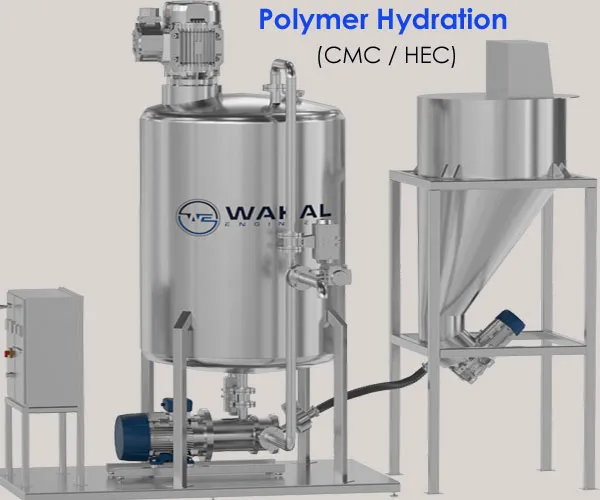
- Polymer hydration (CMC, HEC, guar gum, xanthan gum). Each polymer particle is wetted in a controlled shear zone before the viscosity builds, which prevents the fisheyes and incomplete hydration that come from poor wetting. See polymer hydration.
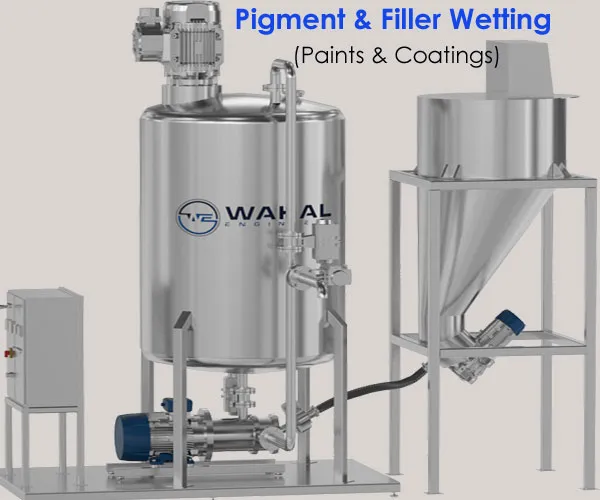
- Pigment and filler wetting for paints and coatings. Better initial wetting reduces bead mill residence time and power consumption. See pigment and filler wetting.
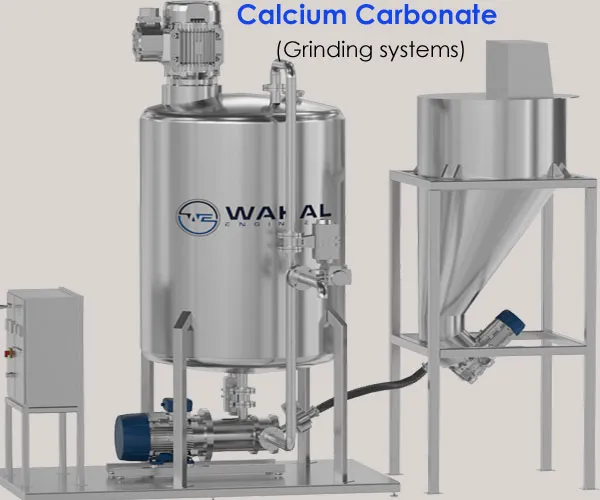
- Calcium carbonate slurry. The LPM brings bulk calcium carbonate into water or binder without dust and feeds a ceramic-lined bead mill. See calcium carbonate slurry grinding.
- Latex and emulsion polymer slurry, with controlled powder induction and optimised shear profiles. See latex and emulsion.
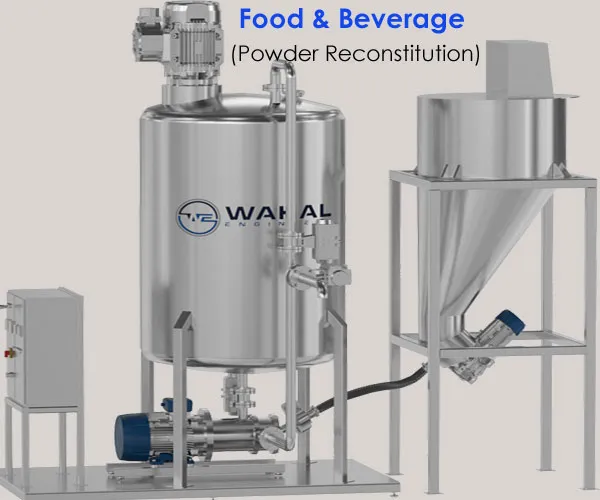
- Food and beverage powder reconstitution. Powders are inducted below the liquid surface for lump-free reconstitution. See food and beverage powder reconstitution.
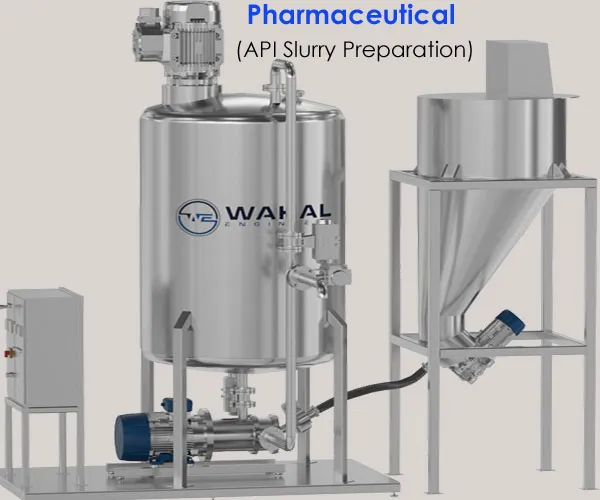
- Pharmaceutical API slurry and suspensions, with dust-free induction and hygienic mechanical sealing options. See API slurry preparation.
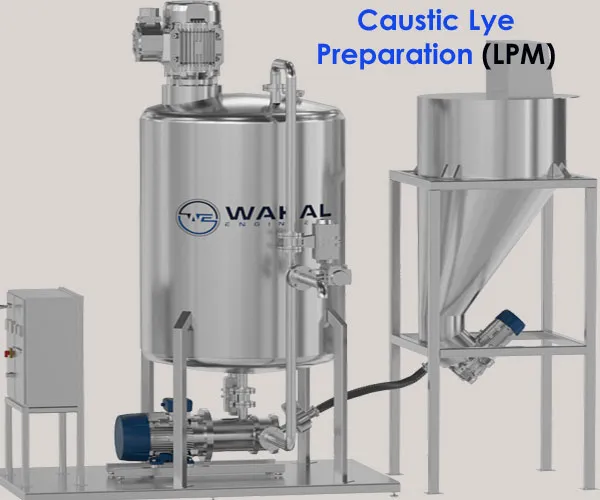
- Caustic lye. Sodium hydroxide flakes or pearls are inducted into water; typical solids addition is 2–6 TPH, with final concentrations up to 50%. See caustic lye preparation.
- Mineral and chemical salt dissolution, with high solids loading. See salt dissolution systems.
- Fumed silica, CMC and Carbopol, bentonite, and battery electrode slurries.
In Wahal plants:
- Paint. Powder induction is the first stage of a paint manufacturing plant: the liquid powder mixer takes pigments and fillers into the liquid, the high-speed disperser handles dispersion and let-down, and a bead mill grinds to the target particle size.
- Ink. In an ink manufacturing plant the LPM's rotor-stator head draws powder into the liquid under vacuum for dust-free, lump-free wetting and dispersion.
- GCC milling. The LPM works with a jumbo bag unloading system to dose ground calcium carbonate powder into water without dust, before wet milling. See GCC milling solutions.
Powder induction mixer or another mixer?
Start from the job the machine has to do.
| Your job | Machine |
|---|---|
| Large volumes of powder into a liquid, dust-free | Powder induction mixer (this page) |
| Dispersing pigments, additives and powders into a liquid | High-speed disperser |
| Stable, fine emulsions or a smaller particle size | Inline homogenizer or high shear homogenizer |
| Grinding to a fine target particle size | Bead mill |
| Blending dry powders with each other | Ribbon blender |
| Pumping and shearing in one unit | Shear pump |
The machines often work together. In a paint line the LPM comes first, and for powders it feeds the bead mill a consistent slurry.
Test your powder before you buy
There's no better way to test a machine than on your own product. Run a trial in our fully equipped laboratory and see what results you get, and how fast. If you need longer, our rental program lets you keep a machine, pre-configured to your requirements, for as long as you need. See trials and rentals.
Wahal Engineers makes powder induction mixers in India, at our factory in Bhigan (Murthal), Sonipat, Haryana, with ISO and GMP compliant manufacturing. Send us your powder, your liquid and your batch size, and we will recommend a machine.
Frequently asked questions
What is a powder induction mixer?
A rotor-stator mixer that creates a vacuum in a flowing liquid and draws powders into it, from silos, sacks, hoppers or barrels. The powder is wetted and dispersed at once, without dust or lumps, and the mix is pumped out. Our model is the liquid powder mixer (LPM).
Is a liquid powder mixer the same as a powder induction mixer?
Yes. Liquid powder mixer (LPM) is the name of our powder induction mixer series. The solid liquid induction mixer is the same machine.
How much powder can an LPM induct?
From 30–75 kg/min on the LPM 10 to 550–675 kg/min on the LPM 200, for calcium carbonate fed from a hopper. The actual rate depends on your powder and on the feeding method.
What solids content can it reach?
Up to 80% solids in the final product, with the product re-circulated to get the desired result.
Can it run continuously?
Yes. The LPM suits both continuous processes and batch processes with re-circulation.
Why is no air drawn into the product?
The powder enters below the liquid surface, and the powder stream is much denser and thicker, so no foreign air is entrapped in the flowing stream.
Can a powder induction mixer blend dry powders?
No. It mixes powders into a liquid. To blend dry powders and other bulk solids with each other, use a ribbon blender.