Two different approaches to dry mixing
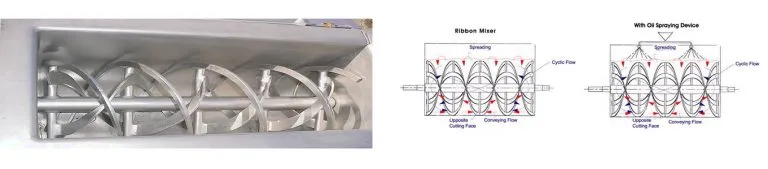
Ribbon blenders use a U-shaped horizontal trough fitted with inner and outer helical ribbons mounted on a central shaft. As the shaft rotates at relatively low speed, the outer ribbons draw material from the sides toward the center while the inner ribbons push material back out toward the ends — a continuous, counter-current folding action that produces thorough, gentle blending over a mixing cycle typically in the range of 15–20 minutes.
Plough shear mixers take a more aggressive approach. Plough-shaped blades mounted on a central shaft actively lift and throw material outward into the open space above the material bed, creating a three-dimensional, mechanically fluidized mixing zone rather than the more contained folding motion of a ribbon blender. This generally achieves faster mixing times and can be combined with high-speed chopper units for lump breakdown or wet granulation.
Key Differences at a Glance
| Factor | Ribbon Blender | Plough Shear Mixer |
|---|---|---|
| Mixing action | Gentle, convective folding via helical ribbons | Aggressive, 3D fluidized lifting and throwing |
| Typical mixing time | 15–20 minutes | Often faster, in the range of a few minutes |
| Mechanical intensity | Lower — gentler on friable materials | Higher — more intense shear and impact |
| Chopper/granulation capability | Less common, though liquid spray bars can be added | Commonly available as an add-on option |
| Best suited for | Free-flowing to moderately cohesive powders, delicate materials | Cohesive powders, materials with varied particle size/density, granulation |
| Equipment footprint and cost | Generally simpler, robust, and cost-effective | Typically more complex given additional intensity and chopper options |
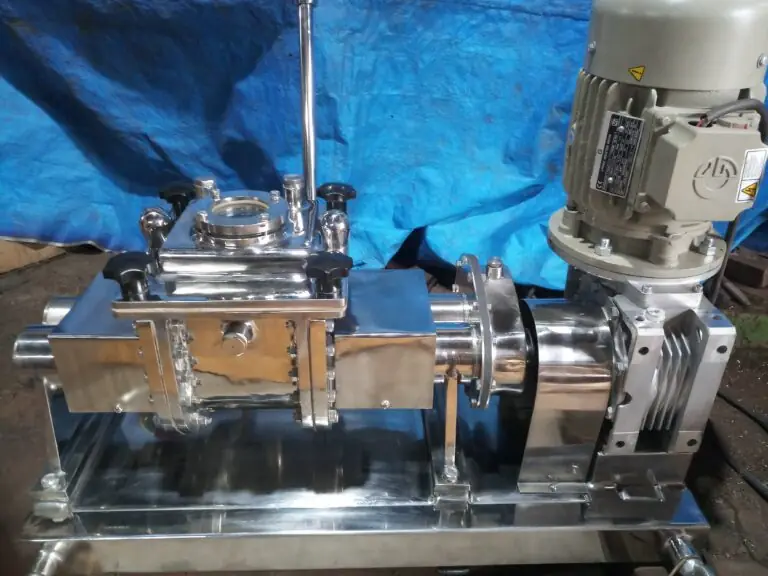
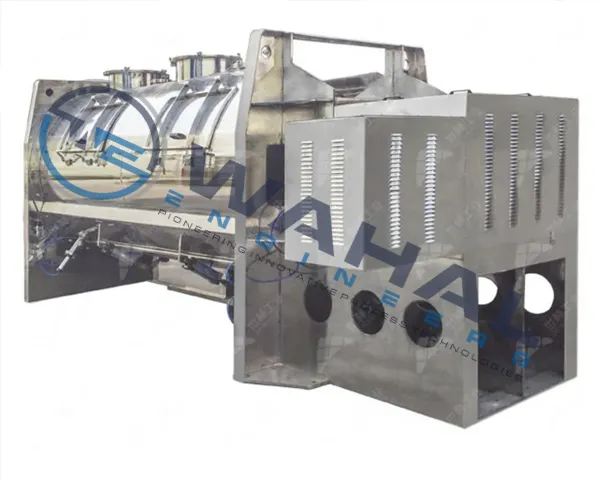
Plough shear mixers | Ribbon Blenders Mixers use a combination of plough blades and shearing action to achieve a homogeneous mixture of the materials. The mixing action is created by the plough blades which move in a circular motion, while the shearing action is created by the blades which move in a linear motion. The combination of these two motions results in a thorough and efficient mixing process.
There are external hoppers to improve mixing action and improve dead zones.
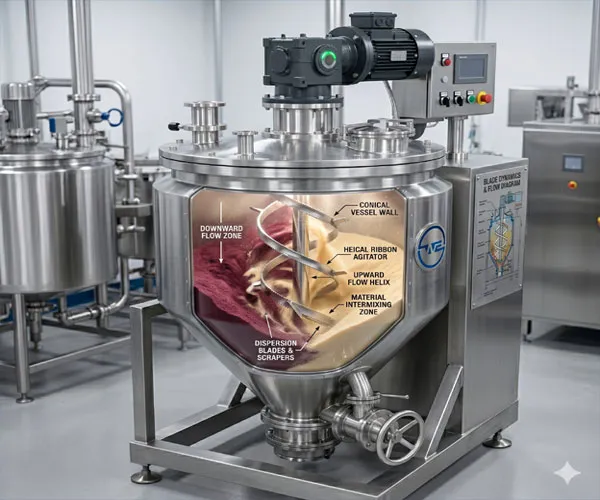
Wahal also designs vertical ribbon blenders for zero dead zone mixing.