What is an inline homogenizer?
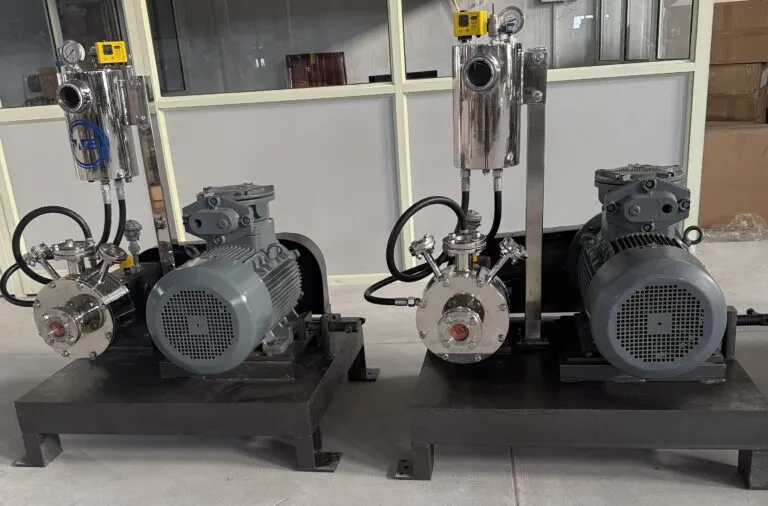
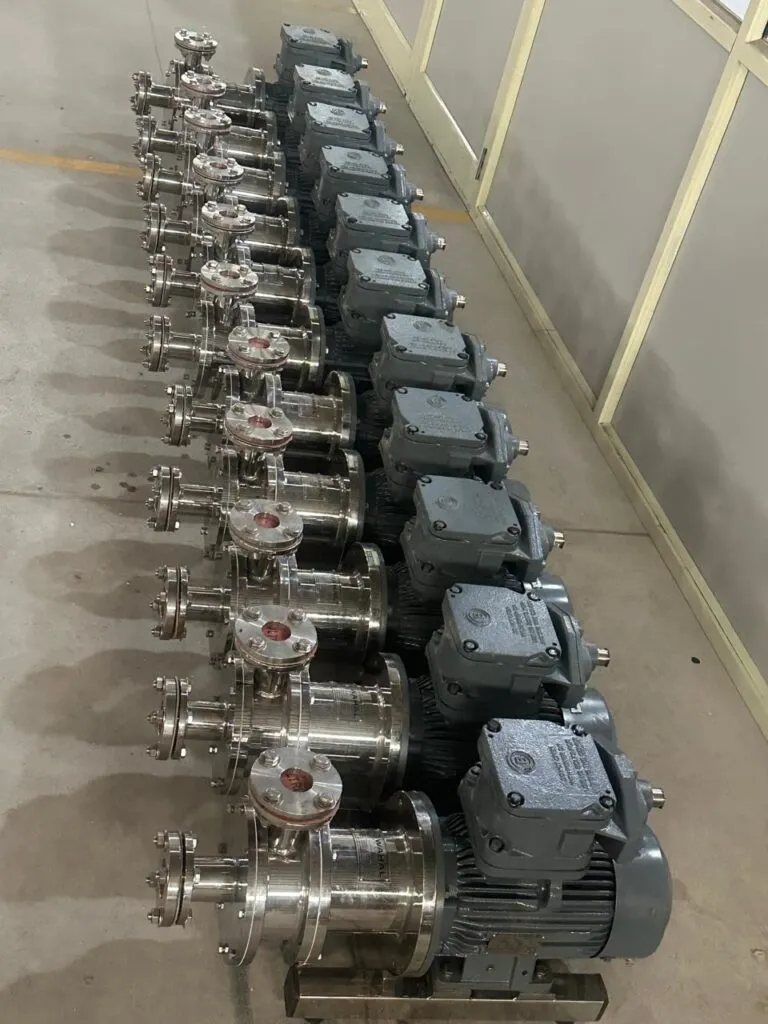
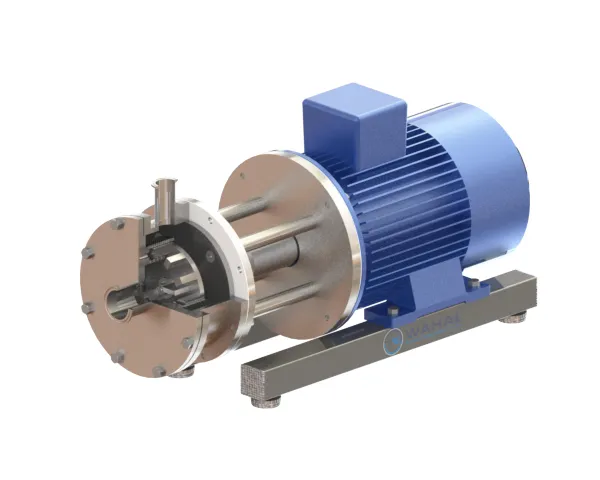
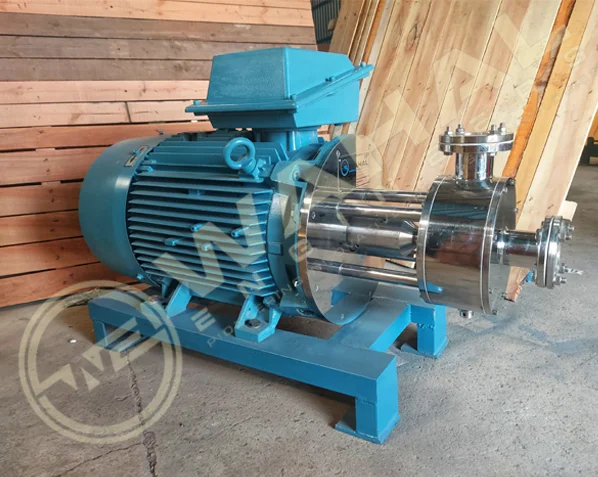
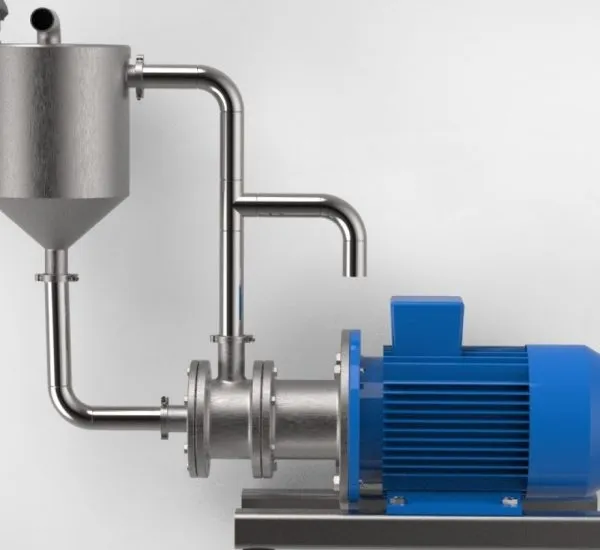
An inline homogenizer, also called an inline homogenizer mixer, in line homogenizer or in-line homogeniser, is a rotor-stator high shear mixer that sits in the process line rather than in the tank. It replaces a simple agitator where that agitator cannot mix well enough, and it is used for emulsification, dissolution, dispersion and particle size reduction.
Three things set it apart from a mixer in the tank:
- It pumps itself. The rotor creates a centrifugal pumping action, so in most cases no external pump is needed.
- Nothing bypasses the head. No liquid or solid can pass from the inlet to the outlet without going through the rotor-stator work head.
- It keeps air out. The homogenizer, vessel and pipework form a closed system, so the product stays free of air.
An inline homogenizer is not a high-pressure homogenizer. That machine is a pump homogenizer used for particle sizes in the nano range, for example for milk products and cell disruption; see our high pressure homogenizer. Inline homogenizers are part of our high shear homogenizer range.
How an inline homogenizer works
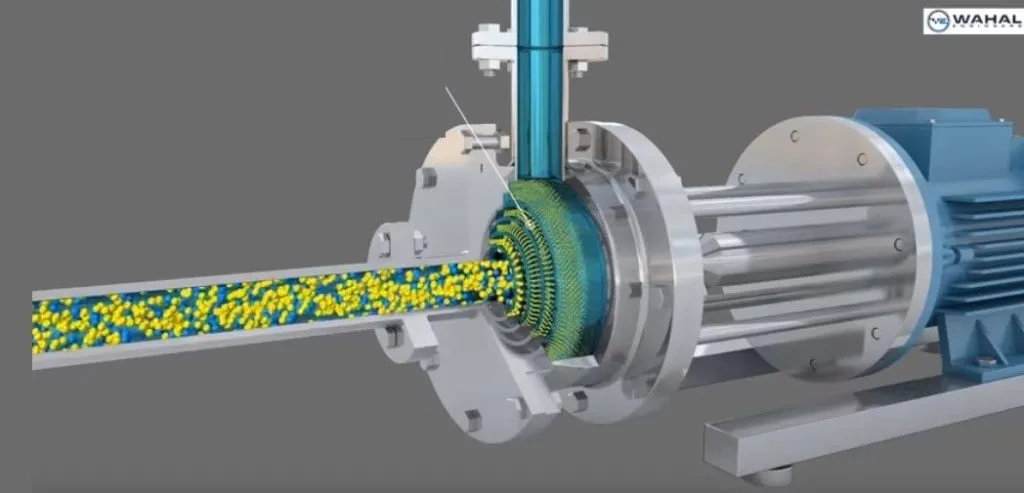
- Intake. The rotating blades create strong suction and draw liquid and solids into the centre of the work head.
- Acceleration. Centrifugal force throws the material out to the edge of the work head.
- Shear. In the narrow gap between the rotor and the stator, the material is subjected to intense mechanical and hydraulic shear, which breaks up droplets and agglomerates.
- Discharge. The product is forced out through the stator to the outlet. It then either carries on down the line (single pass) or returns to the vessel and recirculates until the whole batch is uniform.
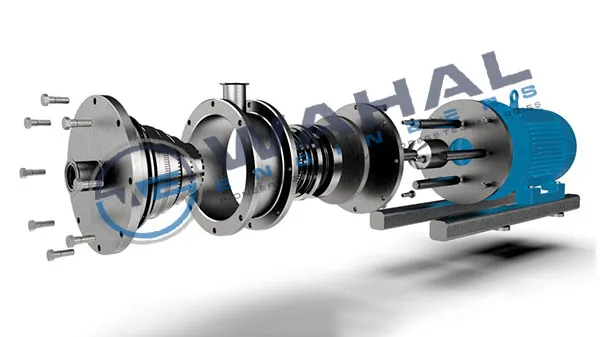
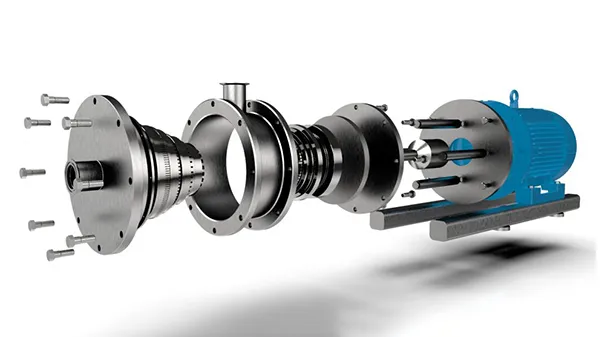
On two- and four-stage models, the product passes through several rotor-stator sets in series in the same pass, and each stage refines it further.
Single, two and four stage inline homogenizers
We build three inline models. They work on the same principle; what changes is how many rotor-stator sets the product passes through in one go.
| Model | Rotor-stator sets | Stator heads | Best for |
|---|---|---|---|
| Single stage inline homogenizer | 1 | Interchangeable; 20+ designs | General inline mixing, emulsifying and dispersing, in a single pass or on a recirculating batch. 15–200,000 L/hr, tip speed up to 95 m/s. |
| Two stage inline homogenizer | 2, in series | Interchangeable; 20+ designs | Finer emulsions and dispersions. Tip speed up to 95 m/s. |
| Four stage inline homogenizer | 4, in series | Each stage configured for the application; not interchangeable | Fine particle size reduction and emulsions, often reaching the target size in a single pass. Patented, designed and made in India. |
How many stages do you need? Each extra stage adds another round of rotor-stator shear within the same pass, so the product gets finer without repeated recirculation. We use CFD analysis to help choose the right mixer and stator design.
We also build the Super Mill, an inline high shear rotor-stator mixer that runs at 6,000 rpm with a tip speed of 45–65 m/s. Our full inline range, including powder induction mixers, is on the inline high shear mixers page.
Rotor-stator heads
The stator sets how fine the product gets. It is changed to suit the particle size required, and over twenty rotor-stator designs are available, from general mixing heads to slotted disintegrating heads and fine emulsion screens. Conical shear tools give an extremely narrow particle size distribution. Extra rotor-stator sets can be supplied with each machine and swapped to suit the application, except on the four-stage model.
Specifications and options
| Parameter | Range / options |
|---|---|
| Rotor-stator stages | 1, 2 or 4 (four-stage design patented) |
| Tip speed | Up to 95 m/s (single and two stage); 45–65 m/s at 6,000 rpm (Super Mill) |
| Throughput | 15 to 200,000 L/hr |
| Operation | Single pass or recirculating batch; self-pumping; can be force-fed with a positive displacement pump for high-viscosity liquids |
| Rotor-stator designs | 20+; interchangeable except on the four-stage model; conical shear tools available |
| Drive | Direct coupling or belt-driven |
| Shaft sealing | Single mechanical seal; double mechanical seal with thermosyphon (plan 53A, optional); stuffing box with impregnated gland |
| Inlet and outlet | Flanged, DIN, Tri-clamp, ASA or to your specification; binary (two-way) entrance for merging partial flows |
| Temperature control | Heating or cooling jacket |
| Motors | TEFC; ATEX-certified or IEC 60079 flameproof/explosion-proof; washdown or stainless; for frequency inverters or starters |
| Control panel | ATEX-approved panels available |
| Hygiene | Sanitary design configurable to FDA norms; CIP/SIP models on request |
| Certification | ATEX, NEMA and UL certification on request |
| Materials | From alloy steels to various polymers; rotor-stator material customised to the application |
| Manufacturing | To ISO practices, in an ISO-certified plant; GMP-compliant mixers |
Applications
Inline homogenizers are used wherever a liquid product has to be emulsified, dispersed, dissolved or reduced in particle size on a line.
- Pharmaceuticals: suspensions and emulsions that need a fine, uniform particle size, and syrups.
- Cosmetics and personal care: creams, lotions and other emulsions.
- Food, dairy and beverage: emulsions, sauces, dispersions and beverage formulations.
- Chemicals: specialty formulations, additive blends and dispersions.
- Bitumen emulsion: the inline homogenizer is used in our bitumen emulsion plants.
To draw large amounts of powder into a liquid stream, see our powder induction mixer.
Inline or batch homogenizer?
- Choose an inline homogenizer for continuous production, high throughput (up to 200,000 L/hr), air-free processing, or single-pass results with a multi-stage model.
- Choose a batch homogenizer to work inside the vessel; the enclosed shaft model is easy to clean and GMP-compliant.
- Choose a bottom mounted homogenizer to break down hard solids, blocks and agglomerates in the tank.
The two approaches can be combined. Our dis-integrated dissolver puts a bottom-mounted homogenizer on the vessel, followed by an inline homogenizer.
Try it on your product first
You can trial your own product on a Wahal machine in our fully equipped laboratory before you order. If you need longer, our rental program lets you keep a machine, pre-configured to your requirements, for as long as you need. See trials and rentals.
For formulation work, our laboratory inline homogenizer has:
- a 1 HP, 2,900 rpm drive motor
- a spindle speed of up to 9,500 rpm, with VFD speed control
- round-hole or emulsion stators
It uses the same rotor-stator principle as the production models, so lab results give a sound basis for scale-up.
Frequently asked questions
What is an inline homogenizer used for?
It emulsifies, disperses, dissolves and reduces particle size in liquid products as they flow through the line. It is used in pharmaceutical, cosmetic, food, dairy, beverage and chemical production, and in bitumen emulsion plants.
How does an inline homogenizer work?
A rotor turning inside a close-fitting stator draws product into the work head, throws it outwards and shears it in the narrow gap between the two. The product leaves through the stator to the outlet, either continuing down the line or returning to the vessel until the batch is uniform.
Is an inline homogenizer the same as an inline high shear mixer?
Yes. Both names describe a rotor-stator high shear mixer installed in the line, and our single-, two- and four-stage machines are sold under both. Our full range of inline high shear mixers also includes powder induction mixers.
Does an inline homogenizer need a separate pump?
Usually not. It is self-pumping: the centrifugal action of the rotor moves the product, which is why it is sometimes called an inline homogenizer pump. High-viscosity liquids can be force-fed with a positive displacement pump.
How many stages do I need?
One stage suits general inline mixing and dispersion. A two-stage model gives finer emulsions and dispersions. The patented four-stage model often reaches the target particle size in a single pass, without recirculation. We can run a trial or a CFD analysis to confirm.
What is the difference between an inline homogenizer and a high-pressure homogenizer?
An inline homogenizer shears the product between a rotor and a stator and pumps it at the same time. A high-pressure homogenizer is a pump homogenizer for particle sizes in the nano range, such as in milk products. It works best when fed a uniform, fine premix. We make both.
Can it be used in pharmaceutical plants or hazardous areas?
Yes. It can be built to a sanitary design configurable to FDA norms, with CIP/SIP models on request. For hazardous areas we supply ATEX-certified or IEC 60079 flameproof motors and ATEX control panels, and ATEX, NEMA and UL certification on request.