What Is a Laboratory Bead Mill?
A bead mill uses a grinding chamber filled with small, inert beads — typically glass, ceramic, or zirconia — through which a liquid suspension is continuously passed. As the internal agitator rotates at high speed, the beads collide with each other and with suspended particles at high energy, breaking them down into progressively finer sizes, often reaching the nanometer scale.
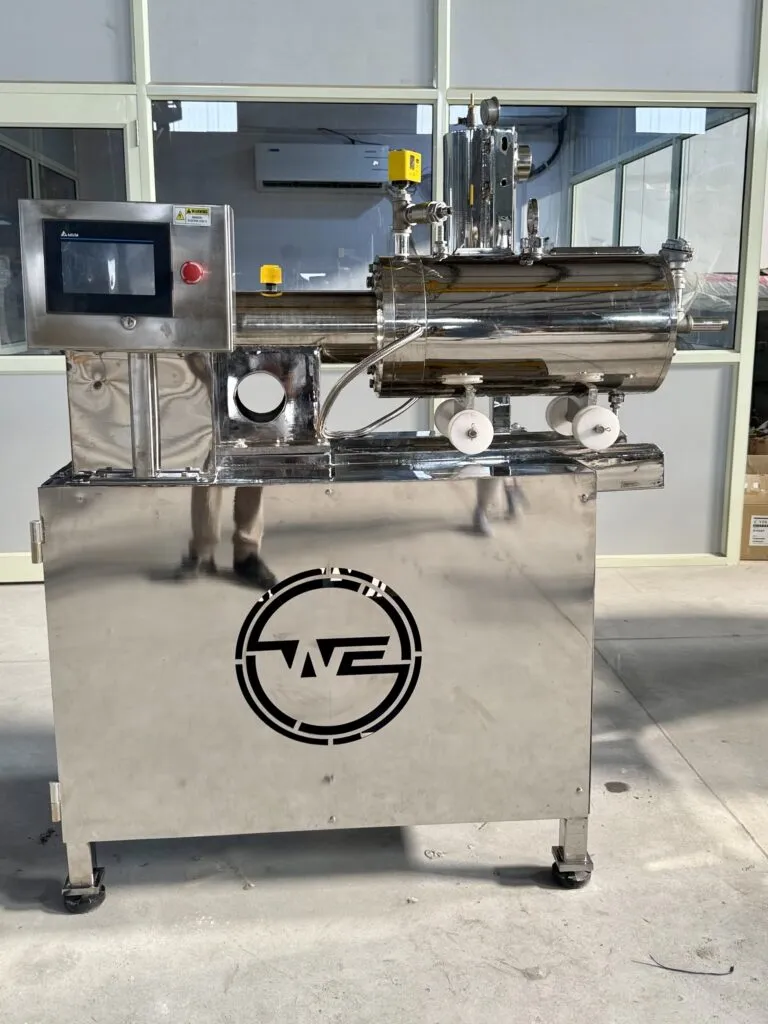
Wahal's Laboratory Bead Mill (WBM 1.4) brings this same wet grinding and dispersion mechanism to a compact 1.4-liter chamber volume, powered by a 3 HP motor — sized specifically for lab-scale trials, formulation development, and pilot-batch testing rather than full production throughput.
Why Lab-Scale Bead Milling Matters
Particle size reduction behavior — how quickly a suspension reaches target fineness, how beads of different sizes and materials perform against a specific formulation, how heat build-up affects a temperature-sensitive product — doesn't always scale predictably from theory to production. A laboratory bead mill lets formulation teams:
- Test and optimize bead size, bead material, and grinding time before scaling to production
- Validate achievable particle size distribution for a new formulation
- Compare grinding chamber materials (steel, ceramic, zirconia) against specific product compatibility requirements
- Run rapid small-batch trials without tying up full-scale production equipment
Key Features
- 0.6 or 1.4-liter grinding chamber — sized for lab-scale trials and small-batch formulation work
- Same tip speed while scaling up
- 0.1-10mm bead size options available
- Nano-scale particle size reduction — capable of achieving fine particle sizes down to the sub-micron and nanometer range, depending on product viscosity and initial particle size
- Multiple grinding media options — hardened steel, polymer, and ceramic/zirconia coatings available depending on process composition and product compatibility
- Thermal control options for temperature-sensitive formulations
- GMP-compliant and explosion-proof configurations available for pharmaceutical and hazardous-environment applications
Applications
- Pharmaceutical R&D — wet milling of Active Pharmaceutical Ingredients (APIs) to improve solubility and bioavailability of poorly soluble drugs
- Paints and coatings — pigment dispersion trials and nano-emulsion formulation testing
- Inks — fine particle dispersion for color pulp and ink formulation development
- Chemical formulation — dispersion and grinding trials for specialty chemical products
- Agrochemical R&D — formulation testing for pesticide and agrochemical suspensions
From Lab Trial to Production Scale
Because Wahal's Laboratory Bead Mill uses the same grinding principle — beads, agitator, and chamber — found across the full WBM production range (up to 300-liter chamber volumes), the grinding parameters, bead selection, and process time established during lab trials translate directly into scale-up planning. This significantly reduces the guesswork typically involved in moving a formulation from R&D to commercial production.
Wet grinding and dispersion throughput will vary depending on the product's viscosity and the initial and final particle size required — lab trial results should be used as a directional basis for scale-up, with production-scale validation recommended before full commercial rollout.
Why Choose Wahal's Laboratory Bead Mill
- Same grinding mechanism as Wahal's full industrial bead mill range, ensuring scale-up consistency
- Flexible media options — hardened steel, polymer, ceramic, and zirconia coatings selected per process requirement
- GMP-compliant and explosion-proof models available for regulated and hazardous applications
- Decades of in-house engineering experience supporting formulation R&D through to full-scale production
Frequently Asked Questions
What is the chamber volume and motor power of Wahal's laboratory bead mill?
The WBM 1.4 model has a 1.4-liter chamber volume powered by a 3 HP motor, sized for R&D and lab-scale trial work.
What particle sizes can be achieved with a laboratory bead mill?
Depending on product viscosity and initial particle size, bead milling can achieve particle size reduction down to the sub-micron or nanometer range.
What grinding media options are available?
Hardened steel, polymer, and ceramic/zirconia coatings are available, selected based on the specific product and process composition.
Can this equipment be used for pharmaceutical applications?
Yes — GMP-compliant models are available for pharmaceutical R&D, including API wet milling for solubility and bioavailability improvement.
Are explosion-proof configurations available?
Yes — explosion-proof models are available for formulations involving solvent-based or hazardous materials.
Do results from the lab bead mill scale up reliably to production equipment?
Because the lab model uses the same grinding mechanism as Wahal's full production bead mill range, trial results provide a reliable directional basis for scale-up, though production-scale validation is recommended before full commercial rollout.
Contact us for a trial today!
Wahal Engineers designs and manufactures high shear mixing, homogenization, and bead milling equipment for the pharmaceutical, food, chemical, and cosmetic industries, backed by decades of in-house engineering experience.