What a water-based paint plant makes
In a water-based paint, water carries everything else. The binder is usually a polymer emulsion, also called latex, such as an acrylic, styrene-acrylic or vinyl acetate copolymer, which is why these paints are often called emulsion paints. Titanium dioxide gives whiteness and opacity; extenders such as calcium carbonate, china clay and talc add body at lower cost; and small amounts of dispersant, thickener, defoamer, coalescent and in-can preservative keep the paint stable and easy to apply.
A water-based plant typically makes interior and exterior emulsions, water-based primers and wall sealers, textured coatings and distempers. Distemper is made the same way, with more extender and less binder. Water-based paints and acrylic paints are both on Wahal's paint application list.
Making industrial water-based coatings? See industrial waterborne coatings. For barrier coatings on packaging, see our VOC-free barrier coatings plant.
The sections of a water-based paint plant
Each section has a matching Wahal machine.
| Section | What happens | Equipment |
|---|---|---|
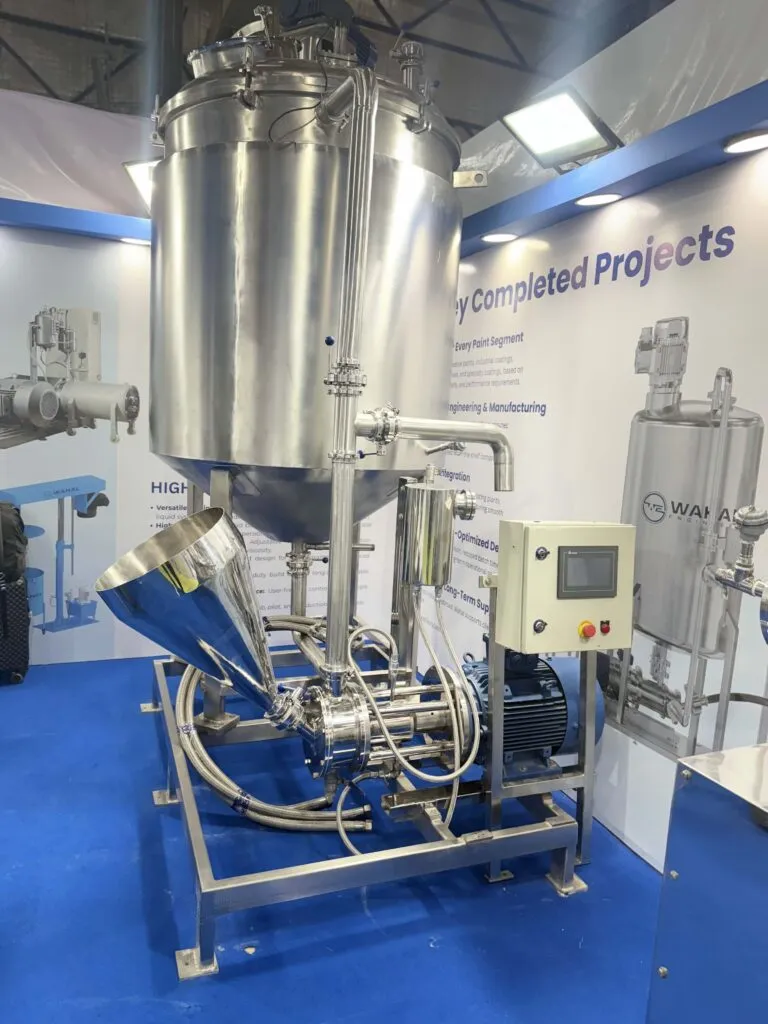
| Powder handling and induction | Titanium dioxide and calcium carbonate move dust-free from storage to the mixing vessels, and a liquid powder mixer draws them into the liquid below its surface. | Liquid powder mixer (LPM), up to 675 kg/min on the LPM 200 (calcium carbonate, hopper feed); powder handling systems |
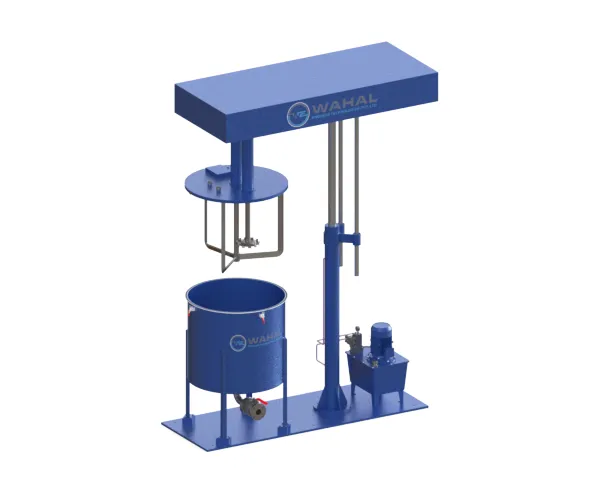
| Dispersion | Pigments and extenders are dispersed in water into a smooth mill base. | High speed disperser; a twin shaft disperser for thick products such as textured coatings |
| Grinding, where needed | Finer grades and tinters are ground to the target particle size. | Bead mills, or a basket mill that disperses and grinds in one vessel |
| Let-down and storage | The binder emulsion and the remaining additives are blended in, and the batch is held for testing. | Stainless steel vessels sized to your batch, with agitators |
| Tinting and control | The batch is tinted to shade and checked for viscosity and colour. | PLC and SCADA batch control, recipe management, inline viscosity and pH sensors, automated dosing |
| Filtration and filling | The paint is filtered to remove impurities and filled into cans, pails or drums. | Filtration units and filling machines, integrated into the plant |
Foam, shear and hygiene: what a water-based production line needs
- Foam and trapped air. Water-based paints take in air easily, and trapped air shows up as foam in the tank and pinholes in the paint film. The LPM draws powder in below the liquid surface, so no foreign air is entrapped, and Wahal's inline mixers run in a closed circuit, free of aeration.
- Shear- and heat-sensitive binders. Latex and emulsion binders are sensitive to shear and temperature and can coagulate if overworked. So the binder goes in at let-down, at lower speed, and cooling jackets hold the temperature where dispersion or grinding warms the batch.
- Thickener hydration. Cellulose thickeners such as HEC form lumps, known as fisheyes, when they are tipped in by hand. The LPM wets each particle before the viscosity builds.
- Hygiene. Water-based paint can spoil through bacterial growth, so the plant should be easy to clean, with smooth stainless steel contact surfaces and no dead zones, and the paint carries an in-can preservative.
- Wash water. Tanks and lines are cleaned with water. The wash water carries paint solids, so it is reused in later batches of a similar product or treated before discharge.
- Lower fire risk. With water as the carrier, the dispersion floor does not carry the flammable-vapour risk of a solvent line. If you also make enamels or other solvent-thinned products, see our solvent-based paint plant.
Plant size, small-scale lines and cost
Plant size follows your daily output, batch size and the number of products and shades you run. Wahal paint plants range from small-scale units of 1,000–5,000 L/day to high-capacity plants of 50,000 L/day and above; our paint manufacturing plant page covers the full range and what a small-scale plant includes.
For a water-based plant, the cost depends mainly on output, how powders arrive (bags, jumbo bags or silo), whether a grinding stage is needed, the number of let-down and storage tanks, the automation level and the filling line. Price on request.
Turnkey water-based paint plant, from design to commissioning
A turnkey solution means we handle every step of the project, from initial design and engineering to final commissioning, delivering a plant that is ready to operate.
- Process design. We start from the production capacity you want, the paints you plan to make and the level of automation you need. Then we lay out the plant from raw material intake to filling, with separate areas for raw material storage, mixing, milling and filling.
- Recipe support. If you have your own formulations, our wet processing experience lets us help optimise them for efficient production.
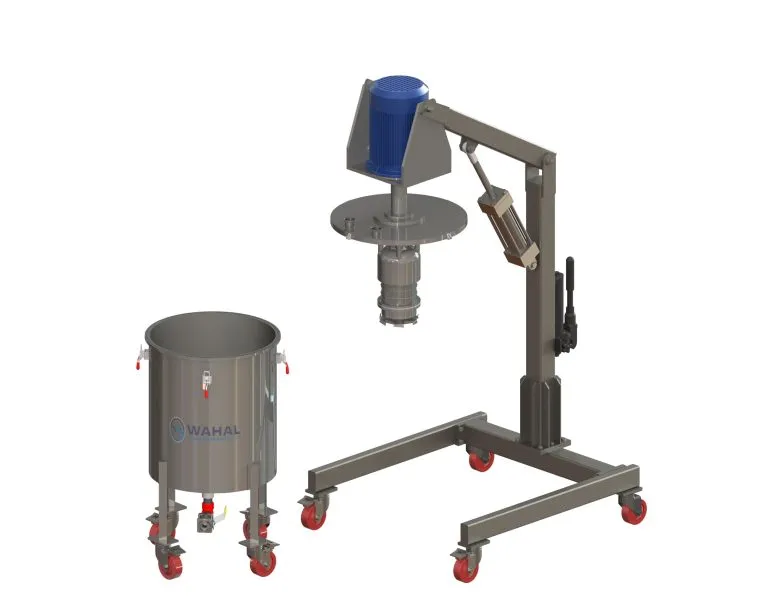
- Equipment. We make the dispersers, mixers, homogenizers and mills ourselves and integrate them with powder handling, filtration and filling.
- Trials. Before you decide, you can test a Wahal powder induction mixer, disperser or bead mill on your own paint in our fully equipped laboratory, or rent a machine pre-configured to your requirements. See trials and rentals.
Wahal Engineers makes its machines at its factory in Bhigan (Murthal), Sonipat, Haryana.
Frequently asked questions
What is a water-based paint plant?
A plant that makes paint with water as the carrier. It inducts and disperses pigments and extenders into a mill base, grinds it where needed, lets it down with the binder emulsion, then tints, filters and fills the paint. Wahal designs, manufactures and commissions these as turnkey plants.
How is emulsion paint made in a factory?
Water, dispersant and other additives go into the tank first. Titanium dioxide and extenders are drawn in and dispersed at high speed into a mill base, which is ground further if the grade needs it. The binder emulsion is then added at lower speed, and the batch is tinted, tested, filtered and filled.
Which machines are used to make water-based paint?
A liquid powder mixer for dust-free pigment and filler induction, a high speed disperser for the mill base, a bead mill or basket mill for finer grades, agitated let-down and storage vessels, and filtration and filling equipment.
Does emulsion paint need a bead mill?
Not always. Many decorative emulsions are made on a high-speed disperser alone, using pigment grades that disperse easily. A bead mill or basket mill is added for finer grinds, such as tinters and some higher-sheen grades.
What does an emulsion paint plant cost?
It depends on the daily output, powder handling, whether you need a grinding stage, the number of tanks, automation and filling. We give prices on request, once we know your paints and output.
Can I test my formulation before buying?
Yes. You can run your own paint on a Wahal powder induction mixer, disperser or bead mill in our trial laboratory, or rent a machine.