What is a Dyno Mill (Dyna Mill)?
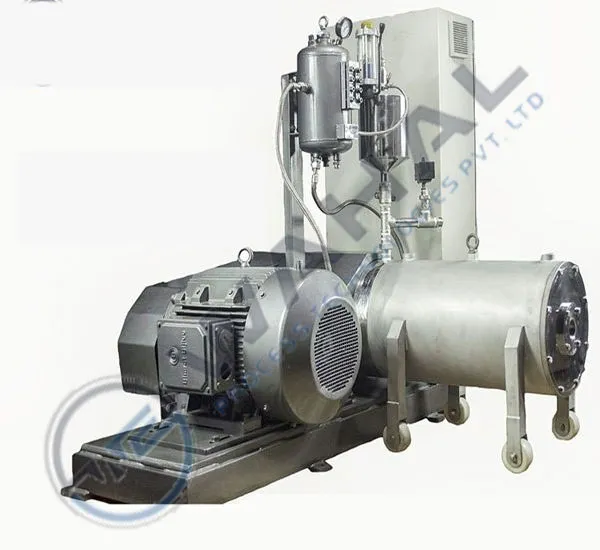
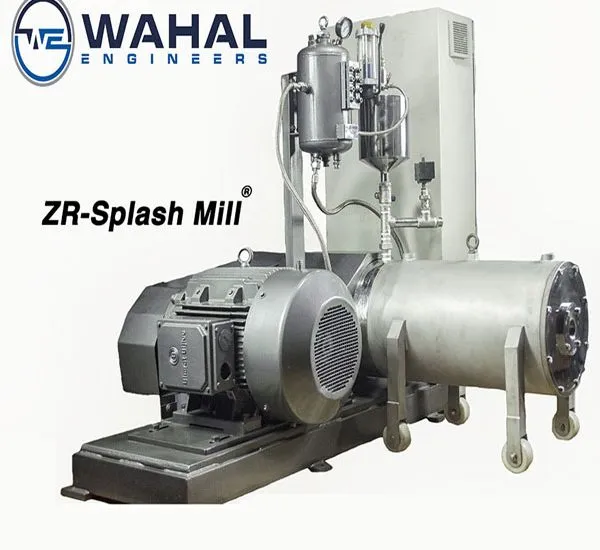
A Dyno Mill, also written Dyna Mill, Dynomill or Dynamill, is a high-energy horizontal agitator bead mill. It uses grinding beads made of glass, ceramics or steel to grind and disperse particles in a liquid suspension.
The grinding chamber is horizontal and filled with beads. An agitator shaft with discs or pins keeps the beads moving. The mill works as a completely enclosed system for dispersion and wet grinding.
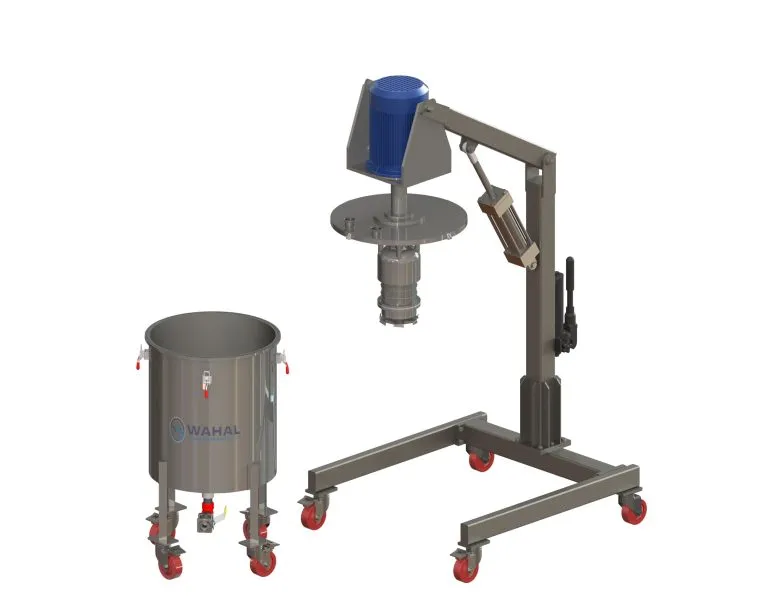
It is one of the machines in our range of bead mills. For premix preparation before grinding, see our high shear homogenizers.
Dyno mill working principle
The Dyno Mill grinds by passing energy from a rotating agitator to the beads, and from the beads to the particles.
- Feed. The suspension enters the horizontal chamber, which is filled with grinding beads.
- Agitation. The agitator shaft, fitted with discs or pins, rotates at high speed and gives kinetic energy to the beads.
- Impact and shear. The beads collide with each other and with the particles, creating intense shear forces and high-energy impacts.
- Size reduction. The energy passes to the particles and agglomerates, which collide and break apart. Shear, impact and attrition together bring them down to sub-micron or nano-scale sizes and give a finely dispersed suspension.
This process is known as bead milling or wet grinding. A special centrifugal separation system allows high flow rates while still grinding intensively.
Dyno mill machine models and specifications
Our horizontal Dyno Mill range has nine models, from a 0.6 litre chamber with a 2 HP motor to a 300 litre chamber with a 200 HP motor.
Model chart
| Model | Chamber volume | Motor power | Batch size (per 8-hr shift)* |
|---|---|---|---|
| WBM 0.6 | 0.6 L | 2 HP | 0–10 litres |
| WBM 1.4 | 1.4 L | 3 HP | 0–50 litres |
| WBM 7.5 | 7.5 L | 10 HP | 20–100 litres |
| WBM 17.5 | 17.5 L | 20 HP | 100–500 litres |
| WBM 32.5 | 32.5 L | 30 HP | 500–1,000 litres |
| WBM 60 | 60 L | 40 HP | 1,000–2,000 litres |
| WBM 100 | 100 L | 75 HP | 2,000–5,000 litres |
| WBM 200 | 200 L | 125 HP | 5,000–10,000 litres |
| WBM 300 | 300 L | 200 HP | 10,000–20,000 litres |
*Batch size and throughput figures are based on an 8-hour work shift and are subject to product viscosity and the initial and final particle size required.
Construction and options
| Item | Detail |
|---|---|
| Grinding beads | Glass, ceramic or steel beads, 0.3–2.5 mm |
| Materials of construction | Hardened steel, polymer, and ceramic/zirconia coatings, selected by process composition and product compatibility |
| Slurries | Water-based and solvent-based |
| Temperature | Thermal protection for thermo-sensitive products |
| Shaft sealing | Double mechanical seal cooling system, to API Plan 53A |
| Product separation | Special centrifugal separation system for high flow rates |
| Pharma and hazardous areas | GMP-compliant models for pharmaceutical use; explosion-proof ATEX and NEMA models |
| Control panels | Explosion-proof control panels |
| Validation | DQ, IQ and OQ documents; calibration and materials certificates; Factory Acceptance Test at our factory or Site Acceptance Test at your site on request |
| Customisation | Can be customised to the customer's needs |
Dyno mill compared with a ball mill
- Efficiency. The agitator design and high-energy impacts give efficient size reduction and dispersion, reaching finer particle sizes in less time than a ball mill.
- Uniformity. The intense shear gives a uniform particle size distribution and dispersion.
- Scalability. Dyno Mills come in a range of sizes, from small laboratory-scale batches to large-scale industrial production.
Dyno Mill applications
A Dyno Mill is used where solids have to be ground and dispersed in a liquid.
- Paints, coatings and inks. Stable dispersions of pigments, dyes and fillers, with uniform colour distribution, better colour strength and gloss. See our ink manufacturing plants and paint manufacturing plants.
- Dye stuffs and pigment production.
- Pharmaceuticals. Suspensions, emulsions and liposomal formulations, and dispersion of active pharmaceutical ingredients (APIs) to improve bioavailability. See wet milling of API.
- Chemicals. Fine chemical dispersions, including catalysts, pigments and specialty chemicals.
- Cosmetics and personal care. Lotions, creams and suspensions.
- Food industry.
- Nanotechnology. Sub-micron and nano-scale particle size reduction with control over size and distribution.
- Coatings and fillers. Audio and video tape coating, thermal and fax paper coating, and fillers for the paper and plastics industries.
Pharma-compliant design with the Wahal validation concept
The qualification documents DQ, IQ, OQ that are required for validation or the certificates for the process-relevant machine components such as calibration- and materials certificates are available for all Bead Mills. On request, we can also carry out the Factory Acceptance Test in our factory or the Site Acceptance Test at your production site.
Wahal Dyno Mills
Wahal Process Technologies Pvt. Ltd is Leading Dyno Mill Manufacturer for the 40+ Years Experienced over 160+ countries Suppliers
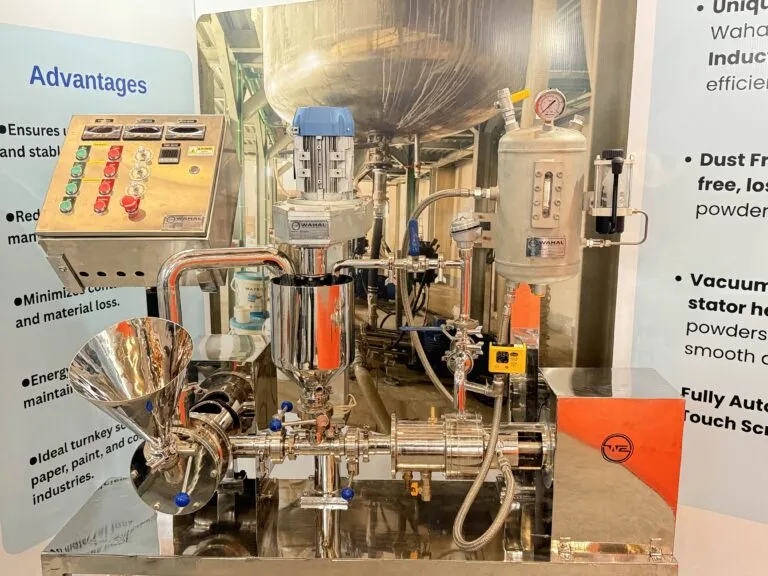
Wahal's Dyno Mills are agitator bead mills with agitator grinding discs, for wet grinding in the micrometre range. Each mill has a grinding container for dispersion and wet grinding in a completely enclosed system. The mills suit a wide range of products and can be customised to the customer's needs.
Try a Dyno Mill on your product first
You can test your own product in our fully equipped laboratory before you order. The trial shows the end result you can expect and the time it takes. If you want to keep a machine for longer, the rental program lets you keep it for as long as you need. See trials and rentals.
For formulation work, our laboratory bead mill (model WBM 1.4, 1.4 litre chamber, 3 HP motor) uses the same grinding principle as the full WBM range up to 300 litres. Bead size, bead material and grinding time worked out on the bench carry over to scale-up planning. Production-scale validation is still recommended before full commercial rollout.
Frequently asked questions
What is the working principle of a Dyno Mill?
A rotating agitator shaft gives kinetic energy to grinding beads in a horizontal chamber. The beads collide with each other and with the particles in the suspension, creating shear forces and high-energy impacts that break the particles and agglomerates apart.
Is a Dyno Mill the same as a bead mill?
A Dyno Mill is a horizontal agitator bead mill: grinding beads in a chamber, stirred by an agitator with discs or pins. See our full range of bead mills, which also includes the basket mill.
Is a Dyna Mill the same as a Dyno Mill?
Yes. We use both names for the same horizontal agitator mill.
What size beads does a Dyno Mill use?
Beads of glass, ceramic or steel, between 0.3 and 2.5 mm. For the amount of zirconium beads to load, see our bead fill volume calculation.
What sizes of Dyno Mill are available?
Nine WBM models, from a 0.6 L chamber and 2 HP motor to a 300 L chamber and 200 HP motor. Batch size per 8-hour shift runs from 0–10 litres to 10,000–20,000 litres, depending on product viscosity and particle size. See the model chart above.
How fine can a Dyno Mill grind?
To sub-micron or nano-scale sizes. On our bead mills, particle sizes of up to one micron, or 50 to 500 nm, can be achieved, depending on product viscosity and the initial particle size.
Can a Dyno Mill be used for pharmaceutical or hazardous-area work?
Yes. DQ, IQ and OQ documents are available, and we offer GMP-compliant models for pharmaceutical applications and explosion-proof ATEX and NEMA models.
How is a Dyno Mill different from a basket mill?
A Dyno Mill has a horizontal chamber filled with beads and an agitator shaft. The basket mill is batch equipment for medium and low-viscosity liquids. It disperses and grinds in one machine and one vessel, with no pumps or valves needed between stages.