What is a ribbon blender?
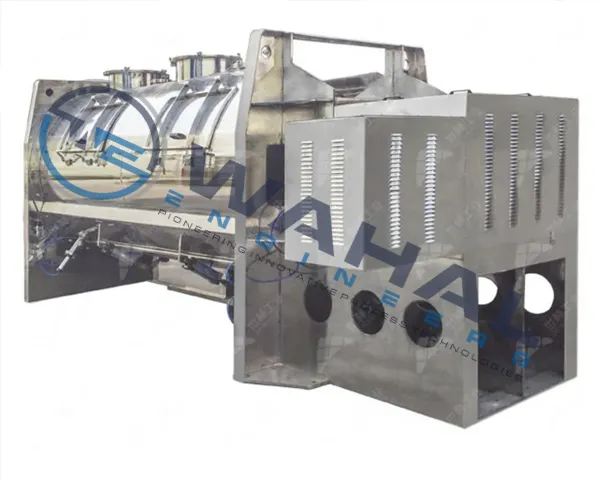
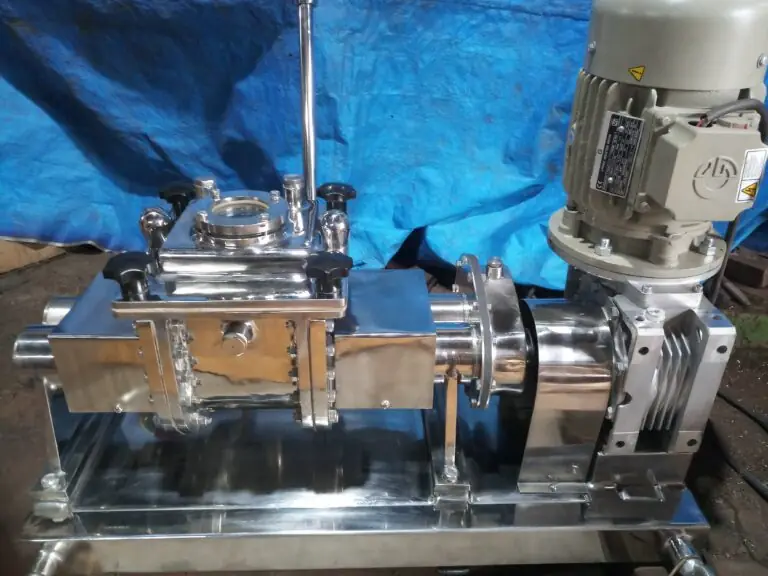
A ribbon blender, also called a ribbon mixer or ribbon blender mixer, is a horizontal mixer for dry powders and other bulk solids. It is a simple, robust machine and is widely used across the process industries for dry mixing of bulk solids.
Its main parts are:
- U-shaped trough. A horizontal shell with a semicircular bottom, usually two to three times longer than it is wide.
- Horizontal shaft. A shaft runs along the length of the trough and carries the arms that hold the mixing elements.
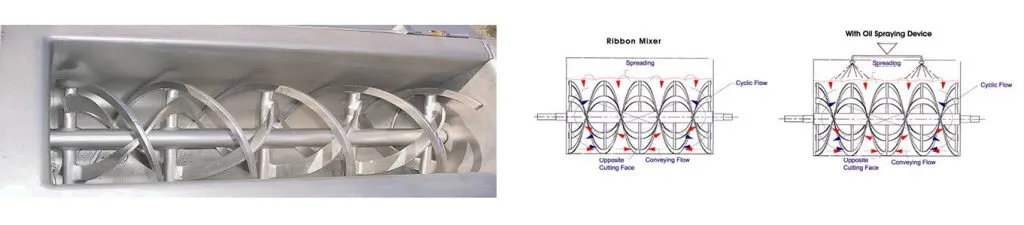
- Ribbon agitator. The arms carry ribbon blades, which can be combined with paddles or helical screws. The most effective layout is the double spiral: an outer ribbon moves the product one way along the trough, and an inner ribbon moves it the other way.
- Close clearance. The ribbons run close to the semicircular bottom, so no layer of material is left behind on it.
How a ribbon blender works
- Load. The dry ingredients are loaded into the trough, filling it to between 40 and 70% of the blender’s rated capacity.
- Turn. The shaft turns the ribbons at a relatively low speed.
- Counter-flow. The outer ribbon conveys material one way along the trough while the inner ribbon conveys it back, so the batch is continuously folded through itself.
- Mix in all directions. The ribbons move the material both radially and laterally, which gives a thorough blend in a short cycle.
- Finish. A typical mixing cycle is 15 to 20 minutes. Where the recipe needs a liquid, it can be added through spray bars.
Ribbon blender design and specifications
The table below lists the design features published for our horizontal ribbon blenders. For a model size and a quotation, tell us your material and batch size.
| Parameter | Wahal ribbon blender |
|---|---|
| Type | Horizontal ribbon blender (ribbon mixer) for dry solids |
| Trough | U-shaped, with a semicircular bottom; usually 2–3 times longer than it is wide |
| Shaft | Horizontal shaft along the length of the trough |
| Agitator | Double-spiral ribbons: outer and inner ribbons convey in opposite directions; paddles or helical screws can be combined with ribbons |
| Clearance | Close to the trough, so no layer of material is left on the bottom |
| Shaft speed | Relatively low |
| Working fill | 40–70% of rated capacity |
| Typical mixing cycle | 15–20 minutes |
| Liquid addition | Spray bars can be added |
| Mixing intensity | Lower than a plough shear mixer; gentler on friable materials |
| Best suited to | Free-flowing to moderately cohesive powders and delicate materials |
Ribbon blender applications
Ribbon blenders are used across the process industries wherever dry solids must be mixed evenly.
- Food: instant mixes. In ragi and millet instant mixes, millet flour is blended with pulse flour, spices, and salt or sugar; see our millet-based foods plant. In instant rava idli and dosa mixes, all the dry powders are blended together and the spices are added last so they don’t break up; see our rava batter production line.
- Agrochemicals: wettable powders (WP) and water-dispersible granules (WG), as part of our pesticide and herbicide plants.
- Pharmaceuticals and chemicals: dry powder blending wherever solids must be mixed uniformly.
Strengths and limits of a ribbon blender
What a ribbon blender does well:
- Simple and robust. The design is simple, robust and generally cost-effective.
- Gentle. Its lower mechanical intensity is kinder to friable and delicate materials.
- Good enough for many jobs. It gives a mixing performance that is sufficient for many applications.
Where another machine may suit better:
- Speed and hygiene. Other mixer designs outperform ribbon blenders in some areas, such as mixing speed and hygienic design.
- Small batches. A horizontal ribbon blender works best at 40–70% of its rated capacity.
- Lumps and granulation. Choppers for breaking lumps or granulating are less common on ribbon blenders.
Ribbon blender or another powder mixer?
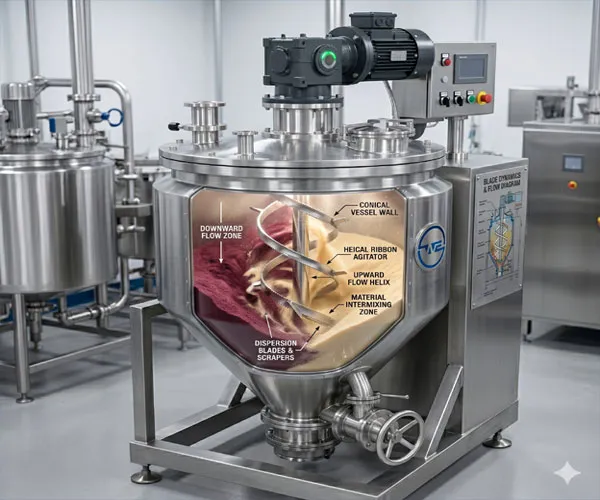
Besides the horizontal ribbon blender, we make a precision vertical ribbon blender and a plough shear mixer for dry powders. The right one depends on your product, your batch size and how often you change products.
| Horizontal ribbon blender | Precision vertical ribbon blender | Plough shear mixer | |
|---|---|---|---|
| How it mixes | Outer and inner ribbons fold the batch back and forth along a U-shaped trough | A ribbon in a conical vessel lifts material from the bottom and spreads it across the top | Plough-shaped blades lift and throw material into a three-dimensional, fluidized mixing zone |
| Intensity and speed | Low speed, gentle; typical cycle 15–20 min | Low speed, low shear; less frictional heat | More intense; often mixes in a few minutes |
| Best for | Free-flowing to moderately cohesive powders and delicate materials | High-value or heat-sensitive powders, additives down to 1% of the batch, batches from 10% of capacity, frequent product changeovers, tight floor space | Cohesive powders, materials of varied particle size or density, lump breaking and granulation with optional choppers |
Mixing powders into a liquid rather than with each other? A liquid powder mixer creates a vacuum in the flowing liquid and draws the powder in without dust. For thick pastes and doughs, see our planetary mixer and Z-blade mixers.
Frequently asked questions
What is a ribbon blender used for?
It blends dry powders and other bulk solids into a uniform mix. Typical uses are instant food mixes such as millet and rava mixes, agrochemical wettable powders and water-dispersible granules, and dry powder blending in pharmaceutical and chemical plants.
How does a ribbon blender work?
A horizontal shaft turns an outer and an inner ribbon at low speed inside a U-shaped trough. The outer ribbon moves material one way along the trough and the inner ribbon moves it back, so the batch is folded through itself until it is evenly mixed.
Is a ribbon mixer the same as a ribbon blender?
Yes. Ribbon blender, ribbon mixer and ribbon blender mixer are names for the same machine: a U-shaped horizontal trough with a shaft carrying ribbon agitators. A vertical ribbon blender, also called a conical ribbon mixer, is a different design with a conical vessel and a vertical agitator.
How full should a ribbon blender be?
Load it to between 40 and 70% of its rated capacity. If you often mix smaller batches, our vertical ribbon blender can mix batches from 10% of its capacity.
How long does a ribbon blender take to mix?
A typical mixing cycle is 15 to 20 minutes. A plough shear mixer, with its more intense action, often mixes in a few minutes.
Can liquids be added in a ribbon blender?
Yes. Spray bars can be added to bring liquid into the batch. If the product also needs lumps broken up or granulating, a plough shear mixer with choppers is usually the better choice.
Do you manufacture ribbon blenders in India?
Yes. Wahal Engineers is a ribbon blender manufacturer in India, with its head office in New Delhi and its factory in Murthal, Sonipat, Haryana. Tell us your material and batch size and we will recommend a machine.