Why Bean Gums Are Prone to Lumping
Locust bean gum and carob bean gum are hygroscopic powders that begin absorbing water the instant they contact a liquid surface. When added using conventional stirring or sprinkling methods, individual gum particles swell rapidly on the outside while remaining dry in the center — forming lumps with a gelled outer layer that traps dry powder inside. Once formed, these lumps are extremely resistant to breaking down, even with extended High Shear Homogenizers mixing or heating, resulting in uneven viscosity, visible specks in the final product, and wasted raw material.
This is the same fundamental problem seen across many hydrocolloids and water-soluble polymers:
the rate of surface wetting outpaces the rate of particle separation, so particles bind together before they can be individually hydrated.
How High Shear Mixing Prevents Lump Formation
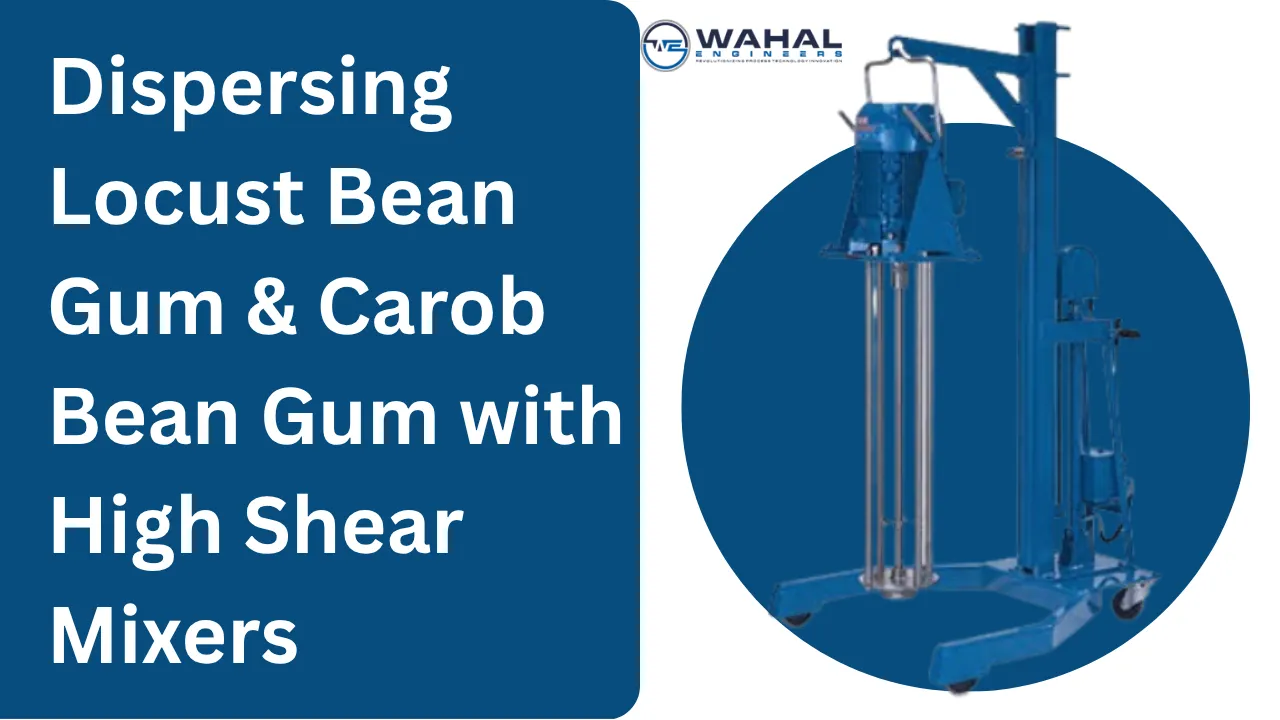
A high shear rotor-stator mixer solves this by combining rapid, below-surface powder induction with intense mechanical separation:
- Vacuum-assisted powder induction draws bean gum powder into the liquid stream from below the surface, rather than allowing it to sit on top where clumping typically begins.
- Immediate high shear dispersion separates individual particles from one another as they enter the liquid, before a gelled outer skin has time to form and bind particles together.
- Uniform hydration follows naturally once particles are properly separated and wetted — each particle absorbs water evenly rather than some remaining dry inside lump
Because locust bean gum and carob bean gum typically require heating (often in the 80–90°C range) to fully develop their thickening properties, proper initial dispersion is what determines whether that heating stage produces a smooth, fully-hydrated solution or one still carrying undissolved lumps that heating alone cannot fix.
Key Process Considerations
Cold-water dispersion before heating is critical — attempting to add bean gum powder directly to hot liquid accelerates surface gelling and worsens lumping
Dispersion speed and shear intensity directly affect final viscosity development — under-dispersed gum will underperform its expected thickening power even after heating
Combination with other hydrocolloids (such as carrageenan or guar gum) is common in food formulations and requires careful sequencing during dispersion
Batch consistency depends on uniform particle wetting, not extended mixing time — a well-dispersed batch hydrates faster and more completely than a poorly-dispersed one given more time
Applications of Locust Bean Gum & Carob Bean Gum
- Dairy and ice cream — used as a stabilizer to control ice crystal formation and improve texture
- Sauces and dressings— provides thickening and mouthfeel without altering flavor
- Processed meats — improves water-binding and texture in meat products
- Baked goods— used to improve dough handling and shelf life
- Pet food— used as a binding and texturizing agent in wet pet food formulations
Why Choose High Shear Mixing for Bean Gum Processing
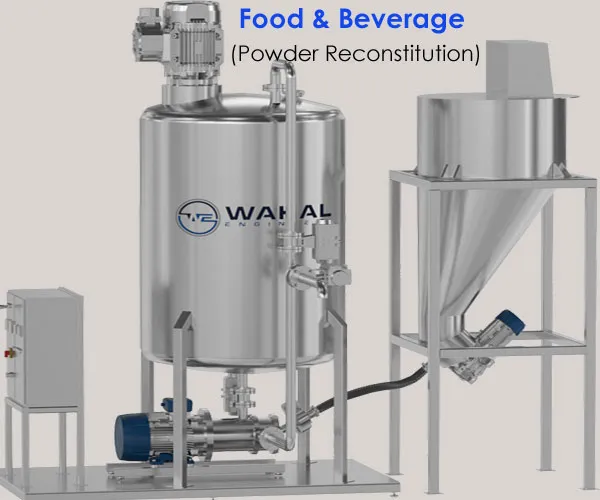
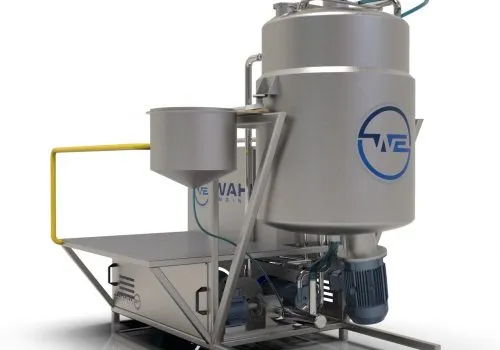
Wahal Engineers’ high shear mixers and vacuum powder induction systems are engineered to solve exactly this kind of powder wetting and deagglomeration challenge, ensuring bean gums and other hydrocolloids disperse and hydrate cleanly on the first pass.
- Vacuum powder induction prevents surface clumping from the start
- Rotor-stator high shear dispersion separates particles instantly for uniform wetting
- Consistent, repeatable viscosity development batch after batch
- Suitable for batch or continuous inline processing, depending on production scale
- Sanitary, food-grade design for dairy, sauce, and processed food manufacturing
Frequently Asked Questions
Why does locust bean gum form lumps when added to water?
Because the powder absorbs water rapidly on contact, individual particles swell and gel on the outside before separating, trapping dry powder inside — a problem that worsens with conventional stirring methods.
Does locust bean gum need to be heated to fully hydrate?
Yes — locust bean gum and carob bean gum typically require heating, often in the 80–90°C range, to fully develop their thickening properties, though proper dispersion before heating is essential to avoid lumps that heat alone cannot dissolve.
What’s the difference between locust bean gum and carob bean gum?
Both are derived from the same carob tree seed and share very similar galactomannan structure and functional properties, and are often used interchangeably in food formulations.
Can bean gums be combined with other stabilizers during mixing?
Yes — they’re frequently used alongside carrageenan, guar gum, or other hydrocolloids, though the order and method of dispersion should be carefully managed to avoid competing hydration demands.
Is high shear mixing necessary at small production scale, or only for large batches?
The lumping problem occurs regardless of batch size — high shear dispersion improves consistency and reduces material waste at any production scale, though the equipment configuration (batch vs. inline) will typically differ based on volume.
Wahal Engineers designs and manufactures high shear mixing, homogenization, and powder induction equipment for the pharmaceutical, food, chemical, and cosmetic industries, backed by decades of in-house engineering experience.