Plant-based milk — oat, almond, soy, coconut, and other dairy-free alternatives — is one of the fastest-growing categories in the beverage industry. But unlike dairy milk, which has a naturally stable fat and protein structure, plant-based milks have to be engineered from raw plant materials to achieve a smooth, creamy mouthfeel and shelf-stable consistency. That engineering challenge is where high shear mixing plays a central role.
Why Plant-Based Milk Is Harder to Stabilize Than Dairy
Dairy milk’s texture comes from naturally emulsified milk fat and casein micelles — a structure built over millions of years of biological evolution. Plant-based milk has no equivalent natural structure. Instead, manufacturers must create a stable emulsion and suspension from scratch, using plant proteins, oils, and starches that don’t naturally want to stay evenly dispersed in water.
Without proper processing, plant-based milk separates quickly — plant solids settle to the bottom, oils rise to the top, and the product develops a chalky or gritty texture rather than the smooth mouthfeel consumers expect from a dairy alternative.
How High Shear Mixing Creates Plant-Based Milk Texture
- Fine particle size reduction of plant solids. Whether the base is oat slurry, ground almonds, or soy protein isolate, the plant material needs to be broken down to a fine, uniform particle size to avoid graininess and to maximize how much of the plant material stays suspended rather than settling out.
- Emulsification of plant oils. Many plant-based milks include added oils (such as sunflower or coconut oil) to replicate dairy milk’s creamy mouthfeel. These oils must be finely emulsified into micron-scale droplets — a coarse emulsion leads to visible oil separation (“ring” formation) at the top of the package.
- Protein and stabilizer dispersion. Plant proteins and stabilizing gums need to be fully hydrated and evenly dispersed to build the suspension structure that keeps the product homogeneous from production through to the end of shelf life.
High shear rotor-stator mixing accomplishes all three simultaneously — reducing particle size, emulsifying oils, and dispersing proteins and stabilizers — in a single processing pass, which is critical for plant-based milk given how much structural work has to be built into the product rather than relying on naturally-occurring dairy fat and protein.
Common Plant-Based Milk Bases and Their Mixing Considerations
- Oat milk — requires fine particle size reduction of the oat slurry to avoid a starchy, gritty mouthfeel
- Almond and other nut milks — benefit from thorough homogenization to disperse nut oils and prevent separation
- Soy milk — soy protein needs proper hydration and dispersion to achieve a smooth, non-chalky texture
Coconut milk-based beverages — require stable emulsification of coconut fat to avoid the fat layer separating during storage
Why Shelf Stability Depends on Processing, Not Just Formulation
Two plant-based milk products with identical ingredient formulations can perform very differently on the shelf, depending entirely on how thoroughly the product was processed. Under-processed batches may look acceptable immediately after production but separate within days. High shear processing ensures the emulsion and suspension are properly built at a microscopic level — droplet and particle size, not just ingredient ratios, are what determine long-term stability.
Why Choose High Shear Mixing for Plant-Based Milk Production
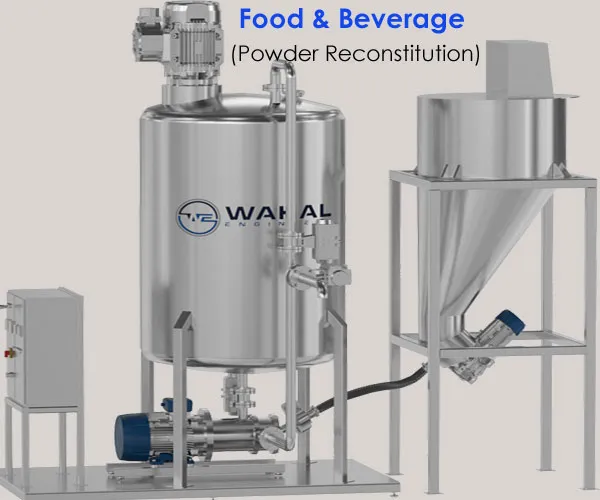
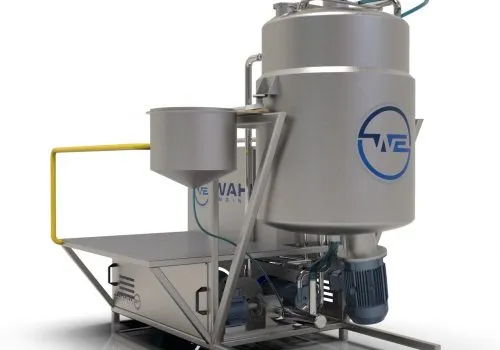
Wahal Engineers’ high shear mixers and inline homogenizers are designed to handle the combined particle size reduction, emulsification, and dispersion demands unique to plant-based milk manufacturing.
- Fine particle size reduction of oat, nut, and soy slurries for a smooth, non-gritty mouthfeel
- Stable emulsification of plant oils, preventing separation and ring formation
- Reliable protein and stabilizer dispersion for consistent suspension over shelf life
- Suitable for continuous inline processing at commercial dairy-alternative production scale
- Sanitary, FDA-compliant design for food and beverage manufacturing environments
Frequently Asked Questions
Why does plant-based milk separate more easily than dairy milk?
Dairy milk has a naturally stable fat and protein structure, while plant-based milk must have that structure engineered through processing — without proper particle size reduction and emulsification, plant solids and oils separate more readily.
What causes a gritty texture in oat or nut milk?
Gritty texture typically results from insufficiently fine particle size reduction of the plant material — high shear mixing breaks particles down to a finer, smoother scale than conventional blending can achieve.
How is oil separation prevented in plant-based milk?
Added oils need to be finely emulsified into micron-scale droplets through high shear mixing; coarse emulsification leads to visible oil rising to the surface over time.
Does the type of plant base (oat, almond, soy, coconut) change the mixing approach?
Yes — each base has different particle characteristics and oil content, so mixing parameters are typically adjusted for the specific plant material being processed.
Wahal Engineers designs and manufactures high shear mixing and homogenization equipment for the pharmaceutical, food, chemical, and cosmetic industries, backed by decades of in-house engineering experience.*