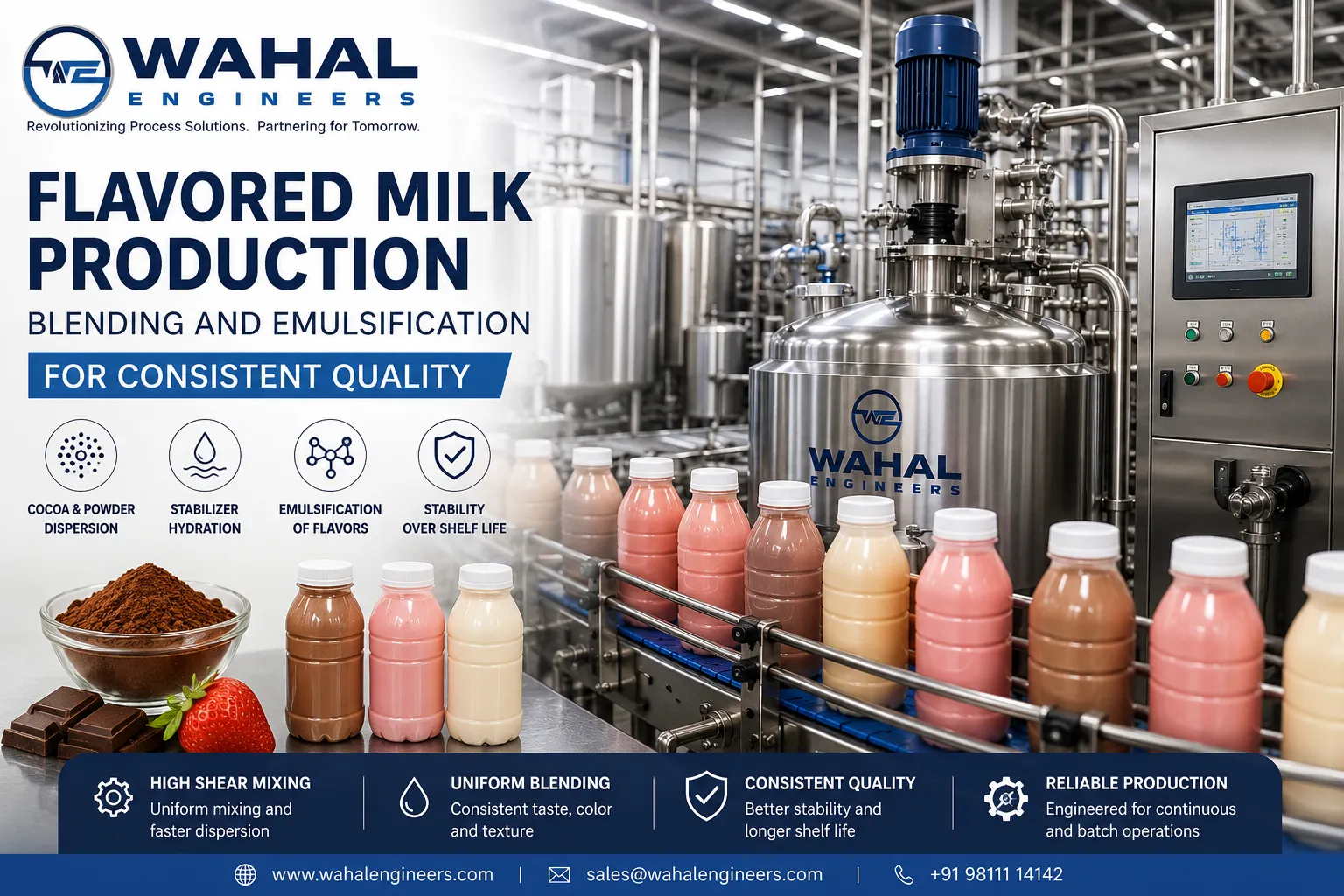
Flavored milk — from chocolate and strawberry to coffee and vanilla varieties — is one of the highest-volume dairy products manufactured worldwide. But producing a batch that stays smooth, homogeneous, and free of sedimentation or fat separation over its full shelf life requires far more control than simply stirring flavoring into milk.
The Core Challenge: Stability Over Shelf Life
Unflavored milk is relatively simple to process, but adding cocoa powder, fruit purees, stabilizers, and sweeteners introduces multiple ingredients with very different densities, particle sizes, and solubility profiles. If these aren’t dispersed and blended uniformly, the result is a product that separates, sediments, or develops an inconsistent mouthfeel well before its intended shelf life ends — a major quality and returns risk for dairy processors.
How High Shear Mixing Supports Flavored Milk Production
A high shear mixer addresses three distinct challenges simultaneously during flavored milk production:
- Cocoa and powder dispersion. Cocoa powder, in particular, is prone to clumping when added to liquid milk using conventional agitation. High shear rotor-stator mixing disperses cocoa particles rapidly and uniformly, preventing the grainy texture and sediment that under-dispersed cocoa causes.
- Stabilizer and hydrocolloid hydration. Flavored milk formulations typically rely on stabilizers (such as carrageenan or cellulose gums) to keep cocoa particles and fruit solids suspended throughout shelf life. These stabilizers need to be fully hydrated and evenly distributed — inadequate hydration leads to weak suspension and visible separation over time.
- Emulsification of flavor oils and fruit components. Fruit-flavored milks often include small amounts of flavor oils or fruit concentrates that need to be finely emulsified into the aqueous milk base to avoid oil-off or flavor layering.
Why Blending Alone Isn’t Enough
Standard paddle or propeller agitation can combine ingredients, but it doesn’t generate the shear force needed to fully break down powder clumps or properly hydrate stabilizers at production scale. The result is often a product that looks acceptable at the point of packaging but separates or sediments during distribution and storage — precisely the failure mode flavored milk manufacturers most need to avoid.
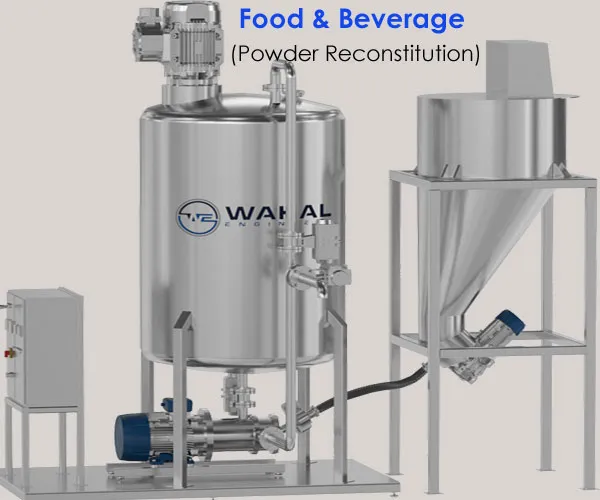
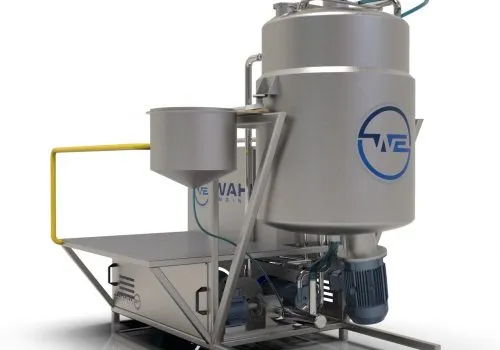
High shear inline or batch mixing solves this by processing the full batch (or a continuous inline stream) through a rotor-stator head, ensuring every particle of cocoa, stabilizer, and flavor component receives the same intense, uniform shear treatment — rather than relying on bulk tank turnover to eventually achieve consistency.
Key Process Considerations
- Cocoa dispersion should happen early, before stabilizer hydration, to avoid competing for shear energy with swelling hydrocolloids
- Stabilizer selection and hydration temperature significantly affect suspension stability — this should be matched to the specific stabilizer system in use
- Batch consistency and shelf-life stability are directly linked to shear intensity and processing time, not just ingredient formulation
- Inline systems suit continuous, high-volume dairy lines, while batch high shear mixers are often better suited to smaller-scale or multi-SKU production
Why Choose High Shear Mixing for Flavored Milk
Wahal Engineers’ high shear mixers and inline homogenizers are built to handle the combined dispersion, hydration, and emulsification demands of flavored milk production in a single processing step.
- Rapid cocoa and powder dispersion, eliminating grainy texture and sediment
- Reliable stabilizer hydration for consistent suspension across shelf life
- Fine emulsification of flavor oils and fruit concentrates, avoiding separation
- Sanitary, FDA-compliant design suitable for dairy processing environments – Available in batch and inline configurations to match production scale
Frequently Asked Questions
Why does flavored milk separate or sediment over time?
Separation typically occurs when cocoa powder, stabilizers, or flavor components aren’t fully dispersed and hydrated during processing — high shear mixing addresses this by ensuring uniform particle breakdown and suspension from the start.
What role do stabilizers play in flavored milk production?
Stabilizers such as carrageenan or cellulose gums keep cocoa and fruit solids suspended throughout shelf life, but they must be fully hydrated during mixing to be effective — inadequate hydration leads to weak suspension and visible separation.
Is high shear mixing necessary for all flavored milk varieties?
It’s most critical for cocoa-based and fruit-based flavored milks, where powder dispersion and emulsification directly affect texture and shelf stability, though it also improves consistency for simpler flavored formulations.
Can this process be run continuously for high-volume dairy lines?
Yes — inline high shear homogenizers are well suited to continuous, high-volume flavored milk production, while batch systems are more practical for smaller runs or multiple product variants.
Wahal Engineers designs and manufactures high shear mixing and homogenization equipment for the pharmaceutical, food, chemical, and cosmetic industries, backed by decades of in-house engineering experience.