Polyvinyl alcohol (PVA) is one of the most widely used water-soluble polymers in industrial manufacturing — found in adhesives, textile sizing agents, paper coatings, packaging films, and even pharmaceutical tablet coatings. But preparing a smooth, lump-free PVA solution is notoriously difficult with conventional mixing equipment. Get the dispersion step wrong, and the result is “fish eyes” — gelatinous undissolved lumps that ruin batch consistency and waste raw material.
Why PVA Is Difficult to Dissolve
PVA is typically supplied as a fine powder or granular solid. When added to water using a conventional agitator or paddle mixer, individual particles clump together as soon as they contact the liquid surface. The outer layer of each clump swells and forms a gelatinous skin almost instantly, which then traps dry, undissolved powder inside — creating the fish eyes that plague poorly-mixed PVA batches. Once formed, these gel lumps are extremely difficult to break down even with extended heating and stirring, often resulting in wasted material and inconsistent final viscosity.
The core problem is one of wetting speed versus particle separation. For PVA to dissolve cleanly, every individual particle needs to be fully wetted and separated from its neighbors before the gelatinous outer layer has a chance to form and bind particles together.
How High Shear Mixing Solves the Problem
A high shear rotor-stator mixer addresses this directly by combining rapid powder induction with intense mechanical dispersion in a single step:
- Vacuum-assisted powder induction draws PVA powder directly into the liquid stream below the surface, rather than allowing it to sit on top of the water where clumping begins.
- High shear rotor-stator action immediately separates and disperses individual particles as they enter the liquid, preventing them from clustering together before wetting occurs.
- Rapid, uniform wetting ensures each particle is fully surrounded by water before any gel skin can form, eliminating the fish-eye problem at its source.
Once uniformly dispersed, the PVA slurry is typically heated to 85–95°C to complete dissolution and reach full solution clarity and target viscosity — but because the dispersion step already prevented clumping, this heating stage proceeds far more efficiently, without the extended cook times needed to break down stubborn gel lumps.
Key Process Considerations
- Powder induction method matters. Feeding PVA powder through a vacuum-based induction system (rather than dumping it onto the liquid surface) is the single biggest factor in preventing fish eyes.
- Concentration affects difficulty. Higher-concentration PVA solutions are more prone to clumping and require more effective initial dispersion to avoid lump formation.
- Grade selection influences viscosity and dissolution behavior. Fully hydrolyzed and partially hydrolyzed PVA grades dissolve differently, and mixing parameters should be adjusted accordingly.
- Batch consistency depends on dispersion, not just heating time. Extending the heating cycle cannot fully compensate for poor initial dispersion — properly wetted powder dissolves faster and more completely at a given temperature.
Applications of PVA Solutions
- Adhesives and glues — PVA is a core ingredient in wood glues, paper adhesives, and packaging adhesives
- Textile sizing — used to strengthen and protect yarn during weaving
- Paper and packaging coatings — improves surface strength, gloss, and barrier properties
- Packaging films — water-soluble PVA films used in detergent pods and agricultural packaging
- Pharmaceutical coatings — used as a film-forming agent in tablet coating formulations
Why Choose a Rotor-Stator High Shear Mixer for PVA Processing
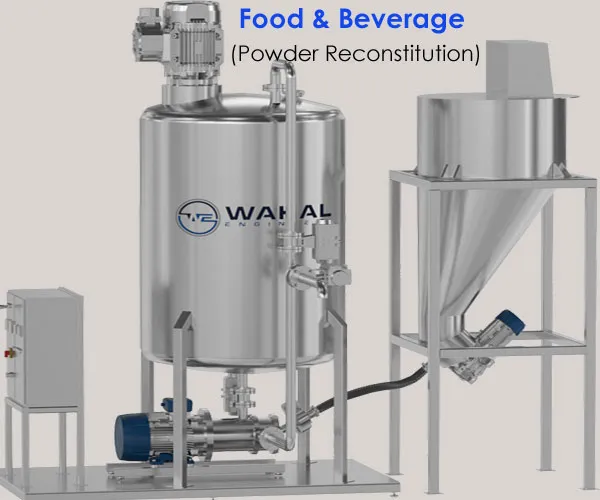
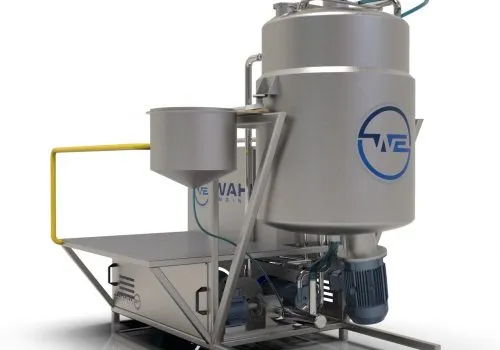
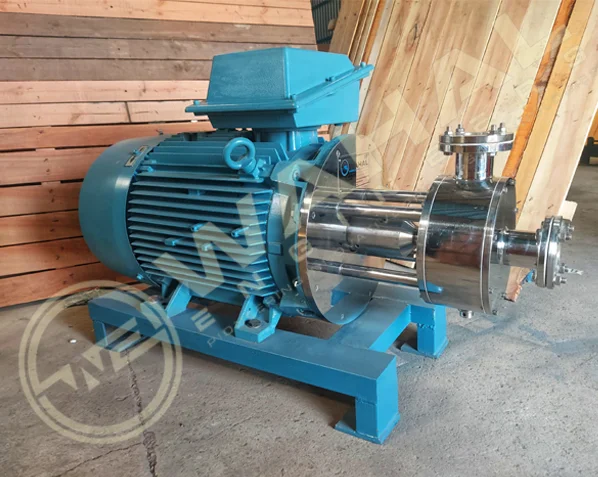
Wahal Engineers’ high shear mixers and vacuum powder induction systems are engineered specifically to solve the powder wetting and deagglomeration challenges that make PVA processing difficult with conventional agitators. By combining vacuum-assisted powder induction with rotor-stator dispersion, PVA (and other clump-prone powders) can be reliably dissolved without the batch-to-batch inconsistency and material waste that fish eyes cause.
- Vacuum powder induction draws powder below the liquid surface, avoiding surface clumping from the start
- Rotor-stator high shear dispersion separates particles instantly, preventing gel skin formation
- Configurable for batch or inline continuous processing, depending on production volume
- GMP-compliant models available for pharmaceutical-grade PVA coating solution preparation
- Decades of in-house engineering experience in solving deagglomeration and dispersion challenges across chemical, adhesive, and pharmaceutical manufacturing
Frequently Asked Questions
What causes “fish eyes” in PVA solutions?
Fish eyes form when PVA powder clumps together before being fully wetted, causing the outer layer of each clump to gel and trap dry powder inside — a problem that conventional surface-mixing methods struggle to prevent.
What temperature is needed to fully dissolve PVA?
PVA solutions typically require heating to 85–95°C to reach full dissolution and target viscosity, though proper initial dispersion significantly improves how efficiently this heating stage works.
Can high shear mixing eliminate fish eyes entirely?
Yes — using vacuum-assisted powder induction combined with rotor-stator high shear dispersion prevents the clumping that causes fish eyes in the first place, rather than trying to break down lumps after they’ve already formed.
Is this process suitable for pharmaceutical-grade PVA coating solutions?
Yes — GMP-compliant equipment configurations are available for pharmaceutical tablet coating and other regulated PVA applications.
Does PVA concentration affect the mixing process?
Yes — higher-concentration solutions are more prone to clumping and require more effective powder induction and dispersion to achieve a smooth, lump-free result.
Wahal Engineers designs and manufactures high shear mixing, homogenization, and powder induction equipment for the pharmaceutical, food, chemical, and cosmetic industries, backed by decades of in-house engineering experience.