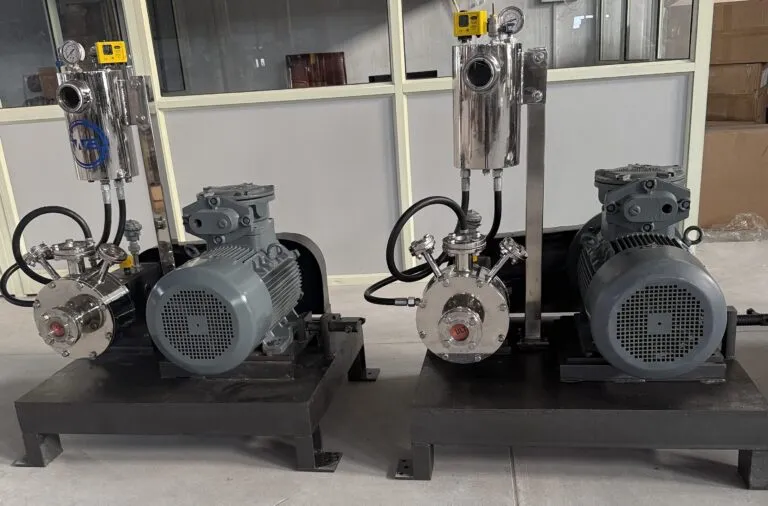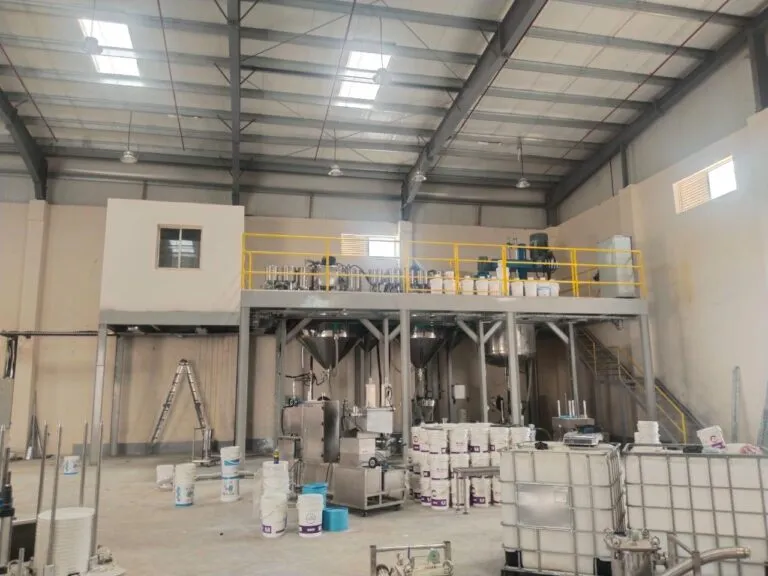
What is a bead mill?
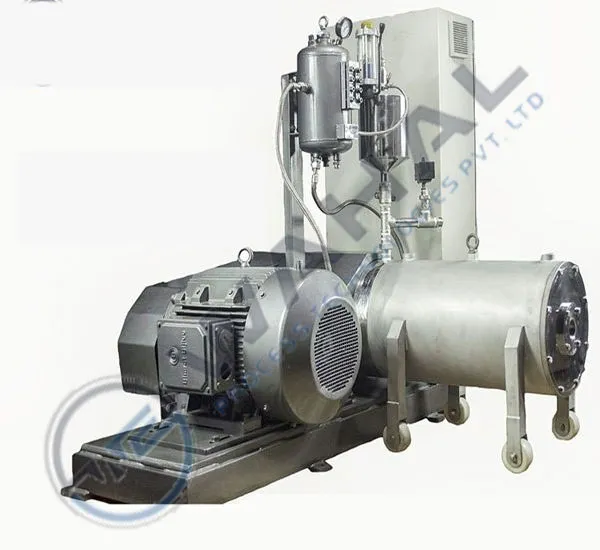
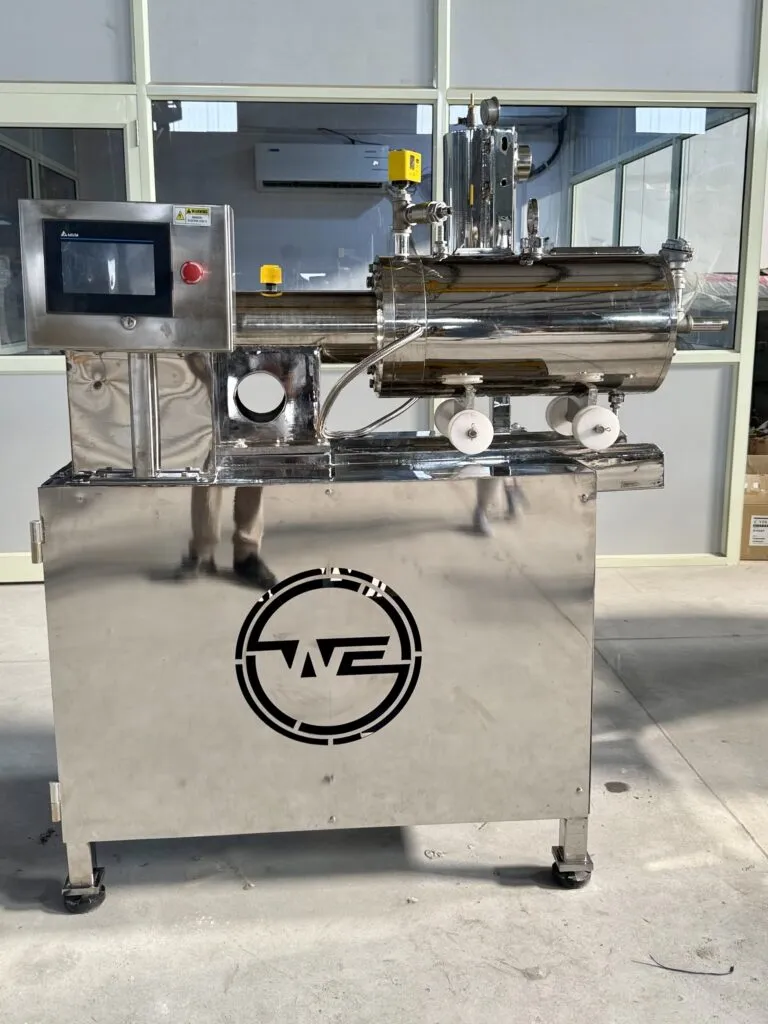
A bead mill, also called a bead milling machine or agitator bead mill, is a wet grinding and dispersion mill. Its grinding chamber holds small, inert beads, typically glass, ceramic or zirconia. A liquid suspension is passed through the chamber while an agitator turns at high speed. The beads collide with each other and with the suspended particles and break them down to progressively finer sizes, often to the nanometre range.
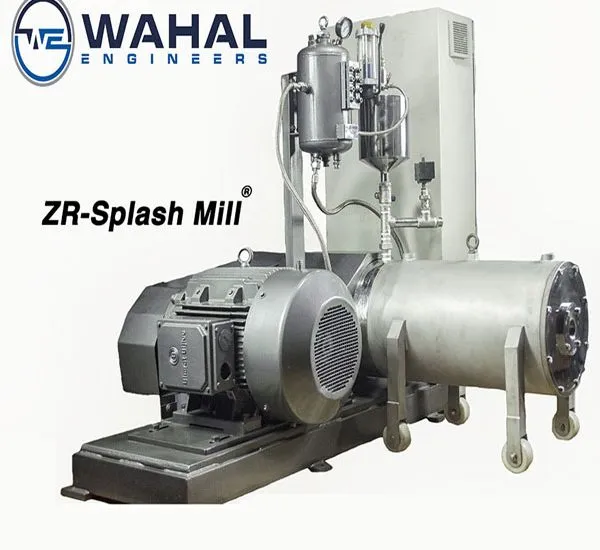
Our bead mills are built as modular wet grinding and dispersion mills for water-based and solvent-based slurries. Our ZR splash series transfers the power of the main motor to the grinding beads effectively and has a well-built agitator disc. The result is a bead mill valued for low power consumption, high performance and fine milling.
What sets our bead mills apart:
- Nano-range grinding. Particle sizes of up to one micron, or 50 nm to 500 nm, can be achieved.
- High flow rates. A special centrifugal separation system allows high flow rates while keeping the degree of grinding intensive.
- Even tough materials. Results in highly efficient micro grinding.
- Heat-sensitive products. Thermal protection is built in for thermo-sensitive products.
- Precise temperature control. A double mechanical seal cooling system complies with API Plan 53A.
How bead milling works
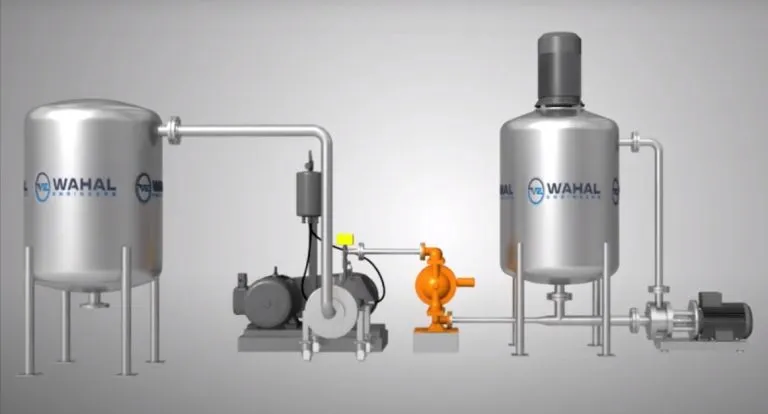
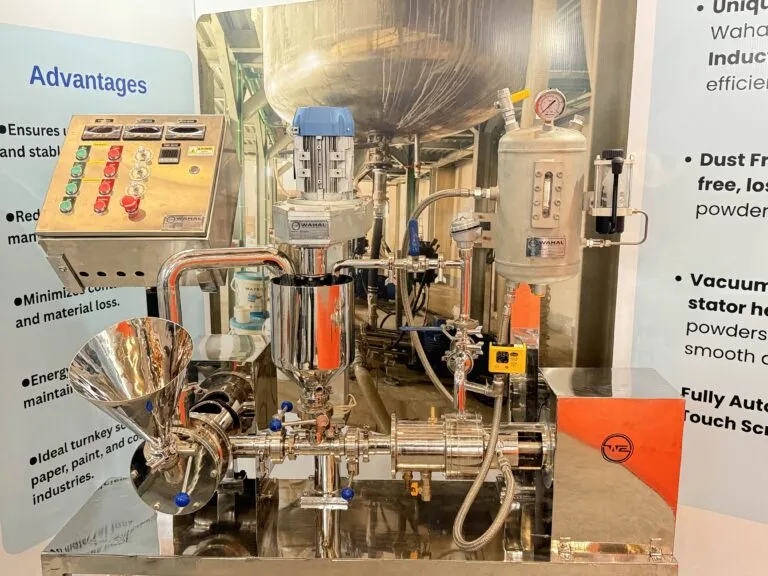
- Premix. The solids are wetted and deagglomerated in the liquid first. Solids of up to 1.5″ can be deagglomerated and dispersed in an inline homogenizer and then fed to the bead mill. For powders, our liquid powder mixer wets them quickly and feeds the bead mill a consistent slurry.
- Feed. The suspension is passed continuously through the grinding chamber.
- Grinding. The agitator (discs or pins) turns at high speed and gives the beads kinetic energy. The beads collide with each other and with the particles, and shear, impact and attrition break the particles down.
- Separation and discharge. The centrifugal separation system keeps flow rates high while the degree of grinding stays intensive.
Bead size, bead material and grinding time are the main settings to optimise, and they can be tested on a laboratory bead mill first.
Bead mill models: WBM series
We build nine WBM models, with chamber volumes from 0.6 to 300 litres and motors from 2 to 200 HP.
| Model | Chamber Volume | Motor Power | Batch Size (per 8-hr shift)* |
|---|---|---|---|
| WBM 0.6 | 0.6 L | 2 HP | 0–10 Liters |
| WBM 1.4 | 1.4 L | 3 HP | 0–50 Liters |
| WBM 7.5 | 7.5 L | 10 HP | 20–100 Liters |
| WBM 17.5 | 17.5 L | 20 HP | 100–500 Liters |
| WBM 32.5 | 32.5 L | 30 HP | 500–1,000 Liters |
| WBM 60 | 60 L | 40 HP | 1,000–2,000 Liters |
| WBM 100 | 100 L | 75 HP | 2,000–5,000 Liters |
| WBM 200 | 200 L | 125 HP | 5,000–10,000 Liters |
| WBM 300 | 300 L | 200 HP | 10,000–20,000 Liters |
*Batch size/throughput figures are based on an 8-hour work shift and are subject to product viscosity and initial and final particle size requirements.
Specifications and options
| Parameter | Range / options |
|---|---|
| Chamber volume | 0.6 to 300 litres |
| Motor power | 2 to 200 HP, by model |
| Particle size | Up to one micron, or 50 nm to 500 nm |
| Slurries | Water-based and solvent-based |
| Materials of construction | Hardened steel, polymer, and ceramic/zirconia coatings, selected based on process composition and product compatibility |
| Shaft sealing and cooling | Double mechanical seal cooling system, API Plan 53A |
| Temperature | Thermal protection for thermo-sensitive products |
| Separation | Special centrifugal separation system |
| Hazardous areas | Explosion-proof models, ATEX and NEMA rated; explosion-proof control panels |
| Pharmaceutical | GMP-compliant models |
| Documents | DQ, IQ and OQ qualification documents; calibration and materials certificates |
| Acceptance tests | Factory Acceptance Test at our factory or Site Acceptance Test at your site, on request |
Types of bead mill we make
Beyond the WBM production range, we make bead mills in other formats. Each has its own page.
| Type | What it is | Page |
|---|---|---|
| Bead mill for pigment grinding | The ZR splash series, 0.6 to 300 L, 50–500 nm | Bead mill for pigment grinding |
| Horizontal bead mill | Agitator bead mill with agitator discs in a grinding container, a completely enclosed system for dispersion and wet grinding; grinding beads of 0.3–2.5 mm | Dyno mill |
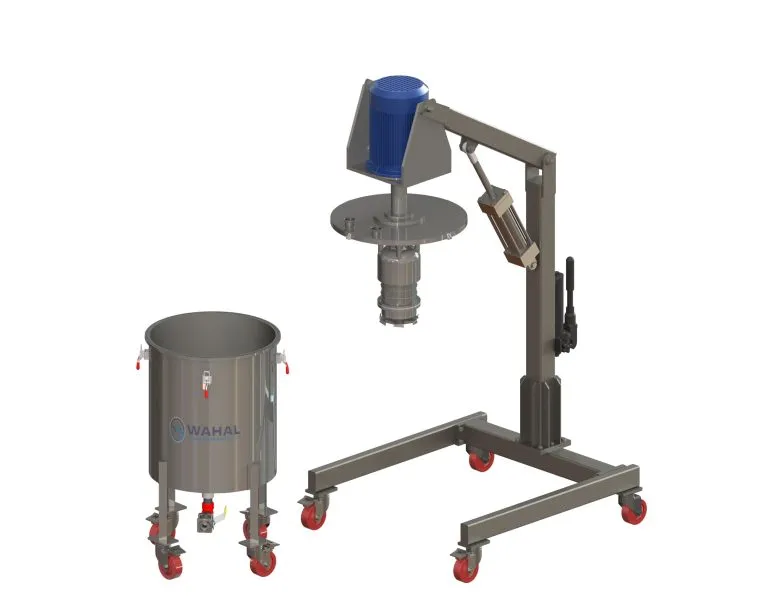
| Basket mill | Wet grinder for medium and low-viscosity liquids and batch production; dispersing and grinding in one vessel; hydraulic lifting | Basket mill |
| Laboratory bead mill | WBM 1.4 with a 1.4 L chamber and 3 HP motor, for lab trials and formulation work; bead sizes 0.1–10 mm | Laboratory bead mill |
Applications
Bead mills are used for water-based and solvent-based slurries in paints, inks, coatings, food and pharmaceuticals.
- Paints and coatings: the bead mill is the fine grinding step in our paint manufacturing plants, grinding pigments to the target particle size for a bead mill for paint duty.
- Inks: after dispersion, pigments need fine grinding to reach nano-level particle sizes for gloss and print quality; see flexible packaging inks and our ink manufacturing plants.
- Pharmaceuticals: wet milling of active pharmaceutical ingredients (APIs) to reduce particle size and improve solubility; see bead milling of API.
- Food: wet milling for a smooth, grit-free texture in chocolate and cocoa mass; see wet grinding for chocolate.
- Calcium carbonate slurries: a liquid powder mixer paired with a ceramic-lined bead mill for paint-grade slurry; see calcium carbonate slurry grinding and PCC wet milling.
- Cell disruption: bead milling breaks the cell walls of microorganisms such as spirulina; see bead milling for cell disruption and bead mills for algae cell disruption.
- Oleoresins: faster, more efficient extraction; see bead mills for oleoresins.
Bead mill or another wet grinding machine?
We also make the other machines that make a product finer. They do different jobs.
- Choose a bead mill to grind solids in water- or solvent-based slurries down to the nano range, for example in paints, inks and coatings. Our bead mills reach up to 1 micron, or 50–500 nm.
- Choose a colloid mill for emulsions, suspensions and pastes; it brings particles and droplets down to a few micrometres.
- Choose a high shear homogenizer for powders to disperse or dissolve, or for continuous inline processing from 15 to 200,000 L/hr. It can also prepare the premix for a bead mill.
- Choose a high-pressure homogenizer for nano-range emulsions such as milk products.
Pharma-compliant design with the Wahal validation concept
The qualification documents DQ, IQ and OQ that are required for validation, or the certificates for the process-relevant machine components such as calibration and materials certificates, are available for all our bead mills. On request, we can also carry out the Factory Acceptance Test in our factory or the Site Acceptance Test at your production site.
Test your product before you buy
There is no better way to test a machine than on your own product. You can run a trial in our fully equipped laboratory and see the result you get and how fast. If you need longer, our rental program lets you keep a machine, pre-configured to your requirements, for as long as you need. See trials and rentals.
For formulation work, our laboratory bead mill (WBM 1.4) uses the same grinding principle as the full WBM range, up to the 300-litre chamber. That makes the bead size, bead material and grinding time set in the lab a directional basis for scale-up, with production-scale validation recommended before full commercial rollout.
Frequently asked questions
What is a bead mill used for?
It grinds and disperses solids in liquid slurries down to fine and nano particle sizes. It is used for paints, inks, coatings, food and pharmaceuticals, and for jobs such as calcium carbonate slurries, API wet milling and cell disruption.
How does a bead mill work?
A liquid suspension passes through a grinding chamber filled with small beads while an agitator turns at high speed. The beads collide with each other and with the particles, and the combined shear, impact and attrition break the particles down. A centrifugal separation system keeps flow rates high.
What particle size can a bead mill reach?
Up to one micron, or 50 nm to 500 nm, can be achieved with our bead mills. The result depends on the viscosity of the product and on its initial and final particle size.
What sizes of bead mill do you make?
Nine WBM models, with chamber volumes from 0.6 to 300 litres and motors from 2 to 200 HP. Batch size per 8-hour shift runs from 0–10 litres on the WBM 0.6 to 10,000–20,000 litres on the WBM 300, depending on viscosity and particle size.
What is the difference between a bead mill and a colloid mill or homogenizer?
A bead mill grinds solids with beads and reaches the nano range. A colloid mill shears emulsions, suspensions and pastes down to a few micrometres. A high shear homogenizer disperses and dissolves powders and can prepare the premix for a bead mill. A high-pressure homogenizer is for nano-range emulsions such as milk products.
Can a bead mill be used for pharmaceutical or hazardous-area work?
Yes. GMP-compliant models are available for pharmaceutical applications, and explosion-proof models are available, ATEX and NEMA rated. DQ, IQ and OQ documents are available for all our bead mills.
How many grinding beads does a bead mill need?
The filling rate is the share of the grinding chamber the beads occupy. For Wahal bead mills it typically ranges from 60% to 80%, depending on mill design, bead size and material viscosity. Our bead fill volume calculation shows the working.
Can I test my product on a bead mill before buying?
Yes. Trials run in our fully equipped laboratory, and our rental program lets you keep a machine for as long as you need. The laboratory bead mill uses the same grinding mechanism as the production range.
Wahal Engineers is a bead mill manufacturer and exporter, with its factory in Murthal, Sonipat, Haryana, India. Tell us your product, batch size and target particle size and we will recommend a machine.