

Why Particle Size Is Everything in Chocolate Texture
Chocolate is a suspension of solid particles — cocoa solids, sugar, and often milk powder — dispersed in cocoa butter fat. The human palate can perceive grittiness from particles as small as 20–25 microns, which means chocolate manufacturers need to reduce these solid components down below that threshold to achieve the smooth, creamy mouthfeel associated with premium chocolate. Coarser grinding, by comparison, produces a gritty or sandy texture that's immediately noticeable and generally considered a quality defect.
Traditionally, this fine grinding has been achieved using five-roll refiners followed by extended conching. Wet milling with a bead mill offers a faster, more efficient alternative or complement to this traditional process.
How Wet Milling with a Bead Mill Reduces Chocolate Particle Size
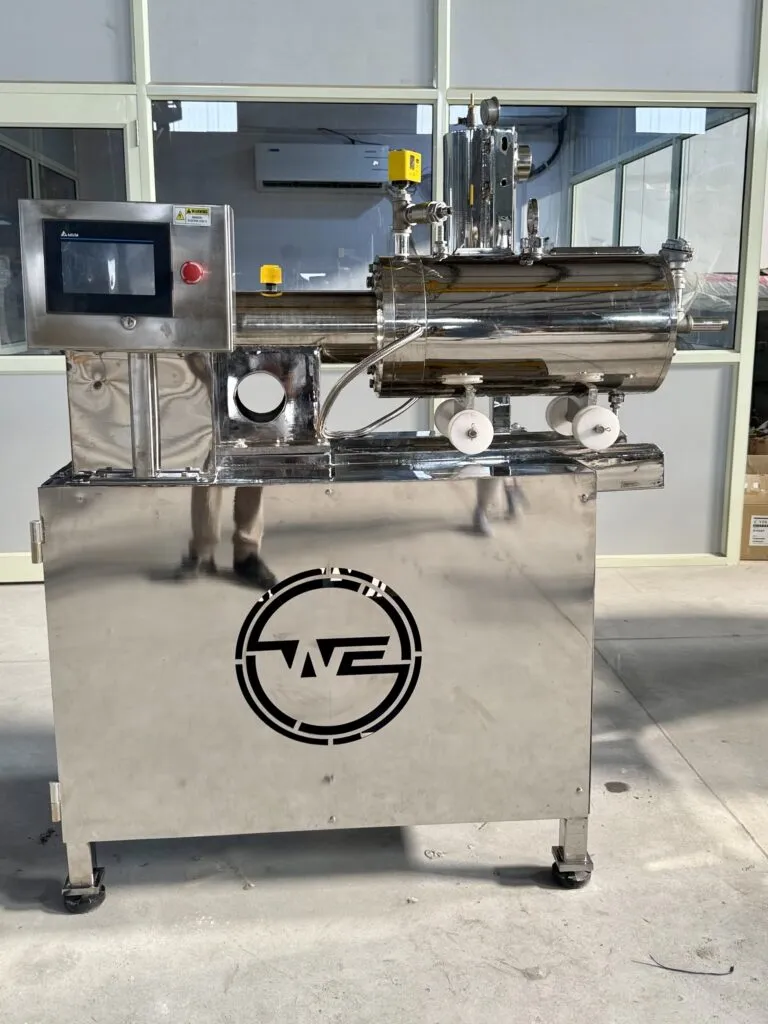
A bead mill achieves fine particle size reduction by continuously circulating the chocolate mass — cocoa solids, sugar, and fat combined into a flowable slurry — through a chamber filled with small grinding beads. As the internal agitator rotates at high speed, the beads collide with suspended particles at high energy, progressively breaking them down to the fine particle size chocolate requires.
Compared to traditional roll refining, wet milling with a bead mill can offer:
- Faster processing cycles, since the continuous grinding action processes the full batch more efficiently than sequential roll passes
- Consistent, repeatable particle size distribution, supporting predictable texture batch after batch
- Flexibility for different chocolate and compound coating formulations, by adjusting bead size, grinding time, and chamber configuration
Key Process Considerations
- Target particle size should be confirmed below the 20–25 micron perceptibility threshold to ensure a smooth, non-gritty final texture
- Grinding media selection matters — bead size and material affect both grinding efficiency and final particle size distribution
- Heat generation during grinding should be managed, since excessive temperature can affect cocoa butter crystallization and final product quality
- Fat content and viscosity of the chocolate mass affect grinding efficiency, and may require formulation adjustments to optimize wet milling performance
Applications Beyond Standard Chocolate
- Cocoa mass and cocoa liquor grinding for base ingredient processing
- Compound chocolate coatings, where cost-effective fat systems still require fine particle size for acceptable texture
- Praline fillings and chocolate-based spreads, where smooth texture is equally critical
- Confectionery products requiring fine particle dispersion of sugar and other solids in a fat-based matrix
Why Choose a Bead Mill for Chocolate Wet Grinding
Wahal Engineers' bead mills are engineered to achieve the fine, consistent particle size reduction that chocolate and confectionery manufacturing demands, offering a faster alternative to conventional refining methods.
- Fine particle size reduction below the taste-perceptible grit threshold
- Consistent, repeatable results batch after batch
- Multiple grinding media options — hardened steel, ceramic, and zirconia coatings selected per process requirement
- GMP-compliant configurations available for food-grade manufacturing
- Decades of in-house engineering experience in wet grinding and dispersion technology across food processing applications
Frequently Asked Questions
What particle size is needed for smooth chocolate texture?
Particle size generally needs to be reduced below 20–25 microns, since the human palate can detect grittiness from particles above this threshold.
Is wet milling a replacement for traditional chocolate conching?
Wet milling with a bead mill primarily addresses particle size reduction, while conching also develops flavor and further refines texture — the two processes can complement each other depending on the production line setup.
Does bead mill grinding generate heat that could affect chocolate quality?
Yes — grinding generates some heat, and this needs to be managed since excessive temperature can affect cocoa butter crystallization behavior, which is important for final product texture and appearance (bloom resistance).
Can this process be used for compound chocolate coatings, not just true chocolate?
Yes — compound coatings that use vegetable fat systems instead of cocoa butter still require fine particle size reduction for acceptable texture, and bead milling is equally applicable.
Wahal Engineers designs and manufactures bead mills and high shear mixing equipment for the pharmaceutical, food, chemical, and cosmetic industries, backed by decades of in-house engineering experience.