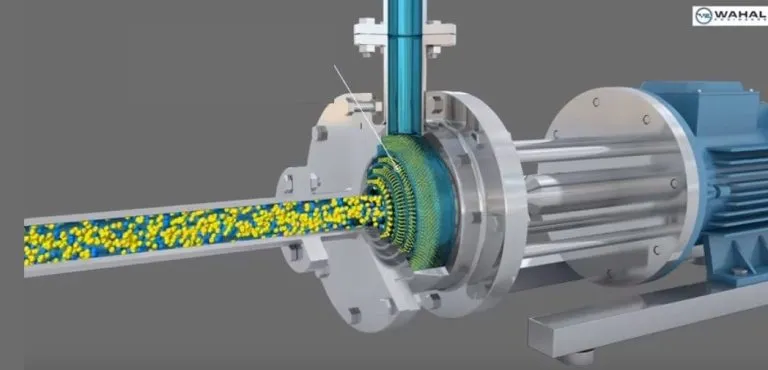
An emulsion is a mixture of two or more liquids that are normally immiscible (unmixable or unblendable). Emulsions are part of a more general class of two-phase systems of matter called colloids. Although the terms colloid and emulsion are sometimes used interchangeably, emulsion should be used when both phases, dispersed and continuous, are liquids. In an emulsion, one liquid (the dispersed phase) is dispersed in the other (the continuous phase). Examples of emulsions include vinaigrettes, milk, mayonnaise, and some cutting fluids for metal working.
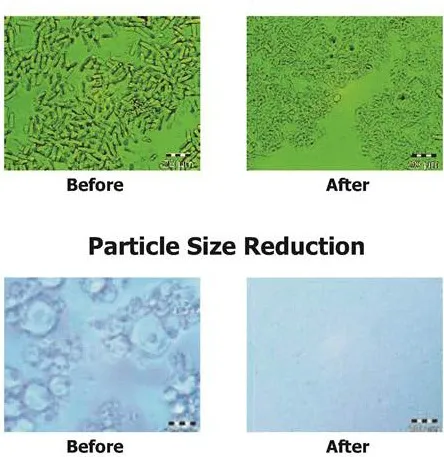
Emulsion droplet sizes vary from 2 to 5 microns and can go down to 0.5 microns in case of liquid emulsions. The word “emulsion” comes from the Latin word for “to milk”, as milk is an emulsion of fat and water, along with other components.
Two liquids can form different types of emulsions. As an example, oil and water can form, first, an oil-in-water emulsion, wherein the oil is the dispersed phase, and water is the dispersion medium. Second, they can form a water-in-oil emulsion, wherein water is the dispersed phase and oil is the external phase. Multiple emulsions are also possible, including a “water-in-oil-in-water” emulsion and an “oil-in-water-in-oil” emulsion.
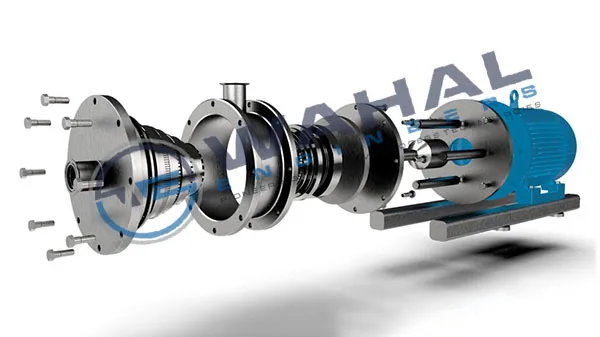
Wahal machines for emulsifying: high shear homogenizers for emulsions in batch and inline designs, the inline homogenizer for continuous lines, the colloid mill for emulsions, suspensions and pastes, and the high pressure homogenizer for nano-range emulsions such as milk products.
Emulsions, being liquids, do not exhibit a static internal structure. The droplets dispersed in the liquid matrix (called the “dispersion medium”) are usually assumed to be statistically distributed.