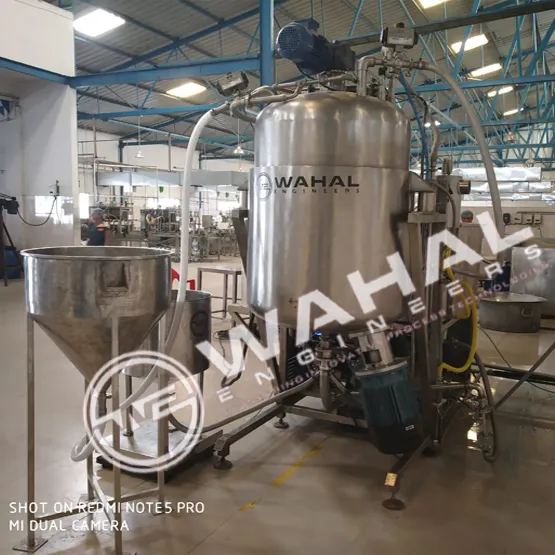
What is an agitator mixer?
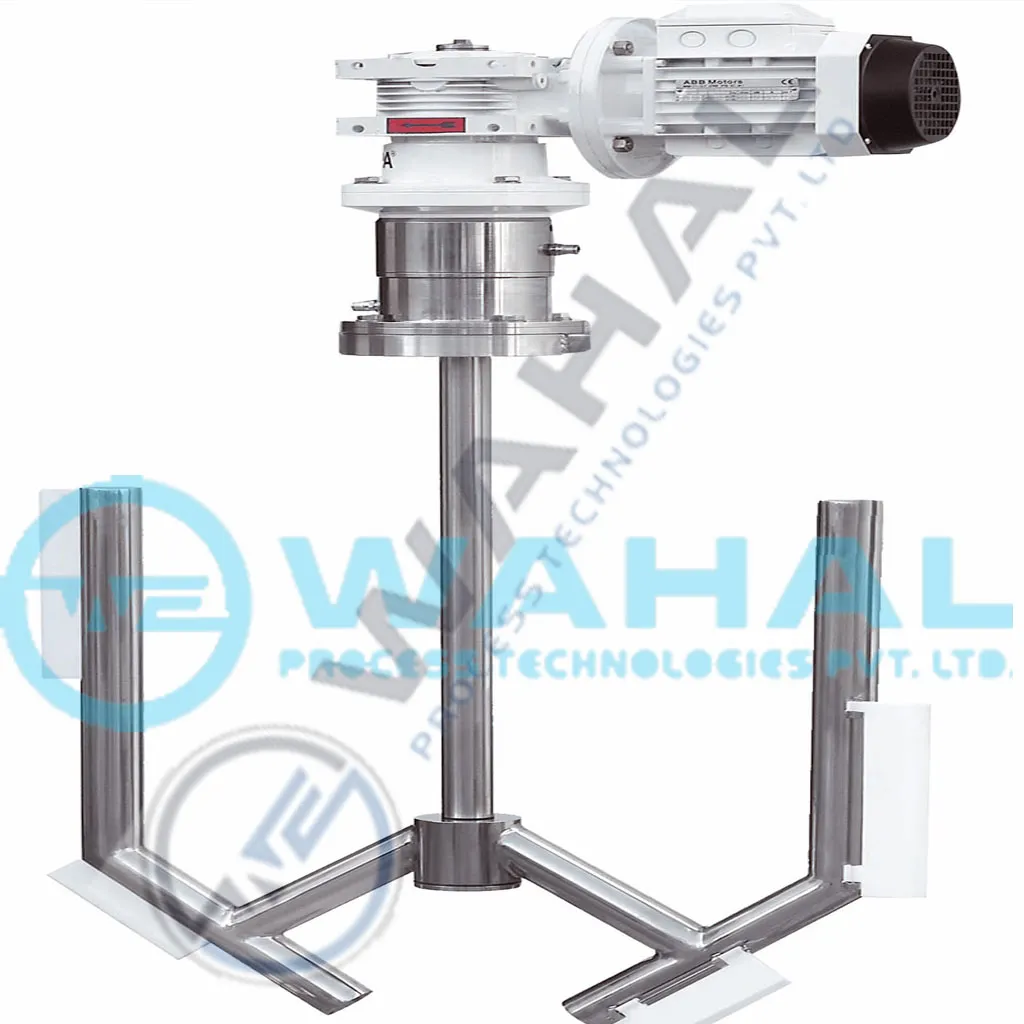
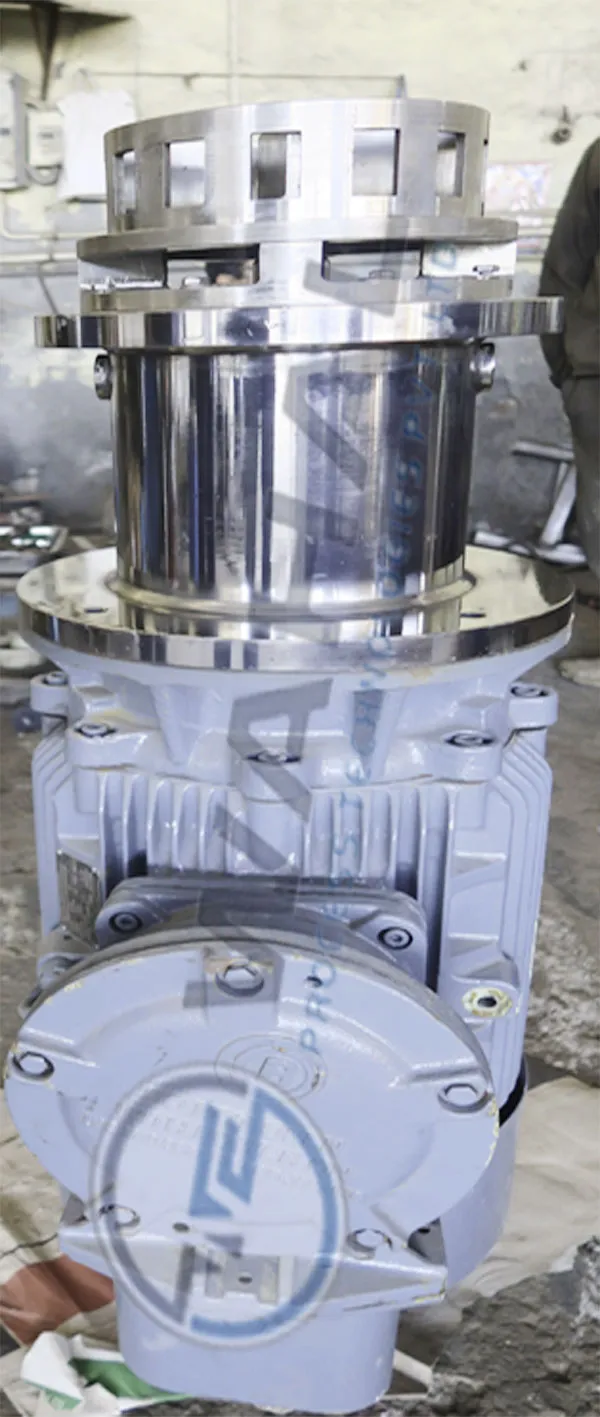
An agitator mixer, also called an industrial or mechanical agitator, is a motor-driven shaft carrying one or more impellers, mounted on a tank or vessel to keep its contents moving. Its main parts are the drive (motor and gearbox), the shaft and its seal, and the impeller.
Agitators do four main jobs, alone or in combination:
- Liquid-liquid mixing: blending liquids of different viscosity or density, for example in emulsification and dilution.
- Solid-liquid mixing: suspending or dissolving solids, in slurries, crystallization and powder wetting.
- Gas-liquid mixing: dispersing gas into a liquid, in aeration, fermentation and hydrogenation.
- Heat transfer: moving product past the jacketed vessel wall for even heating or cooling.
Types of agitators
Agitators are grouped by impeller type, which decides how the liquid moves, and by where the drive is mounted on the vessel.
Anchor agitators
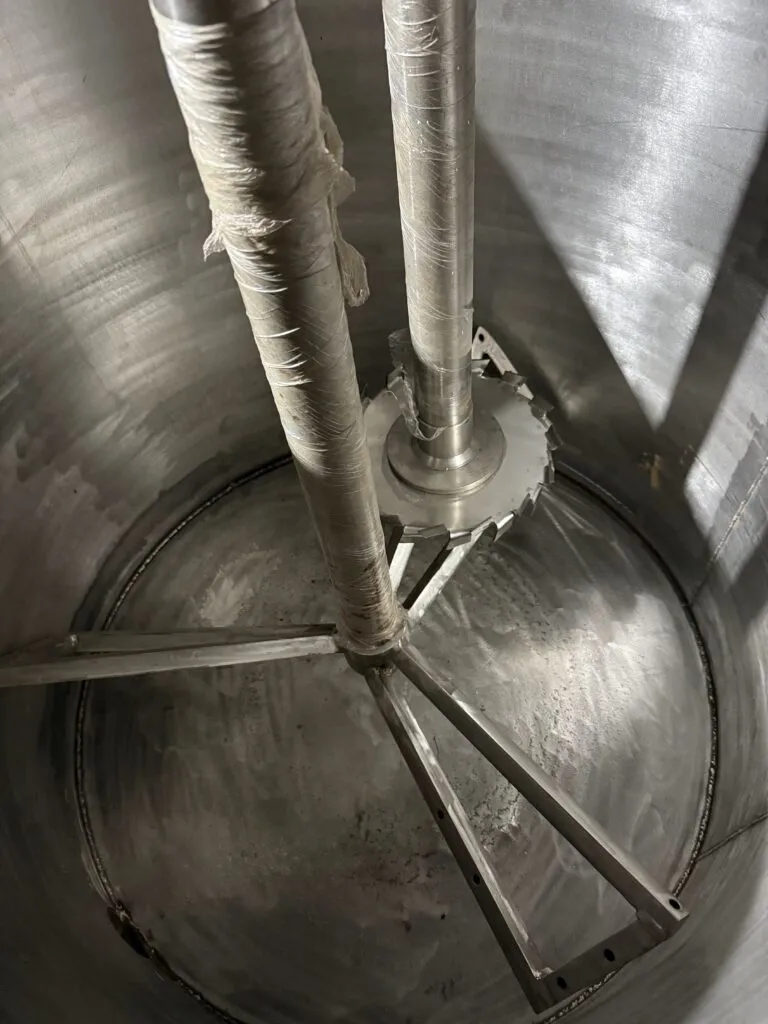
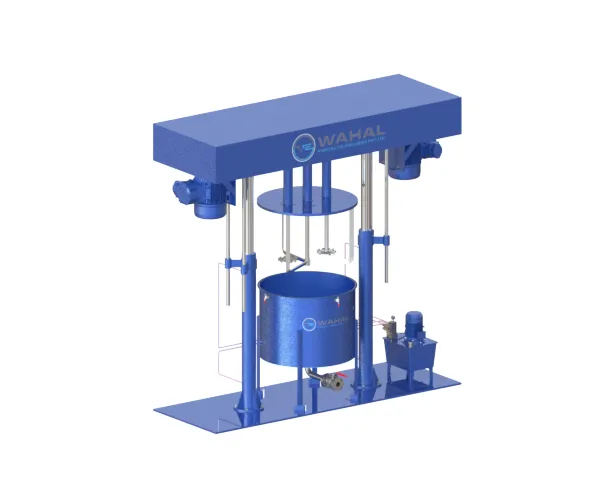
An anchor sweeps close to the vessel wall. It is used for medium- to high-viscosity products, is gentle on shear-sensitive products, and improves heat transfer at the wall. Scrapers can be fitted to the anchor. On our twin shaft dispersers, a slow-turning anchor with Teflon scrapers keeps the walls clean, which cuts material wastage and improves heat transfer to the jacket.
Paddle agitators
Paddle agitators give gentle, low-shear mixing. They are used for medium-viscosity liquids and for keeping solids in suspension.
Propeller agitators
A marine propeller or pitched-blade impeller moves large volumes of low-viscosity liquid with low shear. It is used for high-volume blending and heat transfer.
Turbine agitators
Turbines come in several designs for different duties:
- Pitched-blade and hydrofoil turbines give an axial, down-pumping flow that lifts settled solids off the tank base. They are the standard choice for suspension duty.
- Rushton (disc) turbines have flat radial blades on a disc and strong gas-handling capacity. They are the industry standard for fermenters and reactors. Hollow (concave) blade turbines draw less power and resist flooding better.
- General turbines suit medium-viscosity liquid-liquid reactions and general dispersion.
Helical ribbon and contra-rotary agitators
A helical ribbon keeps viscous products circulating from end to end. For very viscous, dense products such as toothpaste and grease, a contra-rotary (dual-shaft) agitator is used. In our vacuum processing plants, a contra-rotary agitator with perforated blades, scrapers and a vortex breaker mixes the full batch, including material at the walls, without drawing in air.
| Impeller | Product viscosity | Typical duty |
|---|---|---|
| Propeller / pitched blade | Low | High-volume blending, heat transfer, low shear |
| Turbine | Low to medium | Solid suspension (pitched-blade, hydrofoil); gas dispersion (Rushton, hollow blade); liquid-liquid reactions |
| Paddle | Medium | Gentle blending, solid suspension |
| Anchor | Medium to high | Close-clearance mixing, wall heat transfer, shear-sensitive products |
| Helical ribbon | High | End-to-end circulation of viscous, shear-sensitive products |
| Contra-rotary (dual shaft) | Very high, dense | Toothpaste, grease; with scrapers in vacuum plants |
Top, side and bottom entry
- Top entry: the drive sits on top of the vessel. Larger tanks may need more than one impeller on the shaft, and impeller placement and spacing decide the flow pattern and prevent dead zones.
- Side entry: mounted through the tank wall. Side entry agitators suit tanks that are wider than they are tall; large tanks may need several. The mounting angle shapes the flow and helps avoid dead zones. See side entry agitators.
- Bottom entry: the drive sits under the vessel. The impeller is chosen for axial, radial or mixed flow, and the shaft seal must suit the process fluid. Our bottom entry agitators are compact units for laboratory and pilot-scale sanitary vessels.
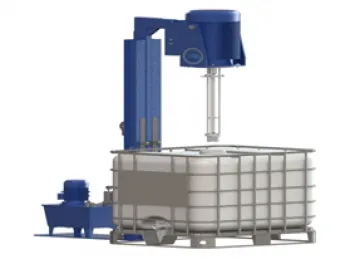
- IBC tote mixers: built for plastic intermediate bulk containers. A hydraulic lift raises the mixer so the container can be taken out after mixing, and smaller models run on wheels. They mix, blend and homogenize light viscous liquids, re-suspend settled solids and dissolve powders. See IBC tote mixers.
How to choose an agitator mixer
Six questions decide the right agitator.
1. What is the mixing duty? Define the goal, whether the process is batch or continuous, how shear-sensitive the product is and how intense the mixing must be. The wrong impeller for the phases causes predictable failures:
| Duty | Goal | Impellers to consider | What goes wrong with the wrong choice |
|---|---|---|---|
| Gas-liquid | Shear gas into fine bubbles and hold them for mass transfer | Rushton or hollow blade turbine, with gas released from a sparge ring under the impeller | The impeller floods and can’t disperse the gas |
| Liquid-liquid | Blend liquids of different viscosity or density | Chosen by viscosity (table above) | Under-mixed batches, longer cycle times, wasted energy |
| Solid-liquid | Suspend or dissolve solids | Pitched-blade or hydrofoil turbine (down-pumping); paddle | Dead zones where solids settle and cake |
| Heat transfer | Even heating or cooling at the jacket | Anchor with scrapers | Product left on the walls, slower heat transfer |
- 2. How does the fluid behave? Viscosity is the critical factor: thicker products need more power and torque and a different impeller. Density affects motor power and impeller design. Note any non-Newtonian behaviour, and for solids the particle size, settling velocity and abrasiveness.
- 3. What vessel is it going into? Diameter, height-to-diameter ratio and internals such as coils, baffles and dip tubes all change the flow. Baffles break vortex flow and improve turnover. Choose top, side or bottom entry to suit the vessel and the process.
- 4. What are the operating conditions? Temperature, pressure, pH, sterility and any hazardous-area rating decide the materials, the seals and the motor. Materials must resist corrosion and avoid contaminating the product; the mechanical seal must suit the fluid, temperature and pressure; hazardous duty needs explosion-proof motors and special seals.
- 5. How big a drive? Choose a motor and gearbox, or a direct drive, for the power and speed the duty needs. Don’t oversize: an oversized agitator wastes energy and can damage the product. Don’t undersize: the batch will be under-mixed. Allow for future changes in the process, and compare power consumption between options.
- 6. Has the design been proven? Check it with CFD, then with a pilot-scale test on your own product.
How CFD checks an agitator design
Mixer performance depends on variables that interact: viscosity, impeller geometry, speed, tank shape and baffle placement. They are hard to estimate by hand or from generic sizing charts. We model your fluid in your vessel before anything is fabricated:
- Flow patterns: dead zones and velocity patterns in the actual vessel, not a generic model.
- Power and torque: shaft loads from real fluid properties, so the motor and drive are right-sized.
- Solid suspension: particle concentration across the whole vessel, not just near the impeller.
- Gas dispersion: bubble distribution, gas hold-up and flooding risk.
- Fewer physical trials: impeller and geometry changes are tested virtually first.
We pair CFD with pilot-scale testing to confirm the impeller, vessel geometry and baffle placement. See CFD analysis.
Mixing tanks with agitators and complete systems
Need a complete mixing tank with agitator rather than an agitator for an existing tank? We supply both.
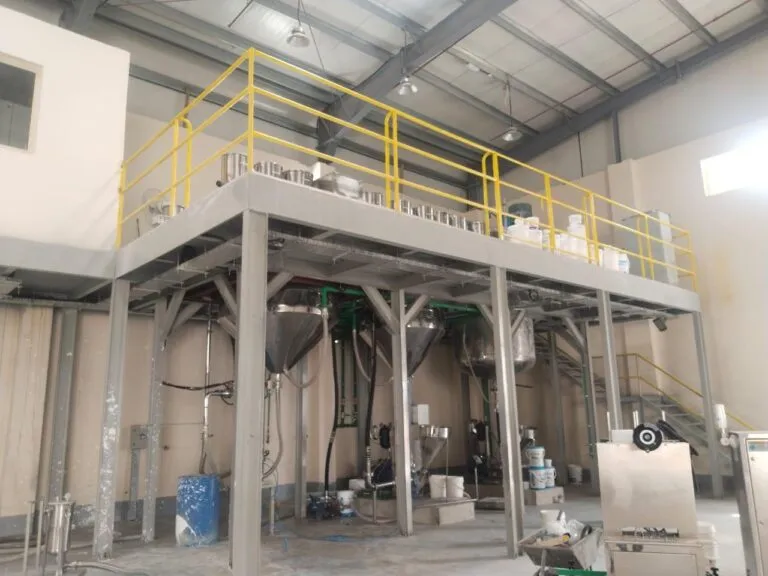
- Process vessels: supplied stand-alone (stationary or mobile) or as automated process units, delivered as working modules and installed on site. They include agitators, homogenizers, metering and control, valves and pipework, with options for hazardous environments. See pharmaceutical vessels.
- Vacuum processing plants: a vacuum-tight mixing tank, a contra-rotary scraper agitator with vortex breaker, an inline high shear mixer and a triple jacket for heating and cooling, in one system.
- Twin and multi-shaft dispersers: a slow anchor with scrapers works alongside a high-speed disperser blade for high-viscosity products. Multi-shaft designs use two or more independently driven agitators under vacuum.
- Milk cooling and storage tanks: SS316L insulated tanks with agitators and temperature control.
When an agitator is not enough
An agitator moves the bulk of the liquid but applies little shear. Our process pages note where that falls short:
- Liquids of very different viscosities don’t blend satisfactorily with an agitator alone.
- Powders float on the surface and form lumps or “fisheyes”.
- Dense solids such as rubber bales, resin blocks and polymer solids can’t be torn apart.
- With polymers such as viscosity index improvers, top-entry agitators leave floating lumps, long hydration times and dead zones at the tank bottom.
For these jobs, add high shear: a high shear homogenizer, a bottom mounted homogenizer, a powder induction mixer or a high speed disperser. Many of our systems combine the two, with an agitator for bulk movement and a high shear mixer for dispersion.
Where our agitators are used
Industrial agitators are used wherever liquids, slurries or suspensions must be blended consistently.
- Chemicals and petroleum products, dyes and pigments, salt and sugar solutions
- Paints, varnishes and adhesives
- Pharmaceuticals, cosmetics and hand sanitizing gels
- Food and beverages, including milk cooling and storage
- Water and wastewater treatment, water purification and flocculation
- Fermentation, aeration and hydrogenation; crystallization and slurries
- Pilot plants and research
Test your product before you buy
Run your product at pilot scale with Wahal to compare agitator configurations before you finalise the design. Trials run in our fully equipped laboratory, and our rental program lets you keep a machine, pre-configured to your requirements, for as long as you need. See trials and rentals.
Frequently asked questions
What is an agitator machine used for?
An agitator keeps the contents of a tank moving. It blends liquids, keeps solids in suspension or dissolves them, disperses gas into liquids and improves heat transfer at the vessel wall. Typical users are chemical, pharmaceutical, food, cosmetic, paint and water treatment plants.
What is the difference between an agitator and a mixer?
An agitator is one kind of mixer: a shaft and impeller that moves the bulk of the liquid in a tank with relatively little shear. When a product needs emulsifying, powder dispersion or particle size reduction, a high shear mixer is used instead of, or alongside, the agitator. Agitators alone struggle to blend liquids of very different viscosities or to wet powders without lumps.
What are the main types of agitators?
By impeller: anchor, paddle, propeller, turbine (pitched-blade, hydrofoil, Rushton), helical ribbon and contra-rotary. By mounting: top entry, side entry and bottom entry, plus IBC tote mixers for intermediate bulk containers.
Which agitator is best for high-viscosity products?
Anchor and helical ribbon agitators, which are also gentle on shear-sensitive products. For very viscous, dense products such as toothpaste and grease, a contra-rotary (dual-shaft) agitator, often with scrapers on the vessel wall.
When should I use a side entry agitator?
Side entry agitators suit tanks that are wider than they are tall. Large tanks may need more than one, and the mounting angle is set to avoid dead zones. See side entry agitators.
How is an agitator sized?
From the mixing duty, the fluid properties and the vessel geometry. We use CFD to predict power and torque, so the motor and drive are neither oversized, which wastes energy and can damage the product, nor undersized, which leaves the batch under-mixed. The result is then confirmed in a pilot test.
Can you supply agitators for hazardous or hygienic duty?
Yes. We fit explosion-proof motors and special seals for hazardous materials, IBC mixers come in hygienic and explosion-proof models, and our process vessels have options for hazardous environments. We manufacture ISO and GMP-compliant mixers, and our manufacturing is ISO-certified.
Do you also supply the mixing tank?
Yes. Vessels are supplied stand-alone or as complete process modules with agitators, homogenizers, controls and pipework, installed on site.
Can I test before buying?
Yes. You can run pilot-scale tests at Wahal with different agitators, or rent a pre-configured machine. See trials and rentals.