Utilizing these high-shear mixers directly at a Lube Oil Blending Plant provides:
| Step | Action | Equipment Involved |
| 1 | The tank is fed with base oil; solid polymer blocks are added when oil reaches approx. | Dissolving Tank |
| 2 | The mixer creates a vortex, drawing blocks into the rotor-stator to be reduced to small particles. | Bottom Disintegrator |
| 3 | Particles are pumped through the secondary mixer and recirculated into the tank until completely dissolved | In-line Mixer |
| 4 | Once fully dissolved and homogenized, the units stop, and the product is ready for transfer. | Discharge System |
Applications in Lubricants
Overview of Mixing Technology
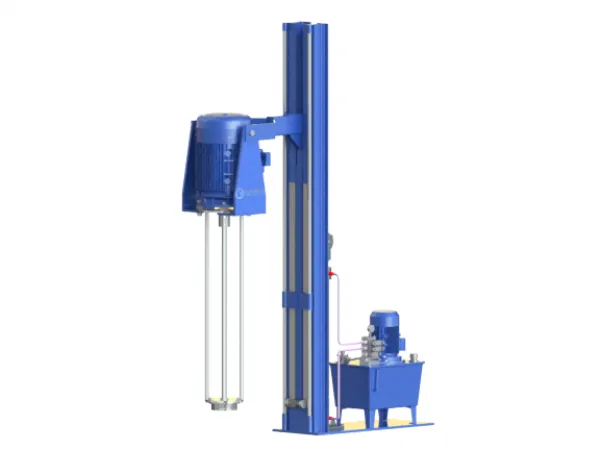
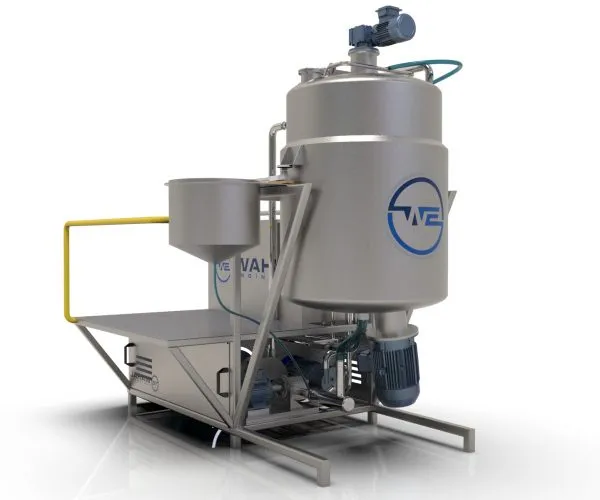
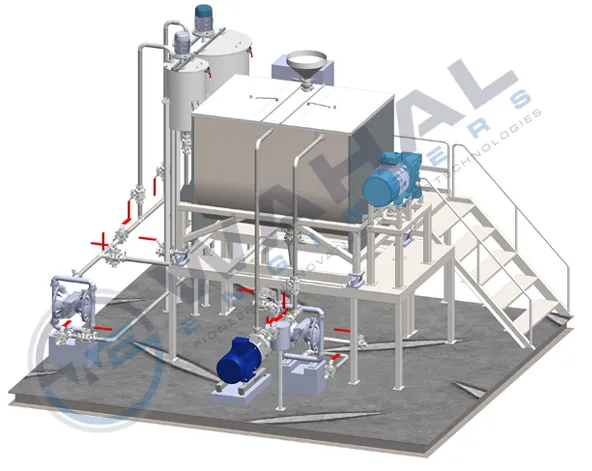
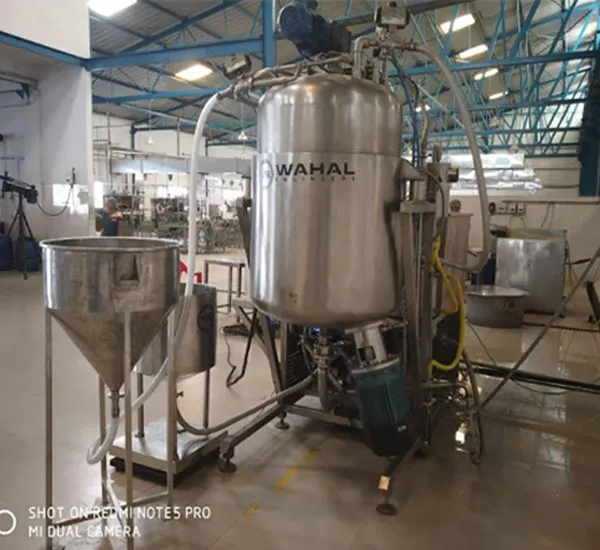
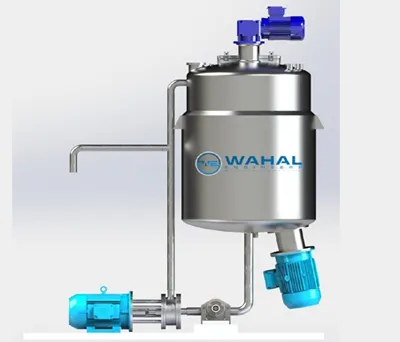
The Wahal high-shear dissolver offers a dual function of disintegrating and homogenizing Viscosity Index (VI) improvers in a single batch operation. This is achieved through the combined action of a bottom high-shear mixer and an in-line high-shear mixer, both of which utilize a rotor-stator design.
Features and Performance
Disintegration without Shredding: The main mixer is installed at the bottom of the dissolving tank. It creates a vortex that draws solid polymer blocks (up to 400 mm) from the surface directly into the rotor-stator
Intense Mechanical Mixing: Due to the high shearing rate, manual shredding or cutting of polymer blocks is unnecessary, even for hard polymers
Total Homogenization: Small particles produced by the bottom unit are pumped through the in-line mixer for final homogenization to achieve optimal product quality.
Thermal Efficiency: Dissolving is assisted by temperature control.
Operating Principle
The process follows a four-step sequence to ensure solid polymers are fully dissolved into base oils:
Applications in Lubricants
VI improvers are essential polymers used in multigrade lubricants to control viscosity relative to temperature. Utilizing these high-shear mixers directly at a Lube Oil Blending Plant provides:
Cost Savings: Limits transported volume and reduces inventory costs
HSE Compliance: Eliminates dusty and unsafe shredding operations
Flexibility: Motor speeds are adapted to specific product types and volumes