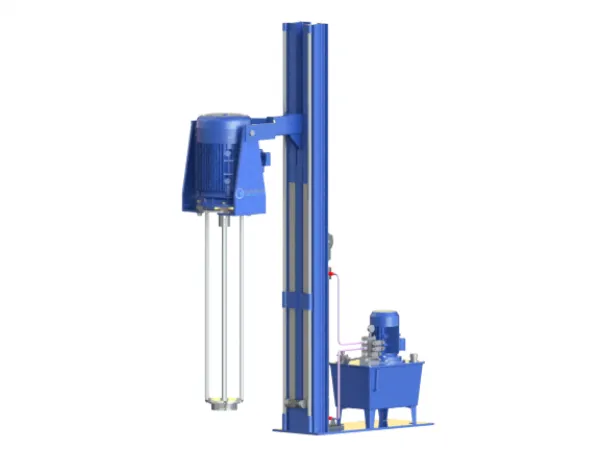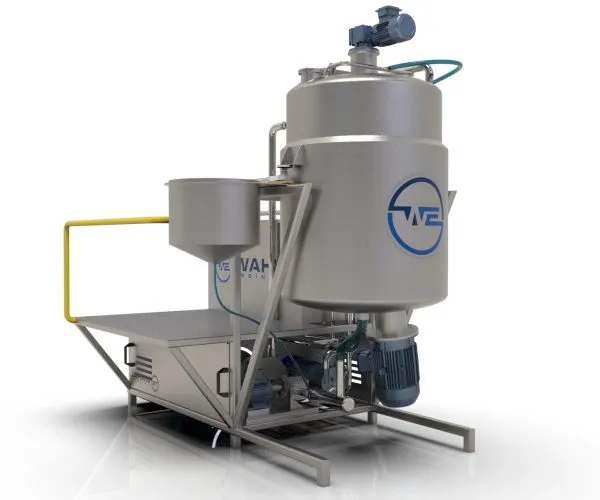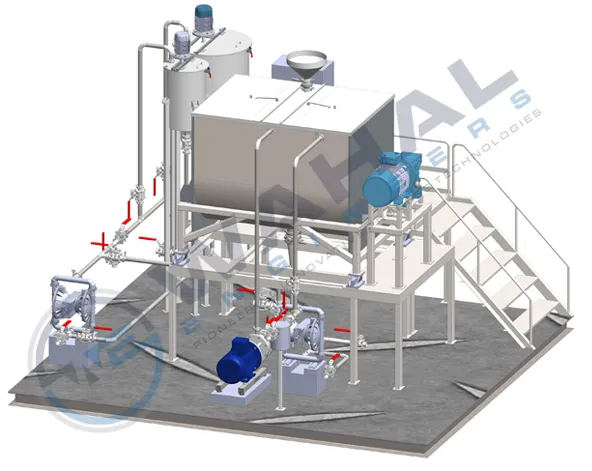
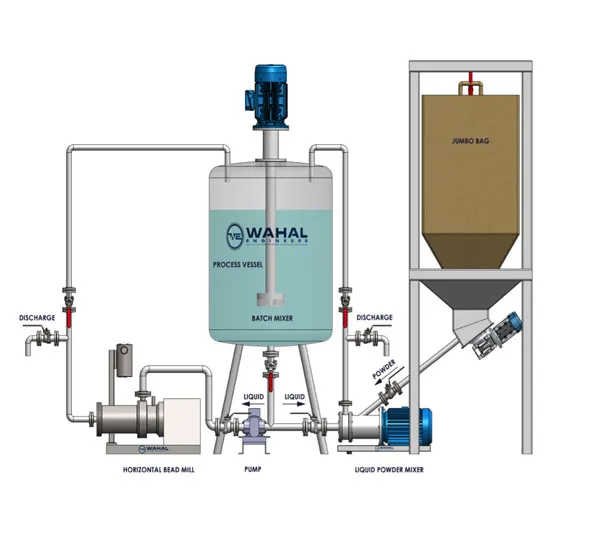
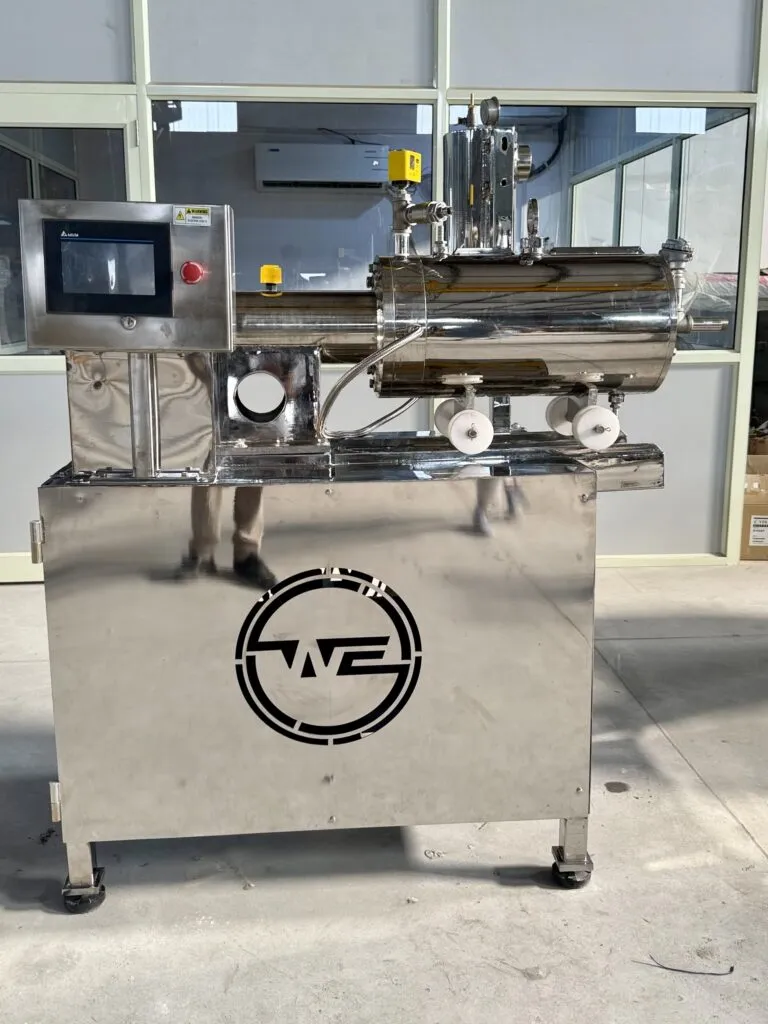
A typical turnkey beta-carotene micro-encapsulation line includes:
- Raw material charging system
- Wahal high shear homogenizer for pre-dispersion
- Wahal bead mill for wet nanomilling
- Holding tank with agitation
- Inline filtration (if required)
- Spray dryer system
- Powder collection and packaging
Each step is engineered for:
- Controlled temperature
- Oxygen management
GMP compliance
Why Wet Milling is Superior for Beta-Carotene Encapsulation
Compared to solvent-based encapsulation:
- No organic solvent handling
- Lower regulatory complexity
- Higher scalability
- Better control over particle size
- Cost-effective continuous production
Wet milling with Wahal equipment enables a cleaner, scalable, and food/pharma-compliant process.
Wahal’s Turnkey Project Execution Capabilities
Wahal offers complete turnkey solutions for beta-carotene micro-encapsulation plants, including:
1. Process Design & Engineering
Particle size target definition
- Stabilizer system optimization
- Heat load calculation
Media selection (zirconia preferred for nutraceutical grade)
Equipment Integration
High shear homogenizers
- Bead mills
- Spray drying systems
- Pumps, tanks, piping
- Automation and control panels
Automation & Process Control
- PLC-based recipe management
- Temperature and flow monitoring
- Controlled recirculation loops
- GMP documentation
4. Commissioning & Validation
Trial runs
- PSD verification
- Spray drying optimization
- Encapsulation efficiency testing
From pilot scale to full commercial production, Wahal ensures scalability without compromising quality.
Technical Advantages of Wahal Systems
✔ Efficient cooling to protect heat-sensitive beta-carotene
✔ Optimized bead dynamics for faster milling
✔ Reduced contamination risk
✔ Energy-efficient designs
✔ Hygienic construction for food & pharma
Conclusion
Micro-encapsulation of beta-carotene via wet milling is a precise balance of dispersion, nanomilling, and spray drying optimization. Wahal high shear homogenizers ensure uniform pre-dispersion, while Wahal bead mills achieve controlled particle size reduction essential for stable nanosuspensions.
The result is:
- Higher bioavailability
- Better spray drying efficiency
- Improved encapsulation yield
- Enhanced product stability
With end-to-end turnkey execution capabilities, Wahal delivers scalable, compliant, and performance-driven solutions for nutraceutical and food manufacturers.
If you are planning a beta-carotene micro-encapsulation project, integrating advanced wet milling technology is not just an option — it is the foundation of process success.
Micro-Encapsulation of Beta-Carotene via Wet Milling | Wahal High Shear Homogenizers & Bead Mills
Micro-encapsulation of beta-carotene has become a critical process in the nutraceutical, food, and pharmaceutical industries. Because beta-carotene is highly hydrophobic, light-sensitive, and prone to oxidation, converting it into a stable, spray-dryable form requires precision particle engineering.
This is where Wahal’s high shear homogenizers and bead mills play a transformative role. By combining controlled wet milling with optimized dispersion and encapsulation techniques, Wahal delivers complete turnkey solutions that enhance bioavailability, stability, and spray drying efficiency.
Why Beta-Carotene Needs Micro-Encapsulation
Beta-carotene in its raw form:
- Is practically insoluble in water
- Exists as crystalline particles
- Aggregates easily
- Degrades under oxygen and light exposure
For commercial applications such as functional beverages, premixes, capsules, and fortified foods, beta-carotene must be converted into a stable nanosuspension before spray drying into microcapsules.
Wet milling is the most efficient and scalable way to achieve this.
Role of Wahal High Shear Homogenizers in Beta-Carotene Wet Milling
Before bead milling begins, proper pre-dispersion is critical.
1. Uniform Pre-Dispersion
Wahal high shear homogenizers create:
- Fine primary dispersion of beta-carotene in aqueous stabilizer systems
- Uniform distribution of emulsifiers (lecithin, Tween, gum arabic, maltodextrin)
- Controlled wetting of hydrophobic particles
This ensures:
- Reduced agglomeration
- Lower bead mill load
Faster achievement of target particle size
2. Improved Stabilizer Adsorption
High shear energy helps coat beta-carotene crystals with stabilizers early in the process. This minimizes re-crystallization and prepares the system for efficient nanomilling.
In short:
Better pre-dispersion = Faster milling + Narrower particle size distribution (PSD)
Role of Wahal Bead Mills in Micro-Encapsulation via Wet Milling
Once pre-dispersed, the slurry enters the bead mill — the core particle engineering stage.
1. Particle Size Reduction to Submicron Range
Wahal bead mills:
Reduce beta-carotene from micron-sized crystals to 100–500 nm
Increase surface area dramatically
Enable improved bioavailability
Smaller particles enhance intestinal absorption and dispersion stability.
2. Controlled Nanomilling with Narrow PSD
Wahal bead mills provide:
- Optimized bead sizes (0.1–0.5 mm zirconia media)
- High energy density
- Efficient cooling systems
- Controlled residence time
The result
- Narrow particle size distribution
- Reduced sedimentation
- Stable nanosuspension
For spray drying, uniform PSD directly impacts powder quality.
3. Enhanced Spray Drying Efficiency
Fine and stable nanosuspension produced by Wahal systems leads to:
- Better atomization
- Uniform droplet formation
- Reduced nozzle clogging
- Higher encapsulation efficiency
- Improved powder flow properties
Because particles are smaller and uniformly stabilized
- Surface deposition during spray drying is reduced
- Encapsulation matrix forms evenly
- Oxidative degradation is minimized
This translates into:
- Higher yield
- Improved color stability
- Longer shelf life
- Better dispersibility in final application