What is a pressure vessel?
A pressure vessel is a closed container built to hold a gas or liquid at a pressure substantially higher, or lower, than atmospheric. "Unfired" means it is not heated by a flame or by combustion gases, which separates it from a boiler.
Pressure vessels are built to codes because of stored energy. Compressed gas in particular can release it suddenly if a shell, nozzle or weld fails. So every part, from shell and heads to nozzles, flanges and supports, is calculated for its design pressure and temperature, made from traceable material, welded to qualified procedures and tested before use.
Types of pressure vessel
By duty, most pressure vessels in a process plant fall into four groups:
- Storage vessels keep a liquefied gas, a volatile solvent, or a product under a nitrogen blanket at pressure.
- Receivers sit after a compressor or a vacuum pump. An air receiver evens out the supply and lets moisture drop out; a vacuum receiver collects liquid and must resist the atmosphere pressing in.
- Process pressure vessels hold, transfer or condition a product inside the process: buffer and holding vessels, jacketed vessels that also heat or cool, and vessels emptied by gas pressure instead of a pump. Add an agitator and a reaction, and it becomes an SS reactor.
- Autoclaves combine pressure with heat for sterilising, curing or running a reaction under gas; a stirred autoclave for hydrogen is a hydrogenation reactor.
Vertical or horizontal, and the choice of heads
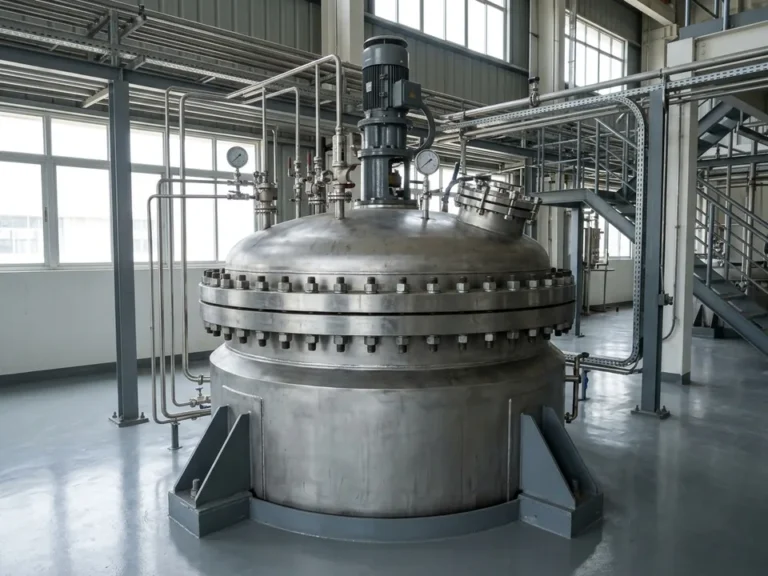
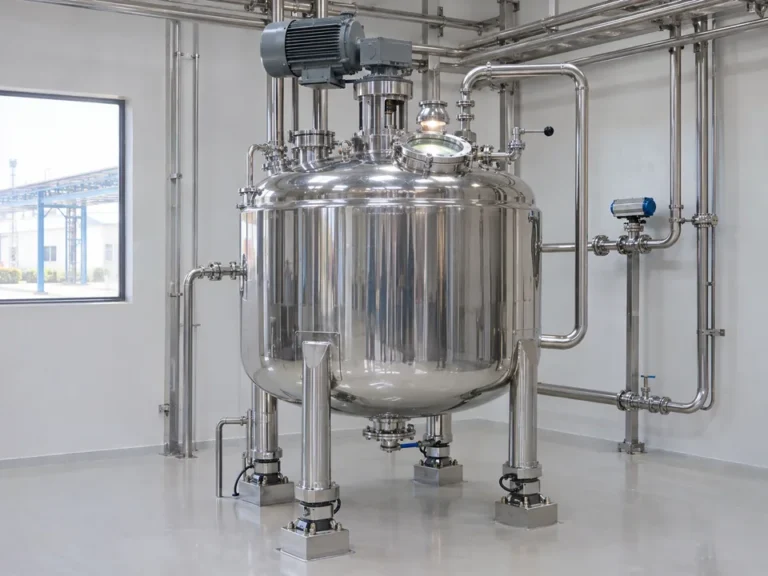
- Vertical vessels take less floor space, drain fully through the bottom head and suit process duty and solids. They stand on legs, hang from lugs on a structure, or sit on a skirt when tall.
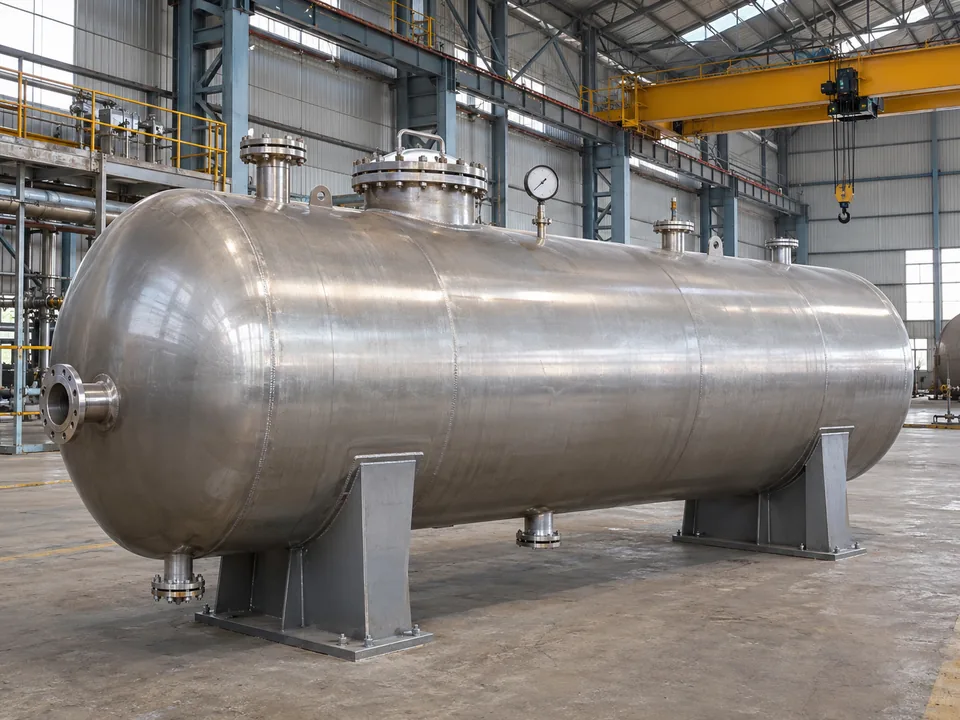
- Horizontal vessels suit large storage volumes where height is limited, and give a wide liquid surface for separating gas from liquid. They rest on two saddles.
The heads (dished ends) are chosen for pressure and cost:
- 2:1 ellipsoidal heads are the common choice and need about the same thickness as the shell.
- Torispherical heads are shallower and cheaper to form but need more thickness, so they suit lower pressures.
- Hemispherical heads need about half the shell thickness and are used at the highest pressures, at a higher forming cost.
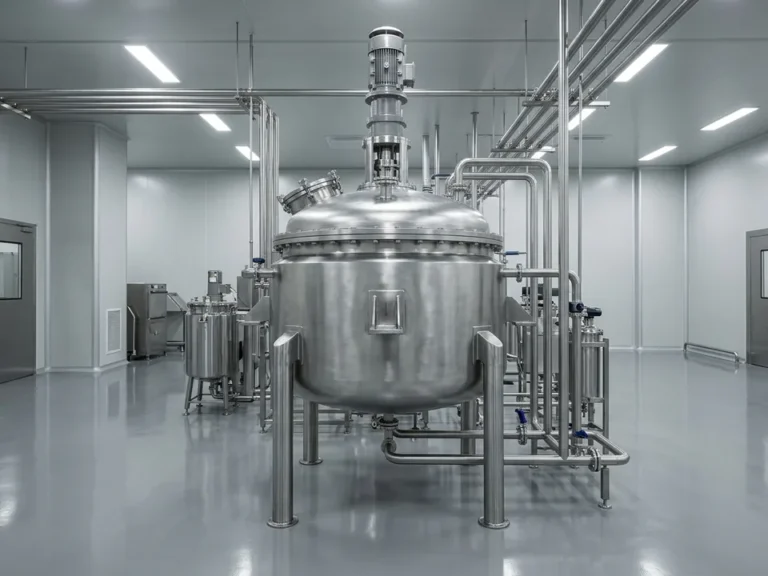
Our vessels are cylindrical with dished ends and come on lugs or legs, with a sealed lid and manhole, sight glasses with wiper and light, and a jacket with insulation where the product must be heated or cooled.
Design codes and rules in India
Pressure vessels in India are usually designed to ASME Section VIII Division 1, or to IS 2825, the Indian standard code for unfired pressure vessels. Vessels exported to the European Union fall under the Pressure Equipment Directive (PED). Vessels that store compressed or liquefied gases, such as LPG or ammonia, also come under the Static and Mobile Pressure Vessels (Unfired) Rules, which PESO administers.
The code, design pressure and temperature, corrosion allowance and inspection agency are normally fixed in the buyer's data sheet. Tell us which apply to your plant and we'll design to them.
Testing and inspection
Codes set how a vessel is checked before it enters service:
- Weld examination. Seams are examined by radiography, ultrasonic or dye-penetrant testing. How much of each seam is examined is tied to the joint efficiency used in the design calculation.
- Hydrostatic test. The finished vessel is filled with water and taken above its design pressure. Under ASME Section VIII Division 1 the standard test is at least 1.3 times the maximum allowable working pressure, corrected for temperature. A pneumatic test is used only where water can't be.
- Records. Material certificates, welding procedures and welder qualifications, test reports and the nameplate data go into the vessel's dossier.
Wahal checks every weld on its stainless steel vessels.
Pressure vessels for pharmaceutical plants
In pharmaceutical plants, many vessels that look like plain process tanks are pressure vessels:
- Steam sterilisation in place (SIP) at about 121 °C puts saturated steam pressure on the shell, and cooling afterwards can pull a vacuum, so the vessel is rated for both.
- Sterile liquids are often moved by nitrogen or sterile air pressure instead of a pump.
- Internal surfaces are polished to a specified roughness (Ra), with sanitary connections that drain fully.
Our pharmaceutical vessels, pressure vessels among them, are built in high-alloy stainless steel and can be supplied stand-alone, stationary or mobile, or as process modules with agitators, valves and controls, installed on site, with options for hazardous environments. For preparation, compounding and sterile process vessels, see pharmaceutical vessels.
Pressure, size and price
We build pressure vessels for design pressures up to 100 bar and capacities up to 150,000 litres. The two limits don't usually meet in one vessel: wall thickness grows with both pressure and diameter, so in practice the largest vessels are designed for moderate pressure, and the highest pressures are reached on smaller diameters.
Wahal fabricates at its works in Bhigan (Murthal), Sonipat, Haryana; the head office is in New Delhi.
The price depends on capacity, design pressure and temperature, material and plate thickness, the code and inspection required, nozzles and supports, any jacket or insulation, and the internal finish. Price on request.
Frequently asked questions
What is a pressure vessel?
A closed container designed to hold a gas or liquid well above or below atmospheric pressure, such as a storage vessel, receiver, autoclave or pressurised process vessel.
What is the difference between a pressure vessel and a storage tank?
A storage tank works at or close to atmospheric pressure and is built to tank standards such as API 650. A pressure vessel is designed, built and tested to a pressure vessel code for a stated design pressure.
Which code is used for pressure vessels in India?
Usually ASME Section VIII Division 1 or IS 2825. Vessels that store compressed or liquefied gases also come under the SMPV(U) Rules, administered by PESO.
How is a pressure vessel tested?
Its welds are examined, then a hydrostatic test with water takes the finished vessel above its design pressure before it goes into service.
Do pharmaceutical vessels need to be pressure vessels?
Yes, if they are steam-sterilised in place, emptied by gas pressure or run under vacuum; they are then rated for that pressure and vacuum.
What pressure and size of vessel can Wahal build?
Up to 100 bar design pressure and up to 150,000 litres capacity, each vessel sized for its duty.
How much does a pressure vessel cost?
It depends on size, pressure, material, code, inspection and fittings. Price on request.