What is an SS reactor?
An SS reactor, or stainless steel reactor, is a closed vessel with an agitator and a heat-transfer surface, built to run a chemical reaction or a temperature-controlled process one batch at a time. In Indian chemical and pharmaceutical plants it is usually called an SSR, to tell it apart from a GLR (glass-lined reactor), and its size is quoted in kilolitres: a 5 KL SSR is a 5,000-litre stainless steel reactor.
Unlike an open mixing tank, a reactor is sealed. It can hold solvent vapour and send it to a condenser, and it can run under vacuum or under pressure. The jacket or coil gives the temperature control most reactions need: heat to get them going, then cooling to keep an exothermic batch from running away.
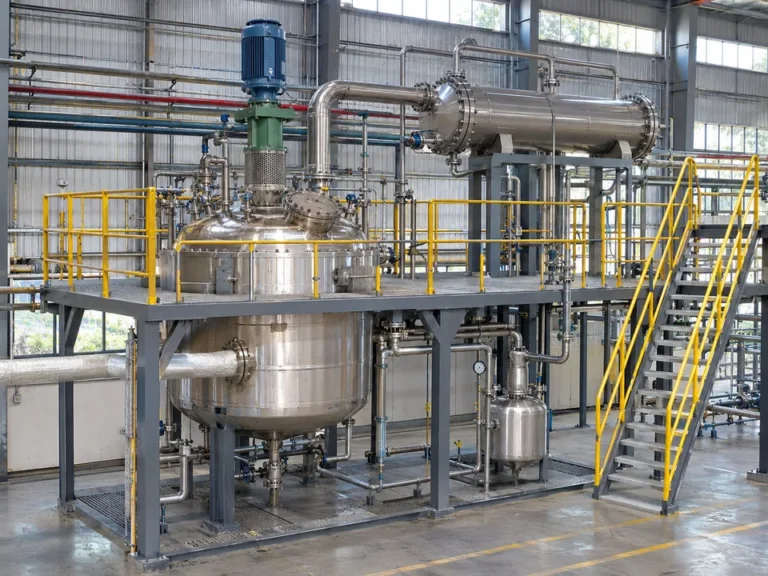
Like our other process vessels, an SS reactor can be supplied on its own or as a process module with valves, controls and pipework, installed on site.
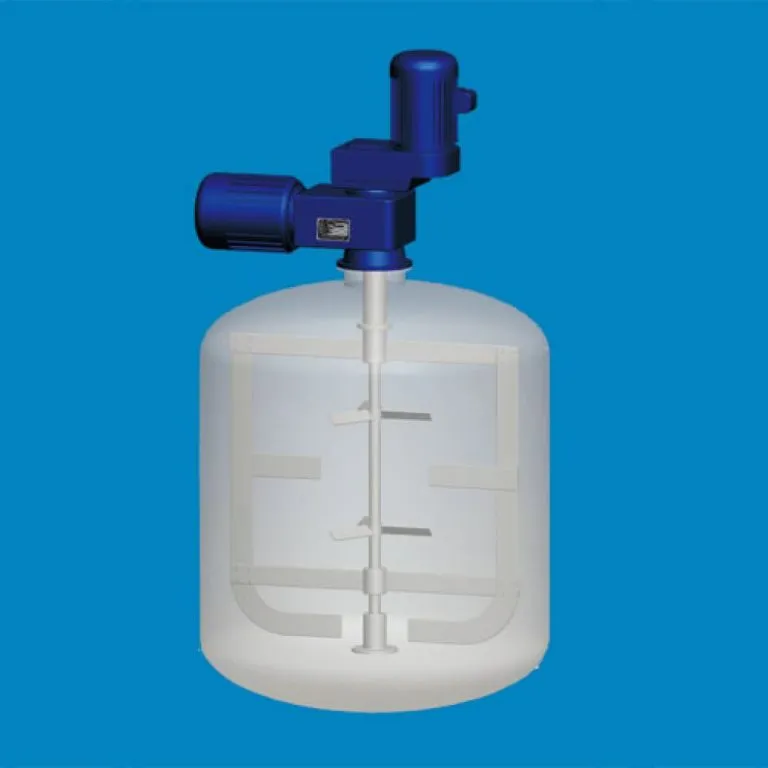
Parts of an SS reactor
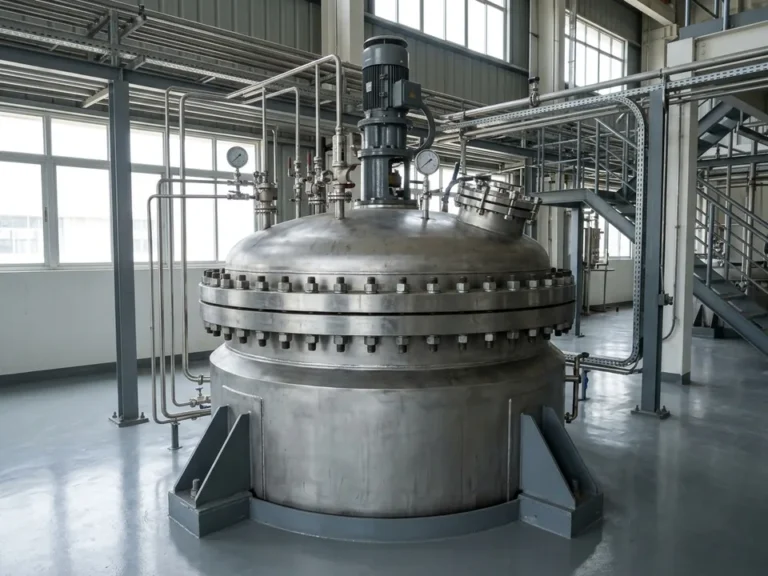
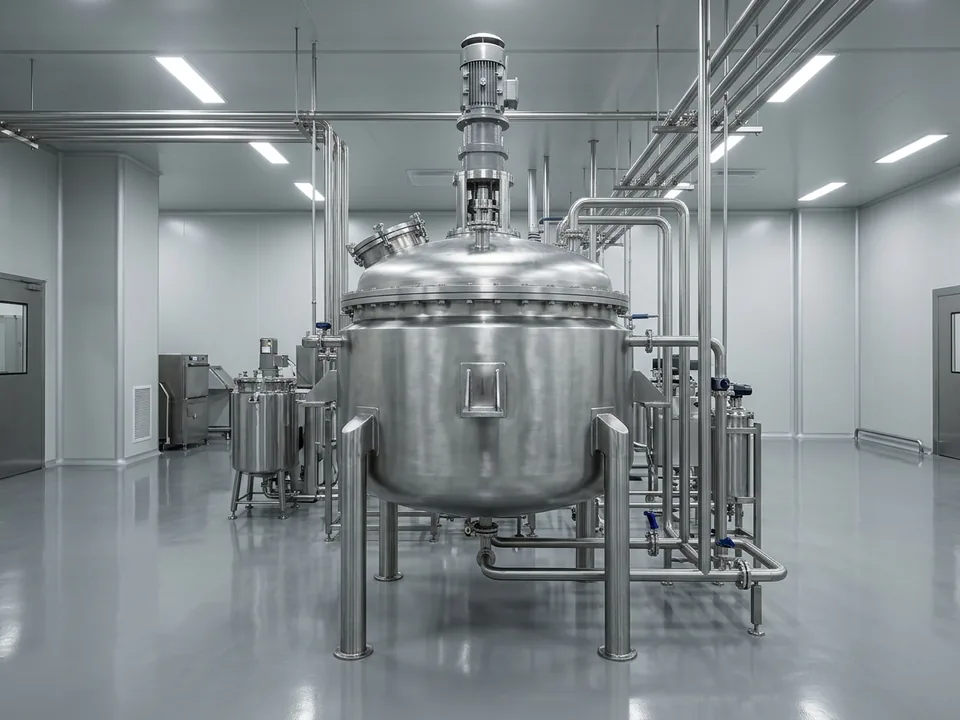
- Shell and dished ends. A cylindrical stainless steel shell closed by dished top and bottom heads. The top dish carries the drive, the manway and most nozzles.
- Heating and cooling surface. A jacket, limpet coil or internal coil, covered in the next section.
- Agitator and drive. One or more impellers on a shaft, turned by a motor and gearbox on the top dish.
- Shaft seal. A mechanical seal where the shaft enters the vessel keeps vapour in and air out. It has to suit the fluid, temperature and pressure.
- Manway, sight glass and light glass. For adding solids, watching the batch and cleaning; sight glasses can have a wiper.
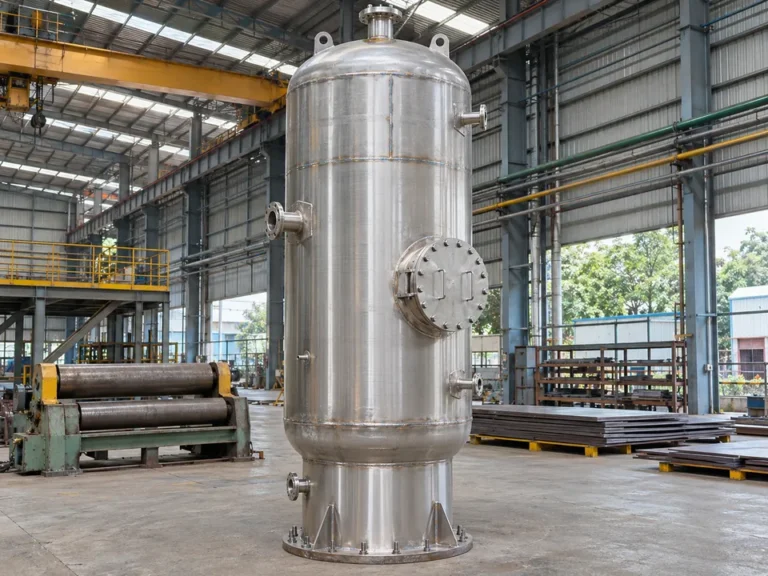
- Nozzles and safety fittings. For liquid charging, the vapour line, instruments, and a pressure gauge with a safety valve.
- Bottom outlet. A flush bottom valve, so no pocket of unmixed product sits below the agitator.
- Supports. Legs, or lugs that rest on a platform or steel structure. Load cells under the supports give the batch weight.
- Instruments and controls. Temperature and pressure sensors, level switches and a PLC panel with HMI.
Jacket, limpet coil or internal coil
How heat gets into and out of the batch shapes the reactor more than anything else. We build all three arrangements, with steam, thermic oil or electric heating:
- Conventional jacket. A second shell around the vessel, with steam, hot water, cooling water or brine in the gap. It covers the most wall area and suits most heating and cooling at moderate jacket pressure.
- Limpet coil. A half-pipe welded in a spiral around the shell. The heating or cooling fluid follows one long path at high velocity, which suits thermic oil and higher service pressures, and the coil also stiffens the shell.
- Internal coil. A pipe coil inside the vessel adds area when a strongly exothermic reaction needs more cooling than the wall can give. It is harder to clean, so it goes in only when the heat load calls for it.
The jacket is SS 304 or carbon steel, and insulation over it keeps the process temperature steady for hot and cold duties.
SS 304 or SS 316?
The body and lid are made in SS 304 or SS 316.
- SS 304 suits water-based products, food and many organic chemicals at moderate temperature.
- SS 316 contains molybdenum, which improves its resistance to pitting by chlorides and to many acids. It is the usual grade for pharmaceutical and fine-chemical reactors.
- Low-carbon grades (304L, 316L) are chosen where welds must keep their full corrosion resistance.
Stainless steel is not right for every chemistry. Hot hydrochloric acid attacks it and wet chlorides can pit and crack it, so such processes normally go into glass-lined or special-alloy reactors. Send us the full recipe, including cleaning chemicals, before the grade is fixed.
Agitator types for SS reactors
The agitator is matched to what the batch has to do:
- Anchor, often with scrapers, for viscous batches and for heat transfer at the jacketed wall.
- Pitched-blade or hydrofoil turbine to keep solids off the base and blend low- to medium-viscosity liquids.
- Rushton or hollow-blade turbine where gas must be dispersed into the liquid.
- Helical ribbon for very viscous products that have to circulate end to end.
Baffles stop the batch swirling round as one mass and improve turnover. When a reaction needs fine dispersion, a high-shear agitator in the reactor, or an inline rotor-stator homogenizer feeding it, does what an impeller can't. We size the agitator and drive for your product and vessel, and the design can be checked with CFD before fabrication. Our agitator mixer page covers every impeller in detail.
Where SS reactors are used
- Chemicals and agrochemicals: condensation and neutralisation reactions, dissolving, crystallisation and solvent extraction, including the synthesis steps of an agrochemical plant.
- Resins: polyester, alkyd and phenolic resins are cooked in jacketed reactors with a condenser; see our polyester resin plant.
- Paints and coatings: reactors and blending vessels hold, heat and cool batches inside a paint plant.
- Pharmaceuticals: bulk drug and intermediate synthesis, crystallisation and solvent recovery, usually in SS 316.
- Food and natural extracts: cooking syrups and flavour bases, and extraction in jacketed, agitated vessels with precise temperature control.
Sizes, pressure and cost
Wahal builds SS reactors up to 150,000 litres (150 KL) and for design pressures up to 100 bar; each one is sized to your batch and rated for your process. Shell, head and jacket thicknesses are calculated from the design pressure and temperature, the diameter and a corrosion allowance, and a reactor that runs under vacuum is also checked against external pressure.
What drives the cost: volume, steel grade, design pressure and temperature, the jacket or coil, the agitator and drive, the seal, the internal finish, and how much instrumentation and automation you want. Price on request.
SS reactor, hydrogenation reactor or pressure vessel?
- A reaction with hydrogen gas needs heavier walls, a tighter shaft seal and a gas-dispersing impeller: see our hydrogenation reactor.
- Holding or storing a fluid under pressure, without mixing, is a job for a pressure vessel.
- An agitator for a tank you already have: see the agitator mixer range.
Frequently asked questions
What is the full form of SSR?
SSR stands for stainless steel reactor. Indian plants use it to tell an SS reactor apart from a GLR, a glass-lined reactor.
What are the main parts of an SS reactor?
The shell with dished ends, a jacket or limpet coil, the agitator with its motor and gearbox, a mechanical seal, a manway with sight and light glasses, nozzles with a pressure gauge and safety valve, a flush bottom valve and the supports.
Which agitator is used in an SS reactor?
It depends on the batch: an anchor for viscous products and wall heat transfer, a pitched-blade turbine for solids, a Rushton or hollow-blade turbine for gas, and a helical ribbon for very viscous products.
What is the difference between a jacketed reactor and a limpet coil reactor?
A jacket is a second shell around the vessel. A limpet coil is a half-pipe welded in a spiral on the shell; its fluid moves faster and it takes higher service pressure, so it is common with thermic oil.
Should I choose SS 304 or SS 316 for a reactor?
SS 316 for chlorides, many acids and pharmaceutical work; SS 304 for milder duties. Send us the recipe and cleaning chemicals and we'll advise.
How large can an SS reactor be?
Wahal builds SS reactors up to 150,000 litres and for up to 100 bar, each sized to the batch and the process.
What does an SS reactor cost?
It depends on volume, steel grade, design pressure, the jacket, agitator, seal and automation. Price on request.