

4. Process economics — throughput, energy and maintenance
Lower effective milling time: Pre-wetted and de-agglomerated feed means the bead mill reaches target PSD faster, lowering net energy per ton.
Reduced bead consumption: Proper feed and ceramic linings reduce aggressive bead wear and frequency of bead changes.
Less product loss: Dust control and wet handling cut raw material losses and cleanup time.
5. Post-milling drying — why and how (and when you should choose it)
Some applications require dry powder after milling (e.g., masterbatches, dry mixes). Wahal systems can be integrated with several drying options:
Spray drying
Flash drying / pneumatic dryers
6. Quality control & formulation advantages
Consistent rheology: Tight particle size and low contamination lead to stable paint viscosity and predictable sag resistance.
Reduced surfactant demand: Better wetting and controlled PSD often reduce the need for expensive dispersants.
Better opacity and gloss control: Uniform particles reflect light predictably — good news for coatings formulators.
7. Typical applications that benefit most
Paints & coatings (architectural, industrial)
Paper fillers & coatings
Plastics & masterbatches (where whiteness matters)
Adhesives, sealants, and dry mixes
Specialty engineered fillers (surface-treated grades)
FAQ (short)
Q: Is ceramic lining always necessary?
A: For high-whiteness and low-contamination applications, yes. If you’re making industrial grade where slight iron pick-up is tolerable, steel might work — but ceramic preserves optical quality.
Q: Will LPM replace a grinder?
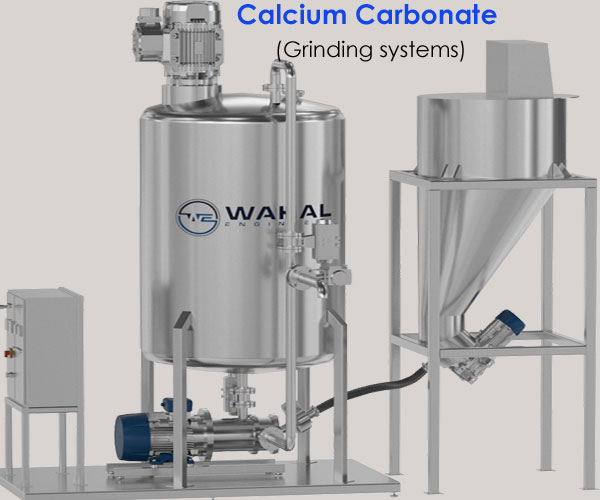
A: No — LPM is a pre-treatment for wetting and de-agglomeration. The bead mill still provides particle size reduction.
Q: Can I run continuous production?
A: Absolutely. LPM → bead mill → dryer lends itself well to continuous lines with stable feed and automated controls.