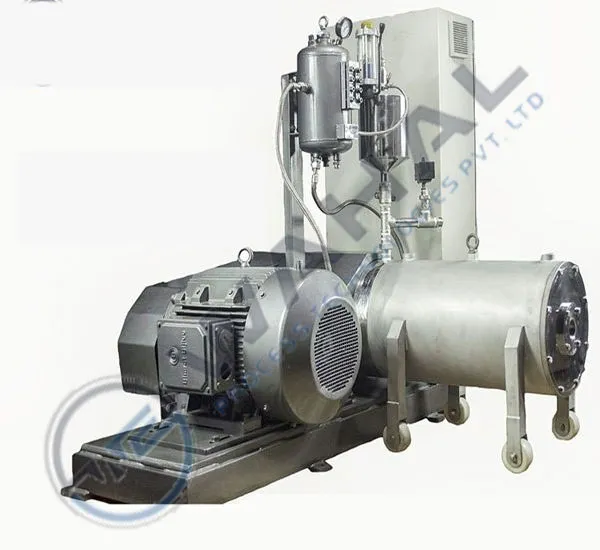
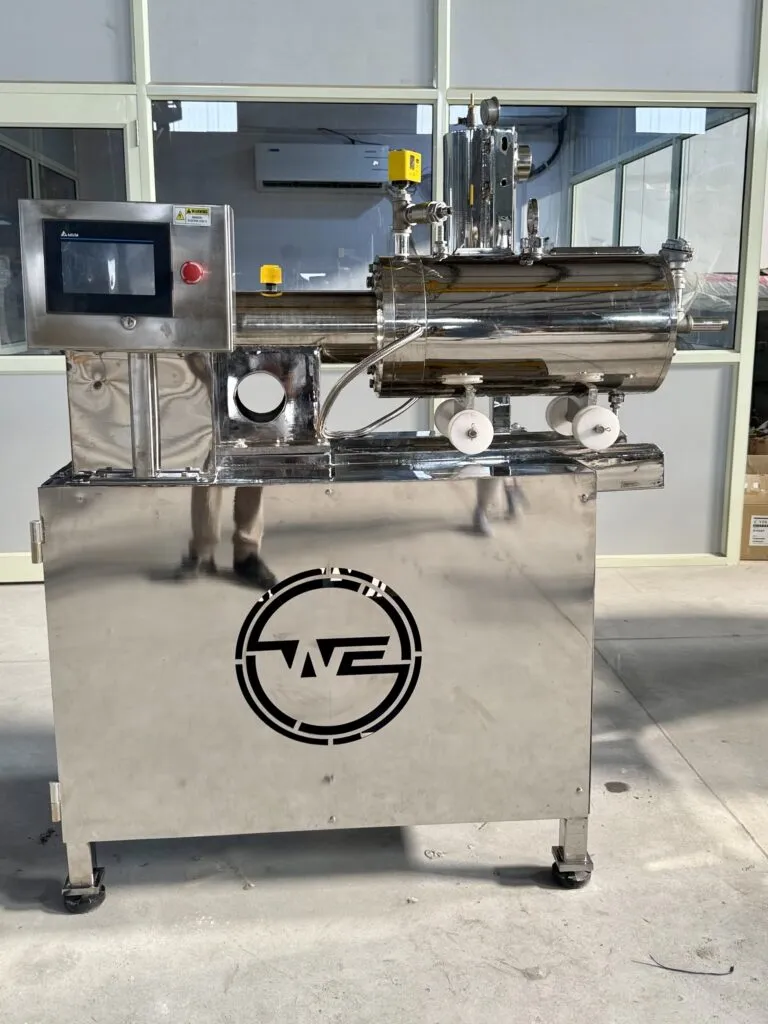
Key Advantages of Wahal Bead Mills for Microalgae Applications
🔹 High Disruption Efficiency
Optimized chamber geometry and rotor design ensure maximum energy transfer to microalgae cells.
🔹 Temperature Control
Jacketed grinding chambers prevent heat build-up, preserving:
Proteins
Pigments (chlorophyll, phycocyanin, astaxanthin)
Omega-3 fatty acids
🔹 Continuous & Scalable Design
From lab and pilot mills to industrial-scale bead mills, Wahal systems support seamless scale-up.
🔹 Hygienic & GMP-Compliant Construction
SS 316L contact parts
CIP/SIP compatible designs
Suitable for food, nutraceutical, pharma, and biotech industries
🔹 Optimized for Wet Biomass
No drying required—reducing energy consumption and operating cost.
Applications of Microalgae Disruption Using Wahal Bead Mills
Wahal bead mills are widely used for:
Protein extraction from Chlorella & Spirulina
Pigment recovery (phycocyanin, chlorophyll, carotenoids)
Lipid and oil extraction for biofuels and nutraceuticals
Astaxanthin extraction from Haematococcus pluvialis
Cell rupture prior to fermentation or enzymatic processing
FAQ Section:
What is the best method for microalgae cell disruption?
Bead milling is one of the most effective and scalable methods for microalgae cell disruption, especially for hard-walled species like Chlorella.
Why is Chlorella difficult to disrupt?
Chlorella has a rigid, sporopollenin-like cell wall that requires high mechanical shear, which bead mills provide efficiently.
Can bead mills be used for wet microalgae biomass?
Yes, Wahal bead mills are designed for wet microalgae processing, eliminating the need for energy-intensive drying.
Are Wahal bead mills suitable for nutraceutical and food applications?
Absolutely. Wahal bead mills are available in SS 316L, GMP-compliant, CIP/SIP-ready designs. High-Efficiency Cell Disruption for Chlorella, Spirulina & Other Microalgae Microalgae such as Chlorella, Spirulina, Haematococcus, and Nannochloropsis are rich sources of proteins, pigments, lipids, antioxidants, and nutraceutical compounds. However, extracting these valuable intracellular components is challenging due to the strong and resilient cell walls of microalgae.
Efficient cell disruption is therefore a critical step in downstream processing—and this is where Wahal Bead Mills deliver a decisive performance advantage.
Why Microalgae Disruption Is Critical Most microalgae species possess rigid cell walls composed of:
Cellulose and hemicellulose
Sporopollenin-like polymers (especially in Chlorella)
Complex polysaccharides and glycoproteins
Without proper disruption:
- Nutrient bioavailability remains low
- Extraction yields are poor
Product quality and consistency suffer
Mechanical disruption using bead mills is widely recognized as the most scalable, solvent-free, and industrially proven method for microalgae cell breakage.
Bead Milling: The Preferred Technology for Microalgae
Among all disruption methods (ultrasonication, enzymatic lysis, high-pressure homogenization), bead milling stands out for:
- High disruption efficiency
- Continuous operation
- Scalability from pilot to commercial scale
- Suitability for wet biomass
- Lower operating costs per kg of biomass
Wahal Bead Mills are specifically engineered to handle high-solids microalgae slurries while maintaining temperature control and uniform particle size reduction.
How Wahal Bead Mills Disrupt Microalgae Cells
Wahal bead mills operate on the principle of intense mechanical shear, impact, and attrition generated by grinding media inside a high-energy milling chamber.
- The Process: Concentrated microalgae slurry is fed into the mill
- Ceramic or glass beads (0.3–1.0 mm typically) are agitated at high tip speeds
- Cells are ruptured through bead-to-cell and bead-to-bead collisions
- Intracellular components are released into the suspension
The result: >90% cell disruption efficiency, even for hard-to-break species like Chlorella vulgaris.
Why Choose Wahal for Microalgae Processing?
With decades of experience in high-shear mixing, homogenization, and bead milling, Wahal Process Technologies offers:
- Application-specific bead mill designs
- Proven installations in food, pharma, biotech, and chemical sectors
- Strong after-sales and process support
- Indian manufacturing with global quality standards
Whether you are developing functional foods, nutraceuticals, bio-actives, or algae-based biofuels, Wahal bead mills provide a robust, efficient, and scalable solution for microalgae disruption.