
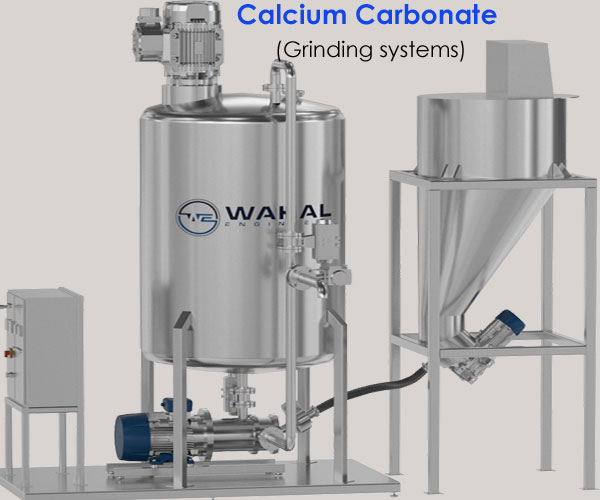
Calcium Carbonate Slurry Grinding Systems

4. Process economics — throughput, energy and maintenance
Lower effective milling time: Pre-wetted and de-agglomerated feed means the bead mill reaches target PSD faster, lowering net energy per ton.

Reduced bead consumption: Proper feed and ceramic linings reduce aggressive bead wear and frequency of bead changes.

Less product loss: Dust control and wet handling cut raw material losses and cleanup time.

5. Post-milling drying — why and how (and when you should choose it)
Some applications require dry powder after milling (e.g., masterbatches, dry mixes). Wahal systems can be integrated with several drying options:

Spray drying

Flash drying / pneumatic dryers

6. Quality control & formulation advantages
Consistent rheology: Tight particle size and low contamination lead to stable paint viscosity and predictable sag resistance.

Reduced surfactant demand: Better wetting and controlled PSD often reduce the need for expensive dispersants.

Better opacity and gloss control: Uniform particles reflect light predictably — good news for coatings formulators.

7. Typical applications that benefit most
Paints & coatings (architectural, industrial)

Paper fillers & coatings

Plastics & masterbatches (where whiteness matters)

Adhesives, sealants, and dry mixes

Specialty engineered fillers (surface-treated grades)

FAQ (short)
Q: Is ceramic lining always necessary?
A: For high-whiteness and low-contamination applications, yes. If you’re making industrial grade where slight iron pick-up is tolerable, steel might work — but ceramic preserves optical quality.

Q: Will LPM replace a grinder?
A: No — LPM is a pre-treatment for wetting and de-agglomeration. The bead mill still provides particle size reduction.

Q: Can I run continuous production?
A: Absolutely. LPM → bead mill → dryer lends itself well to continuous lines with stable feed and automated controls.

Caustic Lye Preparation (NaOH Flakes / Pearls)

What are the advantages of Wahal’s calcium carbonate slurry grinding systems

combining Liquid Powder Mixers (LPM) with Wahal bead mills fitted with ceramic lining and optional post-milling drying — deliver better particle control, higher throughput, lower contamination and predictable, paint-grade results.”

Introduction
Calcium carbonate is a backbone filler in paints, coatings, adhesives, and many industrial formulations. Getting the particle size, shape and surface condition right directly affects opacity, rheology, gloss and cost. Wahal’s systems pair an LPM (for rapid, dust-free powder induction and wetting) with Wahal bead mills (ceramic-lined for low contamination and long life) and the option to dry the slurry after milling. The result: faster process cycles, tighter PSD (particle size distribution), lower waste and a product that scales from lab trials to full production.

1. Cleaner powder handling and faster wetting — why LPM first
Dust-free powder induction: LPMs introduce bulk calcium carbonate into water or binder under vacuum/low-shear induction, eliminating dust and improving workplace safety.

Uniform hydration and wetting: LPMs wet each particle quickly and evenly, reducing lumps and reducing the time the bead mill needs to reach target PSD.

Higher feeding rates: Because the LPM feeds an already-wetted slurry, bead mills receive a consistent feed — improving throughput and stabilizing product quality.

2. Wahal bead mills with ceramic lining — low contamination, long life
Ceramic lining = minimal iron contamination: Ceramic (alumina/zirconia) linings and beads resist wear and avoid metal pick-up — essential when calcium carbonate is used in high-whiteness applications (paints, paper, plastics).

Improved abrasion resistance: Ceramic lining extends equipment life and reduces maintenance downtime compared with steel-lined mills.

Stable optical properties: Lower contamination keeps TiO₂ replacement strategies predictable — you’re not fighting unexpected greying or reduced brightness.

3. Superior milling performance & particle control
Efficient energy transfer: After LPM preconditioning, the bead mill works on dispersed particles — energy is used where it matters, producing a narrower PSD with less over-grinding.

Fine, controlled d50 and d90: The LPM + bead mill pairing delivers tight control over target sizes (e.g., sub-micron fractions when needed), which improves opacity and smoothness in end products.

Better dispersion of surface treatments: If your carbonate is surface-coated (stearates, silanes), the LPM wets and spreads additives uniformly before bead milling locks them into the particle surface.

  • This commitment to customer service underscores Wahal’s reputation for reliability and excellence.
WHAT OUR CLIENTS SAY

Testimonial

Give us a call or drop by anytime, we endeavour to answer all enquiries within 24 hours on business days. We will be happy to answer your questions.


Contact:
Mr. Shubham : +(91)-9899387031

Head Office
Plot No. G-39, Friends Industries Area, Shahbad, Daulatpur
New Delhi – 110042, Delhi, India