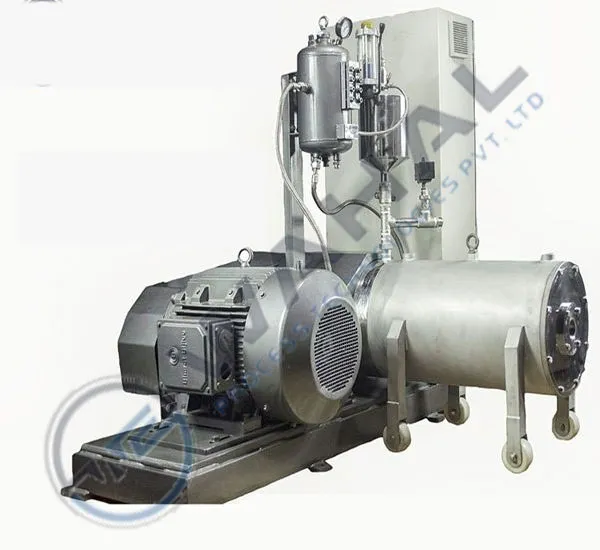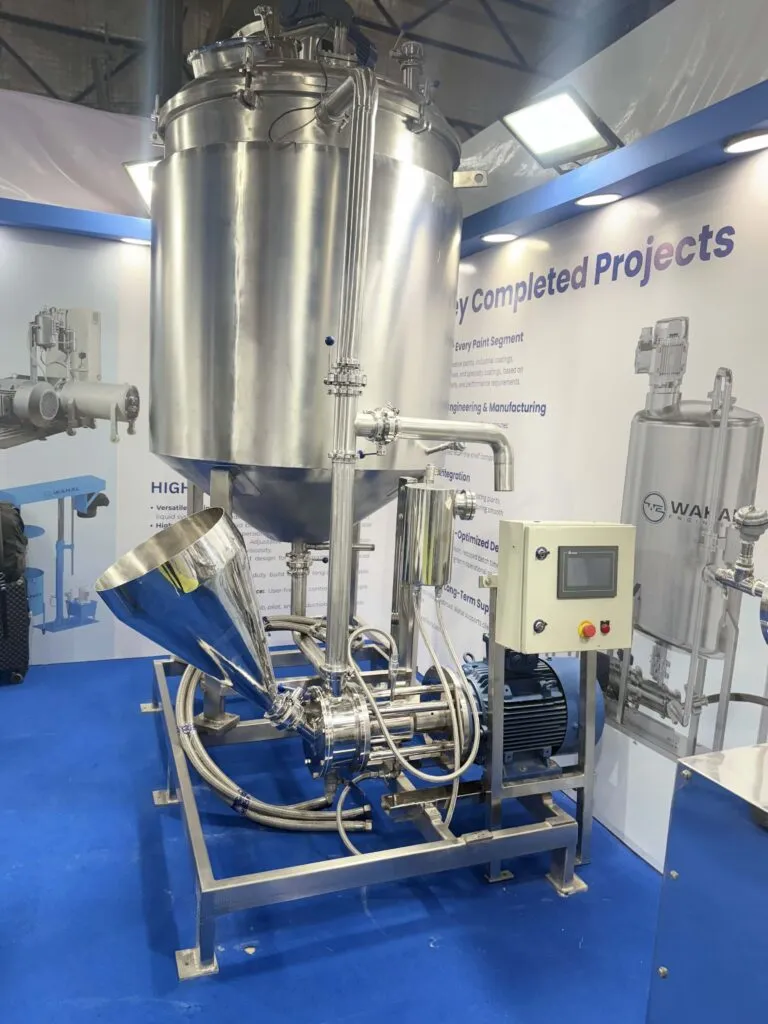
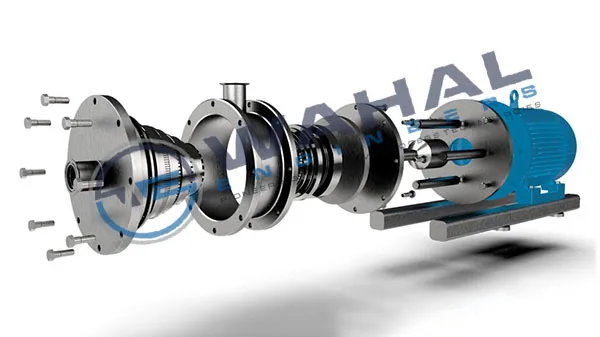
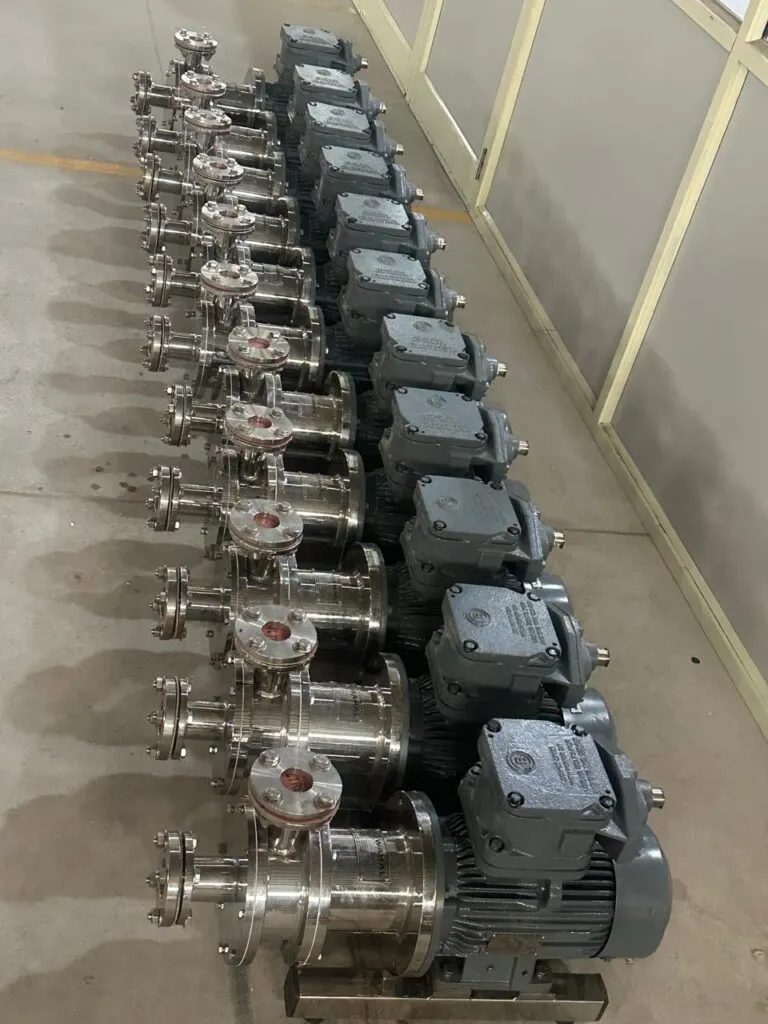
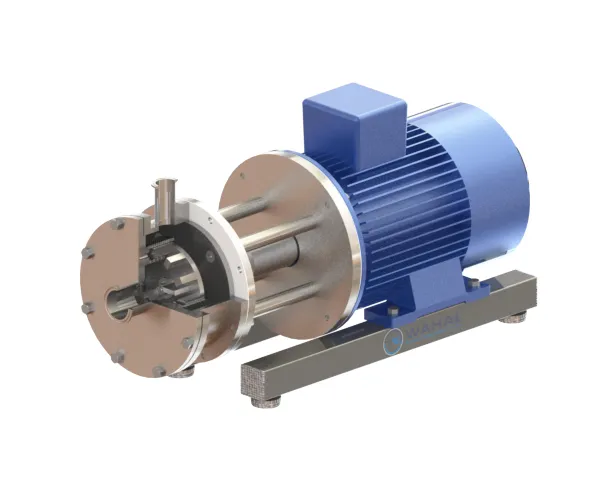
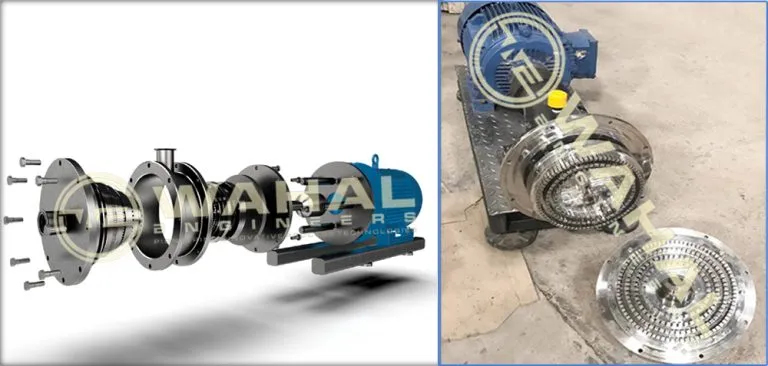
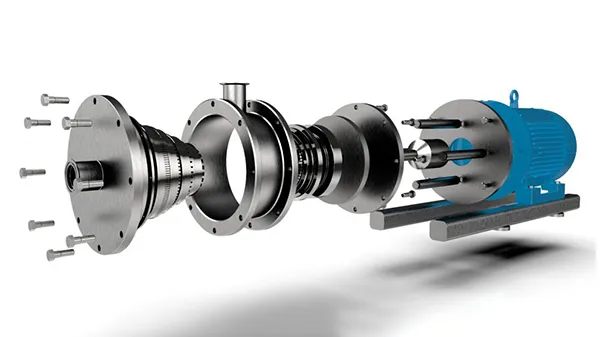
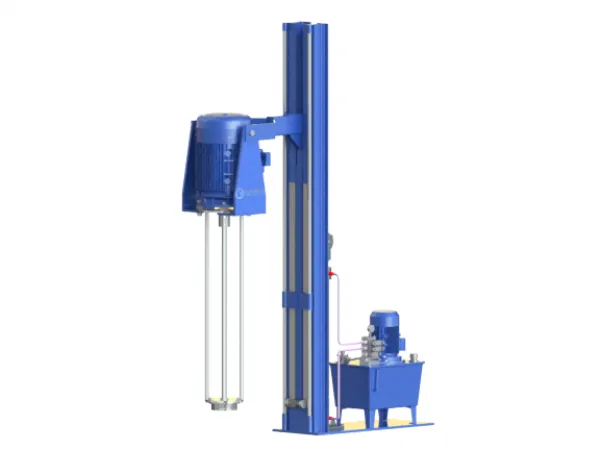
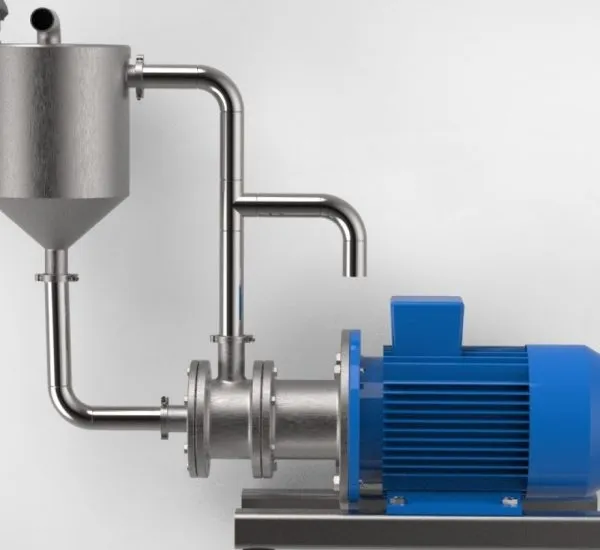
What is a homogenizer?
A homogenizer machine breaks droplets and particles in a liquid down to a fine, even size and spreads them uniformly, so the product stays stable. Two main designs are used in industry:
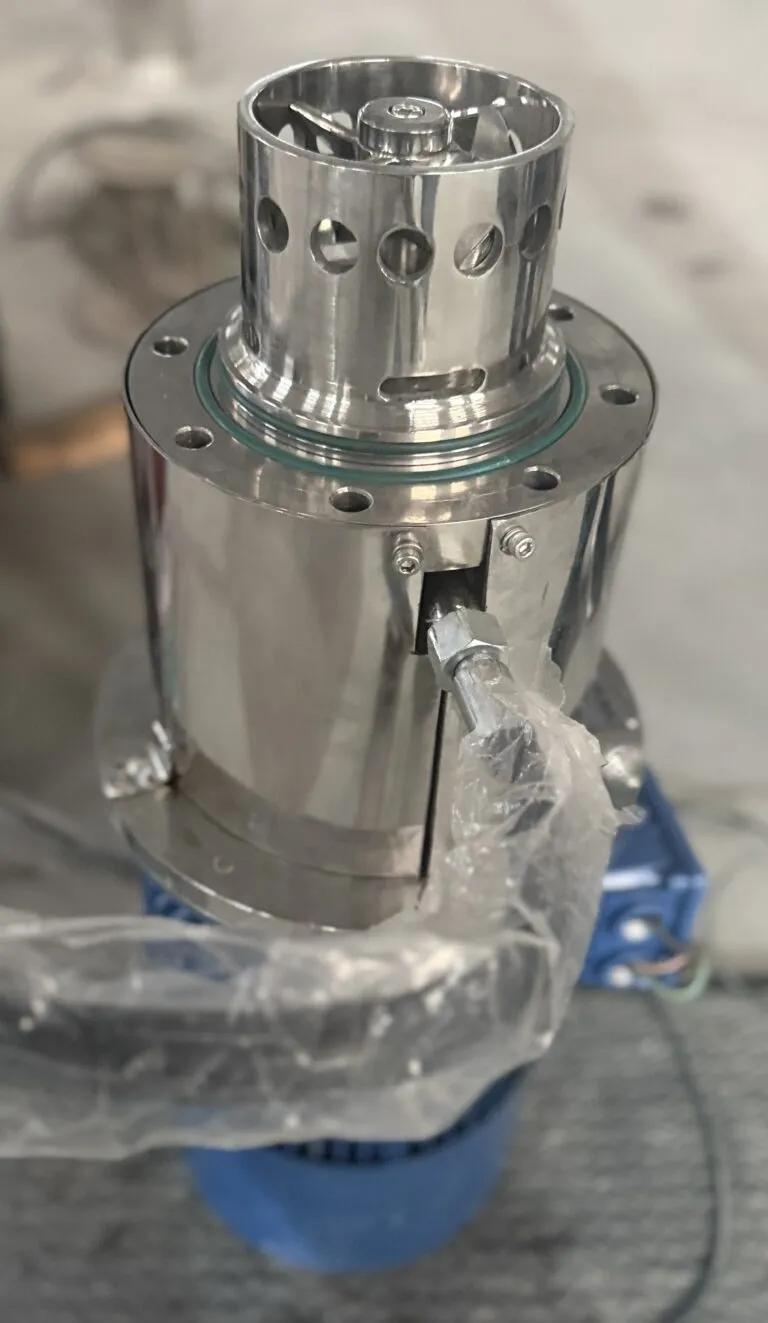
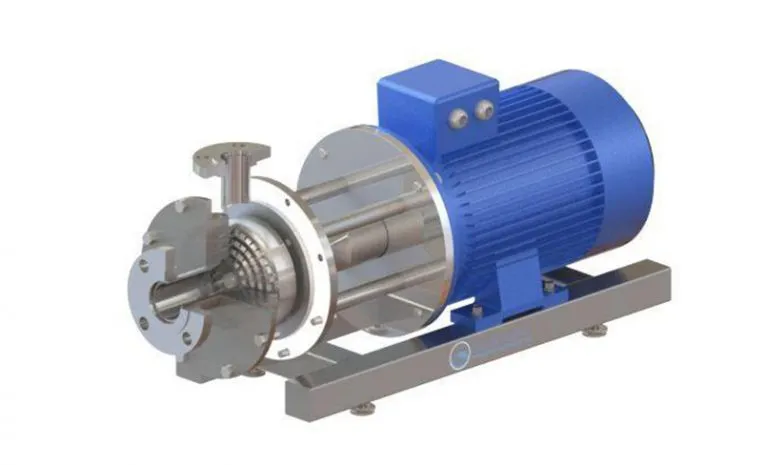
- Rotor-stator (high shear) homogenizers, also called high shear mixers or homogeniser mixers. A rotor turns at high speed inside a close-fitting stator, and the product is sheared in the narrow gap between them. This is the type on this page.
- High-pressure homogenizers are pump homogenizers that reach particle sizes in the nano range. They are used for homogenizing milk products, cell disruption, infusion solutions and microemulsions. Wahal makes these too: see our high pressure homogenizer.
Types of homogenizers and how to choose
“Homogenizer” covers several machines that work in different ways. Wahal makes each type below, and each has its own page.
| Type | How it works | How fine | Typical uses |
|---|---|---|---|
| High pressure homogenizer | A high-pressure pump homogenizer | Nano range | Milk products, cell disruption, infusion solutions, microemulsions |
| High shear (rotor-stator) homogenizer: batch or bottom-mounted | A rotor turns at high speed inside a close-fitting stator, in the vessel or from below it | Fine emulsions and dispersions, set by the stator design | Emulsifying, dispersing, dissolving, wetting powders; bottom-mounted models break down hard solids |
| Inline homogenizer | One, two or four rotor-stator stages in the pipeline; self-pumping | Finer with each stage; the four-stage model often reaches the target in one pass | Continuous production, 15 to 200,000 L/hr |
| Laboratory homogenizer: batch, inline or tissue | The same rotor-stator principle at bench scale | As the production machine, so trial results scale up | Formulation trials from 2 litres; tissue homogenizers break down biological samples |
| Colloid mill | The product is sheared in the narrow gap between a high-speed rotor and a fixed stator with polished surfaces | A few micrometres; down to 0.5 µm with our multi-stage mill on bitumen emulsion | Emulsions, suspensions and pastes |
| Bead mill | Grinding beads, driven by an agitator in a grinding chamber, grind the solids | Up to 1 micron, or 50–500 nm | Water- and solvent-based slurries: paints, inks and coatings |
Which one fits your product:
- Nano-range emulsions such as milk products, or cell disruption: a high pressure homogenizer. It works best when fed a uniform, fine premix from a high shear homogenizer.
- Powders to disperse or dissolve, or a batch in a vessel: a batch high shear homogenizer. For hard solids and agglomerates, a bottom-mounted homogenizer.
- Continuous production or single-pass results: an inline homogenizer.
- Pumping and shearing in one unit: a shear pump.
- Pastes, sauces and emulsions that must come out fine and uniform: a colloid mill.
- Solids to grind to the nano range in paints, inks and coatings: a bead mill.
- Formulation work before scale-up, or biological samples: a laboratory or tissue homogenizer.
How a high shear homogenizer works
The working principle in five steps:
- Suction. The rotating blades create strong suction and draw liquid and solids into the centre of the work head.
- Acceleration. Centrifugal force pushes the material out to the edge of the work head.
- Shear. In the narrow gap between the rotor and the stator, the material is subjected to intense mechanical and hydraulic shear. Droplets break up and agglomerates come apart.
- Discharge. The product is forced out through the stator at high speed, back into the vessel or down the line.
- Repeat or single pass. The flow recirculates until the whole batch is uniform, or passes through once in an inline or multi-stage machine.
The mechanical features that make this work:
- Rotor-stator work head. A precision rotor with blades or teeth turns inside a stator with a minimal tolerance between them, so every pass applies intense shear.
- High speed. On our single- and two-stage inline homogenizers the rotor tip speed reaches up to 95 m/s.
- Interchangeable stators. Over twenty rotor-stator designs are available. The stator is changed to suit the particle size required, from general mixing heads to slotted disintegrating heads and fine emulsion screens.
- No bypass. No liquid or solid can pass from the inlet to the outlet without going through the rotor-stator work head.
Our high shear homogenizer range
Our homogenizer mixers work inline, in the vessel, or from under it, with specialist systems and lab units alongside.
Inline homogenizers
Installed in a pipeline or a recirculation loop, inline homogenizers are self-pumping: the rotor produces its own centrifugal pumping action, so in most cases no auxiliary pump is needed. They run in a single pass or on a recirculating batch.
- Single stage inline homogenizer: one rotor-stator set.
- Two stage inline homogenizer: two sets in series.
- Four stage inline homogenizer: our patented four-stage design, which often reaches the target particle size in a single pass.
See also inline high shear mixers.
Batch homogenizers
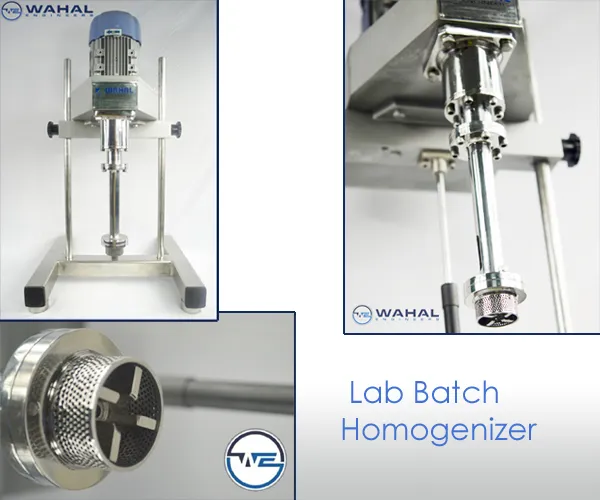
Batch high shear mixers work inside the vessel. There are two designs:
- The in-tank batch homogenizer, for chemicals and other applications.
- The enclosed shaft homogenizer, which seals the shaft from the process liquid, so it is easy to clean and GMP-compliant.
Both are designed to the length and diameter of your vessel, and lifting can be automated with a hydraulic power pack. See all batch homogenizers.
Bottom-mounted homogenizers
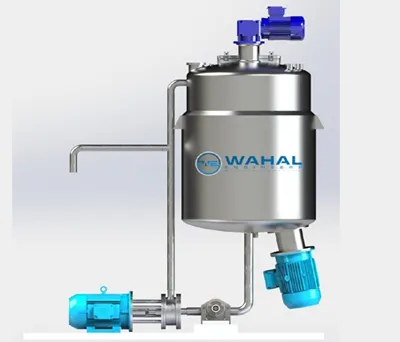
A bottom mounted homogenizer has its drive under the vessel, with the rotor-stator head working in the product from below. It breaks down blocks, bricks and agglomerates, dissolves hard solids, and can even disintegrate rubber bales.
Specialist systems
- Shear pump: pumps and shears in one inline unit, and handles high-viscosity lines.
- Dis-integrated dissolver: a bottom-mounted homogenizer on the vessel, then an inline homogenizer, for rubbers and polymers, lube oils and adhesives.
- Liquid powder mixer (LPM): creates a vacuum in the liquid stream and draws powders straight from sacks, hoppers or silos, dust-free, reaching up to 80% solids in the final product.
- Vacuum processing plant: air-free mixing for creams, lotions, gels and sauces.
Laboratory homogenizers
Laboratory batch homogenizers start from 2 litres. Laboratory inline homogenizers have a 1 HP drive, up to 9,500 rpm and VFD speed control. Both use the same rotor-stator principle as the production machines, so trial results scale up.
| Type | Where it works | Best for | Key figures |
|---|---|---|---|
| Inline (1, 2 or 4 stage) | In the pipeline or recirculation loop | Continuous production, air-free processing, single-pass results | 15–200,000 L/hr; tip speed up to 95 m/s (1 and 2 stage) |
| Batch: in-tank or enclosed shaft | Inside the vessel, from the top | Batch processing; GMP duty (enclosed shaft) or chemicals (in-tank) | Built to vessel size; hydraulic lift available |
| Bottom-mounted | Under the vessel | Hard solids, agglomerates, powder dissolution | Disintegrates blocks and rubber bales |
| Shear pump | Inline | Pumping and shearing in one unit | Four-blade rotor, 4 stator heads |
| Laboratory | Bench or pilot | Formulation trials and scale-up | From 2 L; up to 9,500 rpm (inline) |
Specifications
| Parameter | Range / options |
|---|---|
| Rotor tip speed | Up to 95 m/s (single- and two-stage inline); 45–65 m/s (Super Mill inline, 6,000 rpm) |
| Throughput (inline) | 15 to 200,000 L/hr |
| Viscosity range | 1 to 50,000 cP across batch and inline models |
| Rotor-stator stages | 1, 2 or 4 (patented four-stage) |
| Rotor-stator designs | 20+; interchangeable except on the four-stage model |
| Drive | Direct coupling or belt-driven |
| Shaft sealing | Single mechanical seal; double mechanical seal with thermosyphon (plan 53A, optional); stuffing box with impregnated gland |
| Connections | Flanged, DIN, Tri-clamp, ASA, or to your specification |
| Motors | TEFC, ATEX-certified, IEC 60079 flameproof/explosion-proof, washdown or stainless |
| Hazardous areas | ATEX motors and control panels; ATEX, NEMA and UL certification on request |
| Hygiene | Sanitary design configurable to FDA norms; CIP/SIP models on request; heating or cooling jacket |
| Materials of construction | From alloy steels to various polymers; rotor-stator material customised to the application |
| Validation | DQ, IQ and OQ documents; material and calibration certificates; FAT at our works or SAT at your site |
Applications and industries
High shear homogenizers are used wherever a product has to be emulsified, dispersed, dissolved or reduced in particle size.
- Food and beverage: sauces, dressings, mayonnaise, mustard, tomato ketchup, ginger garlic paste, soups, sugar syrups and beverages, including beer and wine.
- Dairy and confectionery.
- Pharmaceuticals: mixing APIs with excipients for uniform products; ointments and creams, cough syrups, tablet coatings and vaccines.
- Cosmetics and personal care: creams, lotions, shampoos, carbopol gels, lipsticks, toothpaste and sunscreen.
- Paints, inks and coatings: paints, printing inks, paper coatings and dye suspensions.
- Chemicals and agrochemicals: adhesives and specialty chemicals, lube oils, SLES surfactant dilution, fungicides and insecticides.
- Bitumen: pitch and bitumen emulsion.
High shear mixer vs high-pressure homogenizer
Both are called “homogenizers”, but they do different jobs. Wahal builds both.
| High shear mixer (rotor-stator homogenizer) | High-pressure homogenizer | |
|---|---|---|
| How it works | A rotor spinning inside a close-fitting stator shears the product | A high-pressure pump homogenizer |
| What it achieves | Fine emulsions and dispersions; particle size set by the stator design and the number of stages | Particle sizes in the nano range |
| Typical uses | Emulsifying, dispersing, dissolving, wetting powders, particle size reduction, premixing | Milk products, cell disruption, infusion solutions, micro-fibrillated cellulose, microemulsions |
| Solids and powders | Handles them; also breaks agglomerates and disintegrates hard solids | Works best with an already uniform, fine premix |
| Wahal range | Inline, batch, bottom-mounted, lab | High pressure homogenizer |
The two are often used together. A high-pressure homogenizer works best when fed a uniform, fine premix, which a high shear homogenizer produces.
Advantages over conventional mixers
Compared with a conventional agitator, a high shear homogenizer:
- Cuts processing time. The intense mixing action greatly shortens process time compared with a conventional agitator.
- Improves product quality. High shear gives uniform dispersion, so consistency, texture and stability improve batch after batch.
- Does several jobs in one machine. The same machine can mix, emulsify, homogenize, disintegrate, dissolve, disperse, blend, reduce particle size and de-agglomerate.
- Keeps air out. An inline homogenizer and its vessel and pipework form a closed system, so the product stays free of air. This matters wherever entrained air causes problems.
- Pumps itself. Inline models provide their own centrifugal pumping, so an auxiliary pump is usually unnecessary.
- Scales from lab to production. Sizes run from 2 L laboratory units to full production lines.
Behind every machine:
- We manufacture ISO and GMP-compliant mixers trusted by pharmaceutical manufacturers.
- Our manufacturing is ISO-certified.
- We use CFD analysis to select the right mixer and stator design for each process.
How to choose a high shear homogenizer
Six questions decide the right homogenizer machine:
- Batch or continuous? For in-vessel batches, use a batch or bottom-mounted homogenizer. For continuous lines, high throughput or air-free processing, use an inline homogenizer.
- How fine must the product be? One rotor-stator stage suits general mixing and dispersion. The four-stage model often reaches the target particle size in a single pass. For the nano range, add a high-pressure homogenizer.
- Are there hard solids or a lot of powder? A bottom-mounted homogenizer or dis-integrated dissolver breaks down hard solids and agglomerates. A liquid powder mixer draws in large volumes of powder without dust, up to 80% solids.
- How viscous is the product? Our batch and inline range covers 1 to 50,000 cP, and inline machines can be force-fed for high-viscosity liquids.
- Hygiene or hazardous area? For pharma and food, choose a sanitary design configurable to FDA norms, with CIP/SIP and the enclosed shaft option. For solvents and flammable products, specify ATEX or flameproof motors and panels.
- Will it scale up? Trial the formulation on a laboratory unit first. Our lab machines use the same rotor-stator principle as the production models.
Not sure? Send us your product, batch size and target result. We will recommend a machine, using CFD analysis where needed.
Test your product before you buy
There’s no better way to test a machine than on your own product. Run a trial in our fully equipped laboratory and see exactly what results you get, and how fast. If you need longer, our rental program lets you keep a machine, pre-configured to your requirements, for as long as you need. See trials and rentals.
Frequently asked questions
What is a homogenizer machine used for?
It breaks droplets and particles down to a fine, even size so a product stays stable. Typical jobs are emulsifying creams and sauces, dispersing powders, dissolving solids and reducing particle size in food, pharmaceutical, cosmetic, chemical and paint production.
How does a high shear homogenizer work?
A rotor turning at high speed draws product into the work head and throws it outwards. The product is sheared in the narrow gap between the rotor and stator and forced out through the stator. The flow recirculates until the batch is uniform, or passes once through an inline or multi-stage machine.
Is a high shear mixer the same as a homogenizer?
A rotor-stator high shear mixer is one type of homogenizer, often called a high shear homogenizer or homogenizer mixer. The other main type is the high-pressure homogenizer, a pump homogenizer used for nano-range particle sizes.
What is the difference between a high shear homogenizer and a high-pressure homogenizer?
A high shear homogenizer shears the product between a rotor and stator, and it handles powders and solids. A high-pressure homogenizer reaches the nano range, for example for milk products and cell disruption, and works best when fed a uniform, fine premix. We make both.
Should I choose a batch or an inline homogenizer?
Choose batch for processing inside a vessel, especially for GMP duty with an enclosed shaft. Choose inline for continuous production, higher throughput (up to 200,000 L/hr), air-free processing, or single-pass results with multi-stage models.
Are your homogenizers suitable for pharmaceutical (GMP) plants?
Yes. They can be built to a sanitary design configurable to FDA norms, with CIP/SIP options and an enclosed shaft for easy cleaning. We supply DQ, IQ and OQ documents, and can run a factory or site acceptance test.
Can they be used in hazardous (explosive) areas?
Yes. We supply ATEX-certified or IEC 60079 flameproof motors and ATEX control panels. ATEX, NEMA and UL certification can be provided on request.
Can I test my product before buying?
Yes. You can trial your product on a Wahal machine or a laboratory unit before ordering a production model. See trials and rentals.
What are the main types of homogenizer?
High pressure homogenizers for the nano range, high shear (rotor-stator) homogenizers in batch, bottom-mounted and inline designs, and laboratory homogenizers for formulation work. Colloid mills and bead mills do related jobs: emulsions and pastes, and wet grinding of solids. Wahal makes all of them.